
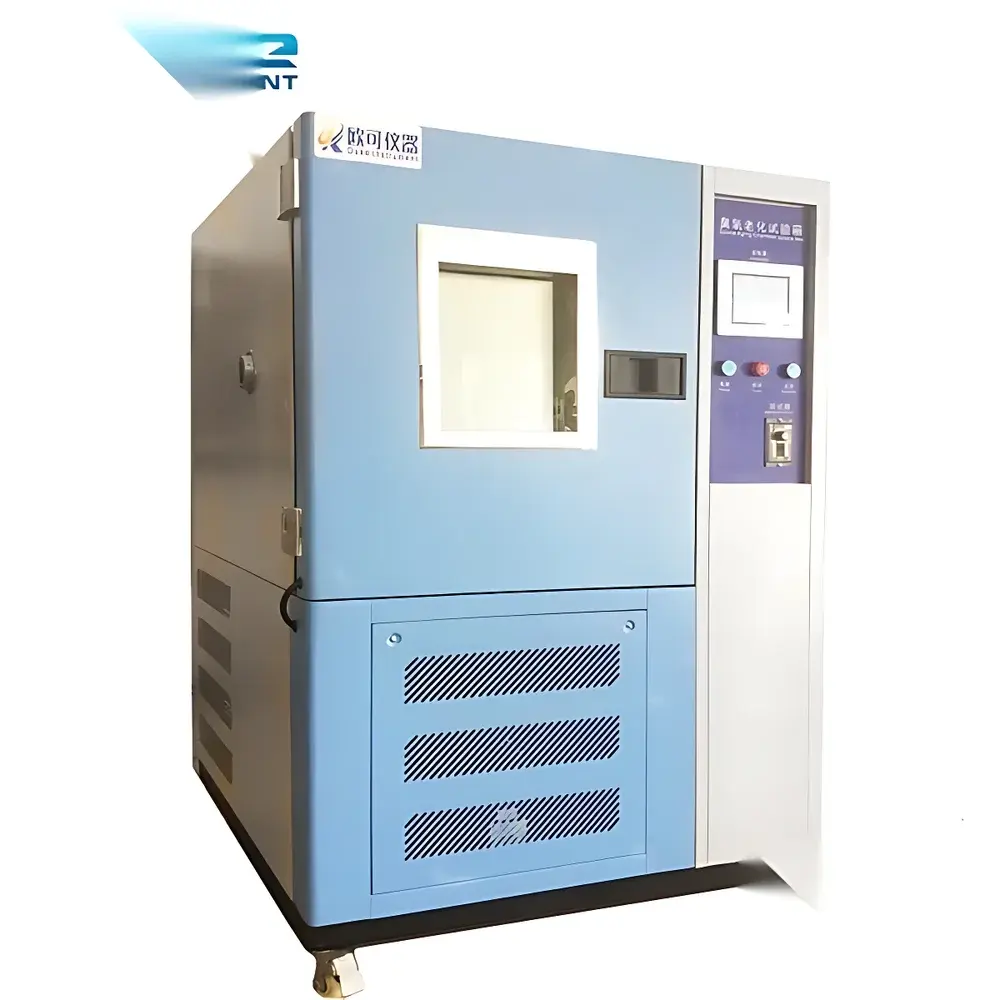
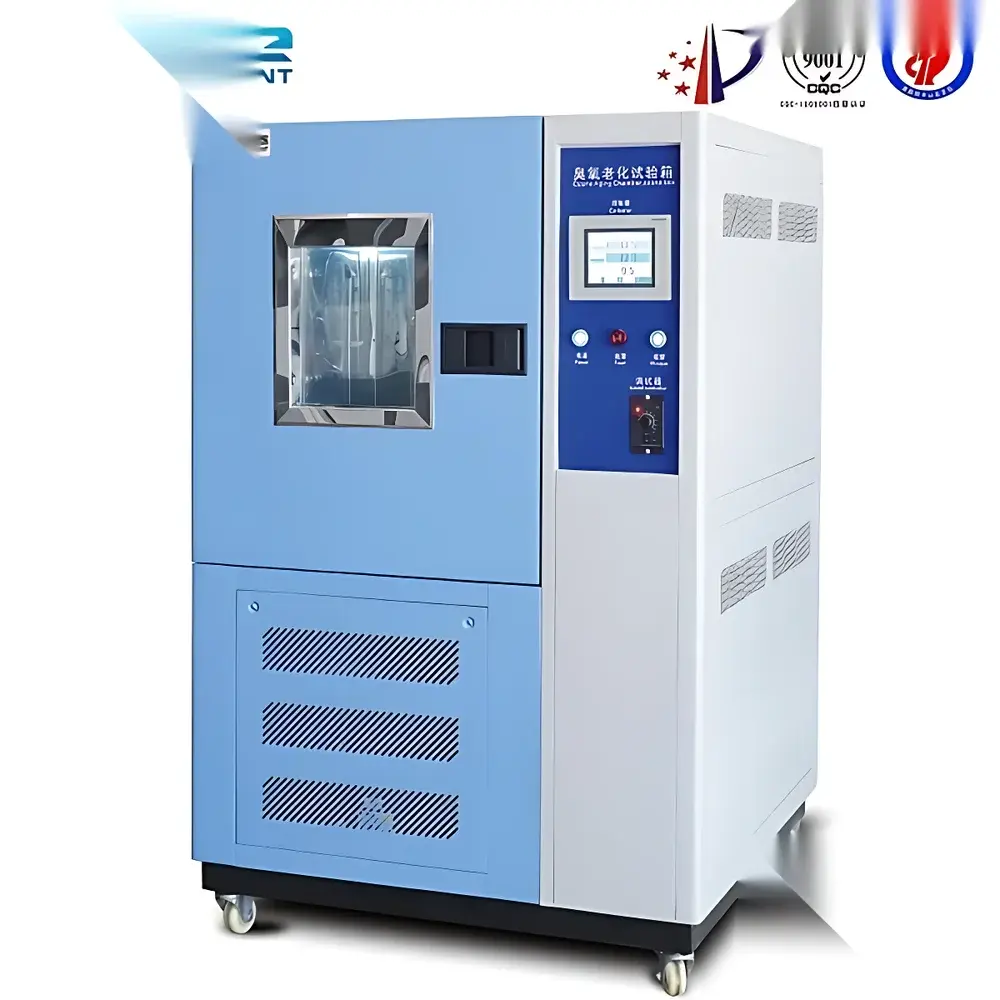
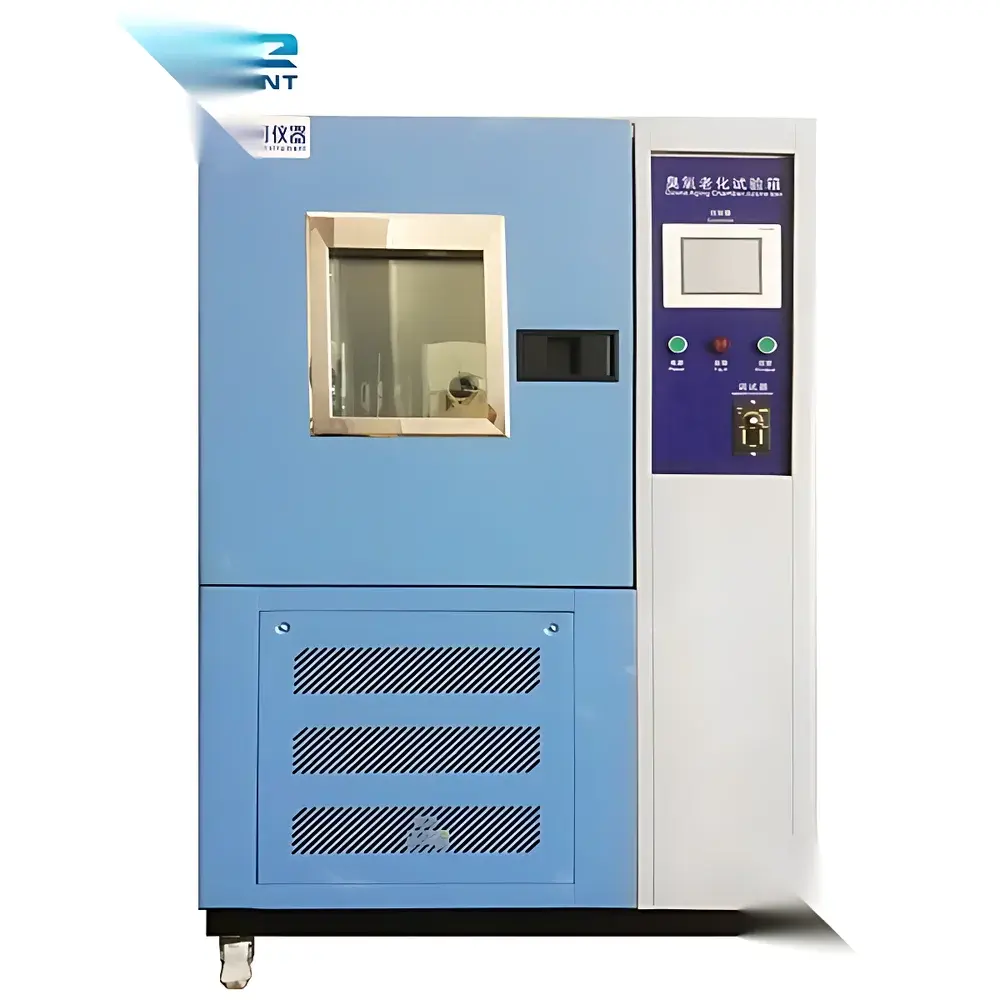
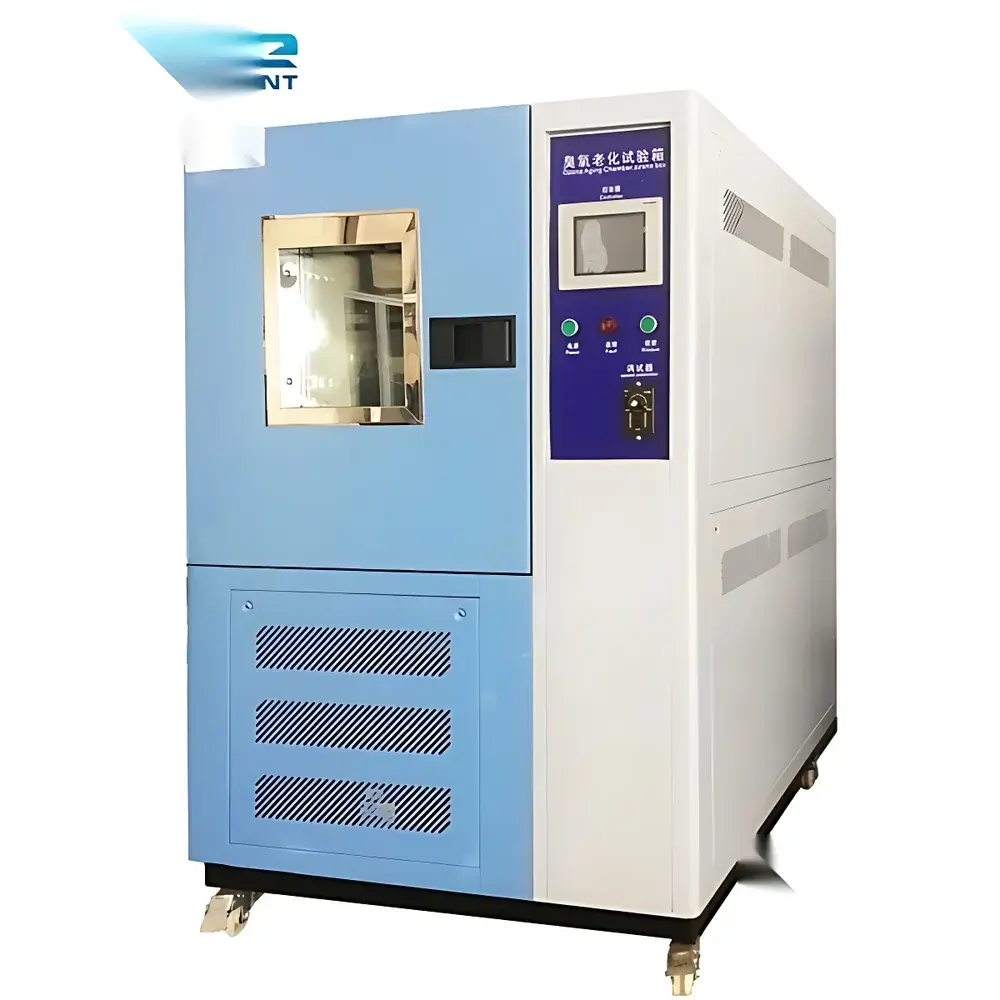
Ozone Weathering Aging Test Chamber QY-Series
| Brand | Other Brands |
|---|---|
| Origin | Imported |
| Manufacturer Type | General Distributor |
| Price | USD 5,300 (approx.) |
| Chamber Volume Options | 80 L / 225 L / 500 L / 1000 L |
| Temperature Range | 25–40 °C |
| Humidity Range | 30–65 % RH |
| Ozone Concentration Range | 50–1500 pphm |
| Temperature Uniformity | ±0.5 °C |
| Sample Rack | 360° continuous rotation at 1 rpm |
| Gas Flow Velocity | 8–16 mm/s |
| Ozone Generation | Silent Discharge Tube |
| Detection Method | Non-Dispersive UV Absorption |
| Sensor Lifetime | ≥5 years |
| Control System | Weilun Color Touchscreen + Siemens PLC |
| Output Interface | 4–20 mA analog output, RS232 serial communication |
| Safety Protections | Leakage current, short-circuit, overtemperature, motor overheat, overcurrent |
Overview
The QY-Series Ozone Weathering Aging Test Chamber is an engineered environmental simulation system designed to evaluate the ozone resistance of elastomeric materials—particularly vulcanized rubber compounds—under controlled, accelerated atmospheric conditions. Unlike general-purpose climate chambers, this instrument implements a closed-loop ozone generation and circulation architecture based on silent discharge technology, enabling precise, stable, and traceable ozone dosing in the range of 50–1500 parts per hundred million (pphm). The chamber operates on the fundamental principle that ozone-induced surface cracking in rubber is a kinetically driven oxidative degradation process, highly sensitive to concentration, temperature, humidity, mechanical strain, and exposure duration. By decoupling and independently regulating these variables—especially dynamic mechanical loading via programmable sample rotation—the QY-Series supports both static and dynamic aging protocols aligned with ASTM D1149, ISO 1431-1, and GB/T 7762 standards. Its stainless-steel reaction chamber, hermetically sealed gas circuit, and integrated non-dispersive ultraviolet (NDUV) ozone analyzer ensure metrological integrity, operator safety, and long-term measurement stability without recalibration drift.
Key Features
- Hermetically sealed, all-stainless-steel test chamber compliant with ISO 1431-1 chamber construction requirements
- Silent discharge ozone generator with low-noise operation and no nitrogen oxide byproduct formation
- NDUV ozone sensor with factory-calibrated linearity, real-time digital display, and ≥5-year operational lifetime
- Programmable 360° rotating sample rack (1 rpm), engineered to replicate cycloidal motion for uniform strain distribution across specimens
- Independent PID-controlled regulation of ozone concentration, temperature (25–40 °C), and relative humidity (30–65 % RH)
- Weilun color touchscreen HMI integrated with Siemens S7-1200 PLC for deterministic logic control and audit-ready parameter logging
- Dual-safety architecture: hardware interlocks (leakage, overtemperature, overcurrent) plus software-enforced operational limits
- Standard 4–20 mA analog output and RS232 interface for integration into centralized lab data acquisition networks
Sample Compatibility & Compliance
The QY-Series accommodates standard dumbbell-shaped, ring-shaped, or strip-type rubber specimens per ASTM D1149 Type A/B/C configurations. Optional static tensile fixtures (with adjustable elongation up to 20 %) and dynamic oscillatory mounts are available for evaluating crack initiation and propagation under mechanical load. All models meet CE electromagnetic compatibility (EMC) directives and are designed to support GLP-compliant validation protocols—including IQ/OQ/PQ documentation packages. The closed-loop gas handling system eliminates ambient ozone leakage, satisfying OSHA PEL (0.1 ppm ceiling limit) and EU Directive 2004/10/EC occupational exposure requirements. Calibration traceability is maintained via dedicated NIST-traceable port for third-party verification of ozone concentration and thermal uniformity.
Software & Data Management
The embedded control firmware supports time-stamped event logging of all critical parameters—ozone concentration, chamber temperature/humidity, rack position, and alarm status—at user-defined intervals (1 s to 60 min resolution). Raw data exports as CSV files via USB or RS232; no proprietary software installation is required. Audit trail functionality complies with FDA 21 CFR Part 11 requirements when operated in supervised mode (user authentication, electronic signature prompts, and immutable log archiving). Optional LabVIEW-compatible drivers enable automated synchronization with external tensile testers or spectral analyzers for correlative aging studies.
Applications
- Accelerated evaluation of ozone resistance in natural rubber (NR), styrene-butadiene rubber (SBR), nitrile rubber (NBR), and ethylene propylene diene monomer (EPDM)
- Quantitative assessment of antiozonant efficacy (e.g., p-phenylenediamine derivatives) in compound development
- Failure analysis of automotive seals, tire sidewalls, and HVAC gaskets exposed to urban or industrial atmospheres
- Supporting ISO 1431-1 Type 1 (static) and Type 2 (dynamic) test method execution
- Material qualification for aerospace elastomers requiring compliance with SAE AMS3320 and MIL-DTL-83528
FAQ
What ozone concentration accuracy is guaranteed across the 50–1500 pphm range?
The NDUV sensor provides ±5 % full-scale accuracy at 23 °C and 50 % RH, verified per ISO 1431-3 calibration procedures.
Can the chamber be validated for GMP-regulated rubber component testing?
Yes—when equipped with optional validation kits (temperature mapping probes, ozone reference analyzers), it supports IQ/OQ/PQ documentation aligned with Annex 15 and ICH Q5C.
Is dynamic testing limited to rotational motion, or can axial extension be applied?
Rotational dynamic mode is standard; axial static tension fixtures are available as accessories per ASTM D1149 Annex A1.
How often does the silent discharge ozone tube require replacement?
Under continuous operation at ≤1000 pphm, service life exceeds 12,000 hours; preventive replacement is recommended every 18 months.
Does the system support remote monitoring via Ethernet or cloud platforms?
RS232 enables local PC connection; Ethernet/WiFi gateway modules are available as field-upgrade options with Modbus TCP protocol support.



