
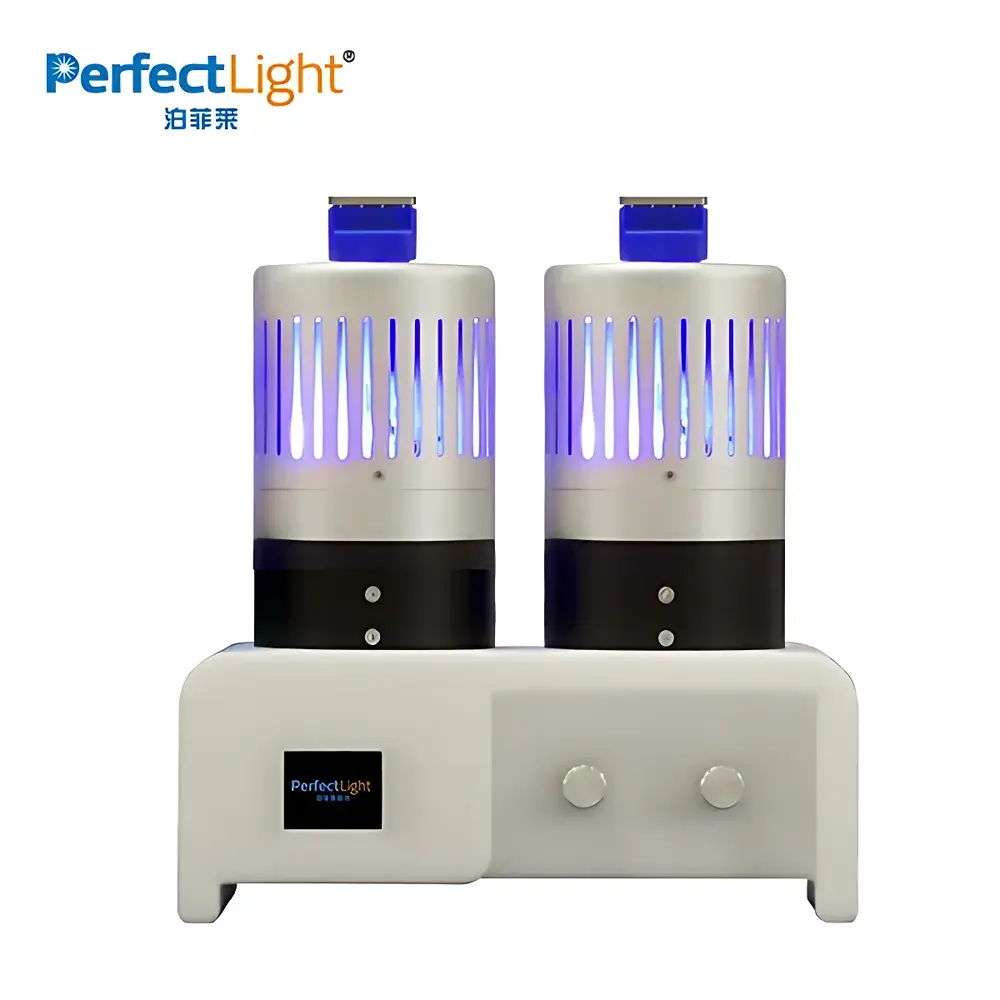
P1 PhotoElf – Standardized Small-Scale Batch Photoreactor
| Brand | PerfectLight |
|---|---|
| Origin | Beijing, China |
| Model | P1 |
| Reactor Type | Dual-Station Intermittent Photoreactor |
| Light Source | Side-Illuminated Tunable LED Array (365–780 nm) |
| Total Rated Power | 20 W (5 W × 4 LEDs) |
| Reaction Volumes | 10 mL / 50 mL / 100 mL |
| Stirring Speed Range | 200–1500 rpm (synchronized across stations) |
| Gas Control | Integrated PLA-MAC1005 Multi-Channel Atmosphere Controller (CO₂, Cl₂, O₂ partial pressure regulation) |
| Dimensions | 350 mm × 250 mm × 350 mm |
| Compliance | Designed for GLP-aligned photochemical screening workflows |
| Software Interface | PoXue Smart Display with remote monitoring and multi-unit cascade capability (up to 3 units × 2 stations = 6 parallel reactions) |
Overview
The P1 PhotoElf is a purpose-engineered dual-station batch photoreactor developed by PerfectLight for standardized, reproducible small-scale photochemical reaction screening in academic laboratories and industrial R&D settings. It operates on the principle of controlled photon delivery to reaction mixtures under precisely regulated thermal, mechanical, and gaseous environments—enabling systematic investigation of light-driven transformations including radical initiation, photocatalytic cycles, and solar-simulated processes. Unlike generic jacketed reactors, the P1 integrates side-illuminated, narrow-band LED arrays with independently tunable wavelengths (365–780 nm), allowing wavelength-dependent quantum yield assessment and action spectrum mapping. Its modular architecture supports scalable experimental design: up to three P1 units can be synchronized via PoXue Smart Display software, delivering six parallel, individually addressable reaction zones with synchronized illumination, stirring, and gas dosing—critical for high-throughput catalyst evaluation and reaction condition optimization.
Key Features
- Dual independent reaction stations with fully synchronized stirring (200–1500 rpm), ensuring identical hydrodynamic conditions across comparative experiments.
- Side-illuminated LED array with four discrete 5 W channels, covering UV-A through visible spectrum (365–780 nm); each channel independently controllable for wavelength-specific excitation studies.
- Integrated PLA-MAC1005 multi-channel atmosphere controller enabling precise partial pressure regulation of reactive gases—including CO₂, Cl₂, and O₂—with real-time feedback and programmable gas-switching protocols.
- Modular scalability: Up to three P1 units can be daisy-chained and centrally managed via PoXue Smart Display, supporting coordinated irradiation timing, gas sequencing, and data logging across 6 reaction vessels.
- Reaction vessel compatibility with standard borosilicate glass vials (10 mL, 50 mL, 100 mL), accommodating heterogeneous (liquid–solid, gas–liquid–solid), biphasic (liquid–liquid), and homogeneous reaction systems without modification.
- Compact footprint (350 × 250 × 350 mm) optimized for fume hood integration and benchtop deployment in space-constrained synthetic laboratories.
Sample Compatibility & Compliance
The P1 PhotoElf accommodates a broad range of photochemically relevant substrates and catalytic systems, including transition metal complexes (e.g., Ir(III), Ru(II), Cu(I)), organic photocatalysts (e.g., acridinium salts, eosin Y), semiconductor nanoparticles (TiO₂, g-C₃N₄), and radical precursors (alkyl bromides, diazonium salts). Its inert reaction chamber design—compatible with common organic solvents (acetonitrile, DMF, THF, DCM), aqueous buffers, and corrosive gas environments—ensures operational robustness during extended irradiation. The system adheres to fundamental safety and documentation requirements for laboratory-scale photochemical research: all electronic controls meet IEC 61000-6-3 EMC standards; gas handling components comply with ISO 8573-1 Class 4 purity specifications; and experimental metadata (light dose, stir rate, gas composition, timestamp) are automatically logged to support GLP-compliant recordkeeping and audit readiness.
Software & Data Management
Control and monitoring are executed through the PoXue Smart Display—a dedicated embedded touchscreen interface supporting real-time parameter visualization, protocol scheduling, and error diagnostics. Remote access is enabled via Ethernet or Wi-Fi, permitting off-site experiment supervision and parameter adjustment without physical presence. When cascading multiple P1 units, the software enforces temporal synchronization of illumination onset/offset, gas injection sequences, and stir profile transitions—eliminating inter-unit timing drift that compromises comparative kinetic analysis. All operational logs—including cumulative photon fluence (calculated from LED irradiance calibration curves), gas partial pressures, temperature trends (via optional external probe input), and user-defined annotations—are exported in CSV format for downstream integration with LIMS or statistical analysis platforms (e.g., Python pandas, JMP, OriginLab). Audit trails retain operator ID, timestamp, and parameter change history per ICH GCP and FDA 21 CFR Part 11 principles—though full electronic signature functionality requires on-premise server deployment.
Applications
- Photocatalyst screening under variable wavelength excitation to identify optimal absorption–activity correlations.
- Quantitative assessment of quantum efficiency across reaction volumes (10–100 mL) to deconvolute mass-transfer limitations from intrinsic photochemical kinetics.
- Gas-phase reactant optimization in C–H functionalization, CO₂ reduction, and oxidative coupling reactions requiring controlled O₂ or Cl₂ partial pressures.
- Development of daylight-driven synthetic protocols using broadband visible-light simulation (400–780 nm) with calibrated spectral output.
- Method transfer from discovery-scale photochemistry to pilot-scale continuous-flow systems via matched photon flux density and residence time modeling.
- Teaching laboratory implementation for undergraduate photochemistry modules emphasizing experimental design, wavelength dependence, and reproducibility metrics.
FAQ
What light intensity calibration standards are supported?
The P1 includes factory-applied irradiance calibration curves for each LED channel (measured in mW/cm² at 1 cm distance using NIST-traceable photodiode sensors); users may perform periodic verification with external radiometers.
Can the system accommodate custom reaction vessels?
Yes—vessel mounting fixtures accept standard 10/50/100 mL screw-cap glass vials with PTFE-lined septa; custom adapters for alternative geometries (e.g., quartz microreactors) are available upon request.
Is temperature control integrated?
No built-in heating/cooling; however, the reactor base features threaded ports for external Peltier or circulating chiller connection, and ambient temperature stability is maintained within ±2°C during typical 4-h runs.
How is photon dose quantified during operation?
Irradiance values (mW/cm²) are multiplied by exposure time (s) and effective irradiated area (cm²) to yield fluence (J/cm²); this calculation is automated in PoXue Smart Display when vessel geometry is selected.
Does the PLA-MAC1005 support mass flow controllers for inert gas purging?
Yes—the controller accepts analog inputs from third-party MFCs and provides proportional valve actuation for argon/nitrogen purge sequences alongside reactive gas modulation.



