
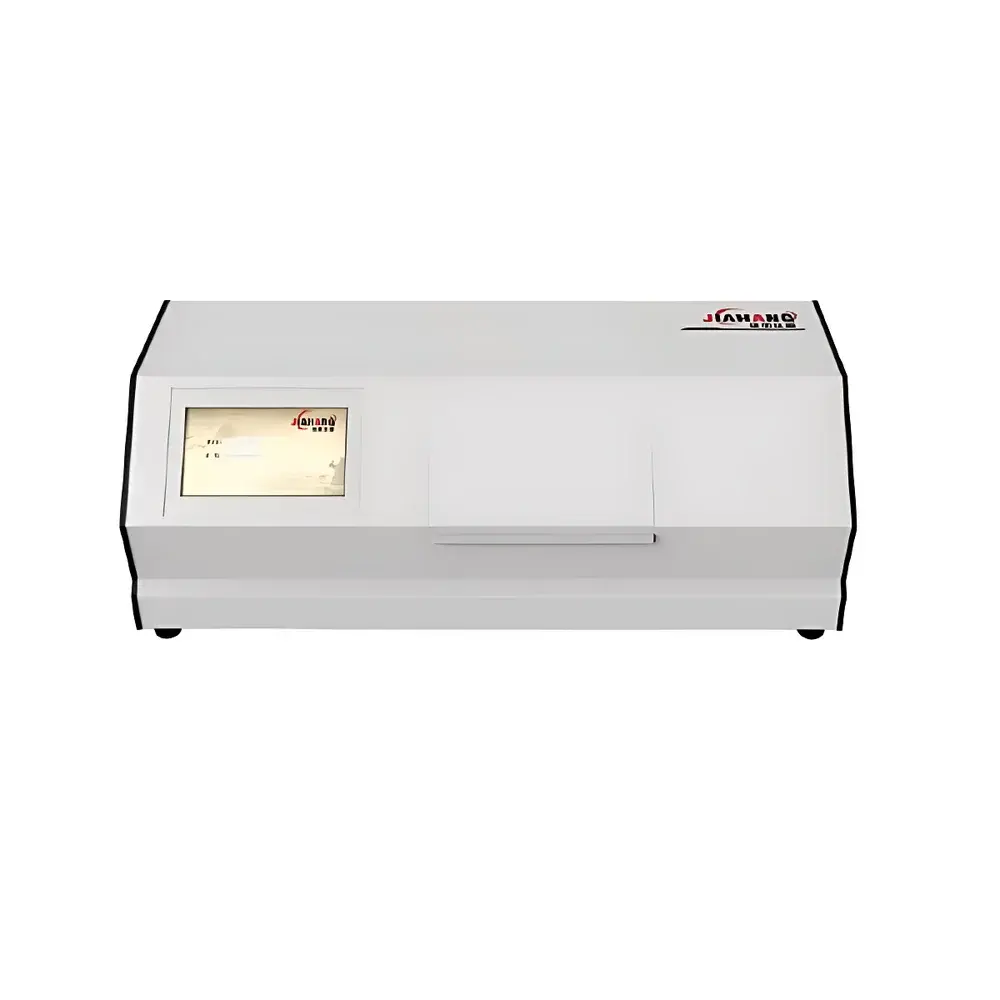
P200 Automated Polarimeter
| Origin | Shanghai, China |
|---|---|
| Manufacturer Type | Authorized Distributor |
| Origin Category | Domestic (PRC) |
| Model | P200 |
| Price Range | USD 1,400 – 7,000 |
| Instrument Type | Automatic Polarimeter |
| Temperature Control | Integrated Peltier-based Thermostatic Cell Holder |
| Digital Display | 5.6" TFT True-Color Touchscreen |
| Light Source | High-Stability LED at 589.3 nm (Na-D Line Equivalent) |
| Optical Path | Dual-Beam Balanced Detection |
| Measurement Range | Optical Rotation ±89.99°, Sucrose Concentration ±257°Z |
| Resolution | 0.001° (optical rotation) |
| Accuracy | ±0.01° (within ±45°), ±0.02° (beyond ±45°) |
| Repeatability (Std Dev) | ≤0.002° |
| Temperature Control Range | 15–40 °C (adjustable in 0.1 °C increments) |
| Temperature Stability | ±0.2 °C |
| Sample Tubes | 100 mm (ambient & thermostatted), 200 mm (ambient) |
| Minimum Transmittance | 1% |
| Data Storage | 1000 measurement records |
| Interface | USB 2.0 (host/device) |
| Power Supply | 220 V ±10%, 50 Hz ±1 Hz, 250 W |
| Net Weight | 24 kg |
Overview
The P200 Automated Polarimeter is a precision optical instrument engineered for the quantitative determination of optical rotation—defined as the angular deflection of plane-polarized light induced by chiral compounds in solution. Based on the fundamental principle of polarimetry, the P200 employs a stabilized 589.3 nm LED light source calibrated to match the sodium D-line spectral output, ensuring metrological consistency with international reference standards (e.g., ISO 5725, USP ). Its dual-beam balanced detection architecture minimizes drift and enhances long-term stability, making it suitable for regulated environments where traceable, repeatable measurements are mandatory. Designed for routine QC laboratories and academic research settings, the P200 delivers high reproducibility across pharmaceutical active pharmaceutical ingredient (API) assays, sugar content quantification in food and beverage matrices, and enantiomeric excess (ee) evaluation in asymmetric synthesis workflows.
Key Features
- Stabilized 589.3 nm LED light source with >100,000-hour lifetime—eliminates warm-up time, thermal drift, and spectral instability associated with sodium vapor or tungsten-halogen lamps;
- Integrated Peltier-controlled cell holder supporting temperature-regulated measurements from 15 °C to 40 °C at ±0.2 °C stability—critical for temperature-sensitive samples per ASTM E1252 and pharmacopeial monographs;
- High-resolution angular detection with 0.001° resolution and ≤0.002° repeatability (standard deviation), enabling reliable low-concentration chiral analysis;
- Multi-parameter calculation engine supporting direct readout of optical rotation (α), specific rotation ([α]), concentration (g/100 mL), and sucrose scale (°Z) without manual conversion;
- 5.6-inch full-color capacitive touchscreen interface with intuitive icon-driven navigation—designed for glove-compatible operation in cleanroom and GMP-compliant labs;
- USB 2.0 interface compliant with Windows-based data export protocols; supports CSV-formatted report generation and timestamped record archiving.
Sample Compatibility & Compliance
The P200 accommodates standard 100 mm and 200 mm pathlength sample tubes—including thermostatted 100 mm cells—enabling analysis of low-absorbance or highly scattering solutions down to 1% transmittance. Its extended ±89.99° measurement range allows unambiguous characterization of highly optically active substances such as camphor derivatives, certain antibiotics (e.g., chloramphenicol), and concentrated sucrose syrups without manual range switching or zero-resetting. The instrument meets core requirements for regulatory compliance: measurement traceability to NIST-traceable polarimetric standards, documented calibration procedures aligned with ISO/IEC 17025, and operational suitability for GLP and GMP environments. While not inherently 21 CFR Part 11 compliant, its USB data export functionality supports integration into validated LIMS or ELN systems with appropriate audit trail configuration.
Software & Data Management
The P200 operates via embedded firmware with no external PC dependency. All measurement parameters—including date/time stamp, tube length, temperature setpoint, wavelength, and user ID—are automatically embedded in each stored record. Up to 1000 measurement entries are retained in non-volatile memory with overwrite protection enabled by default. Data export occurs via USB mass-storage mode: connecting the instrument to a Windows host mounts it as a removable drive, allowing drag-and-drop retrieval of .csv files containing raw α-values, calculated concentrations, and metadata. No proprietary software installation is required. For laboratory information system (LIS) integration, third-party middleware may parse exported CSV headers (e.g., “Sample_ID”, “Temp_C”, “Rotation_deg”, “Conc_g_per_100mL”) to populate structured databases under validated protocols.
Applications
- Pharmaceutical QC: Quantification of enantiomeric purity in chiral APIs per USP , EP 2.2.7, and JP 6.05;
- Sugar industry: Direct °Z determination in cane juice, beet extract, and refined syrups per ICUMSA methods;
- Food & beverage: Verification of honey authenticity, maple syrup grading, and citric acid enantiomer ratio;
- Academic research: Kinetic monitoring of enzymatic resolution reactions and real-time chiral inversion studies;
- Chemical manufacturing: Batch release testing of optically active intermediates including amino acids, tartaric acid, and menthol derivatives.
FAQ
Does the P200 support automated calibration verification?
No—the P200 does not include built-in auto-calibration; however, it accepts certified quartz control plates (e.g., ±5°, ±15°, ±34°) for periodic performance verification per ISO 17025 internal quality control protocols.
Can the instrument operate without temperature control?
Yes—ambient-mode measurements are fully supported using 100 mm or 200 mm non-thermostatted tubes; temperature display remains active but does not regulate.
Is the LED source replaceable by the user?
The LED module is factory-aligned and sealed; replacement requires authorized service technician intervention to maintain photometric alignment and wavelength fidelity.
What is the maximum allowable turbidity for valid measurement?
Samples must transmit ≥1% of incident light at 589.3 nm; highly turbid or particulate suspensions require centrifugation or filtration prior to analysis to avoid scattering-induced error.
Does the P200 comply with FDA 21 CFR Part 11?
Out-of-the-box, it does not provide electronic signatures, audit trails, or role-based access control; however, its data export architecture enables integration into Part 11–compliant enterprise systems when deployed with validated middleware and procedural controls.




