
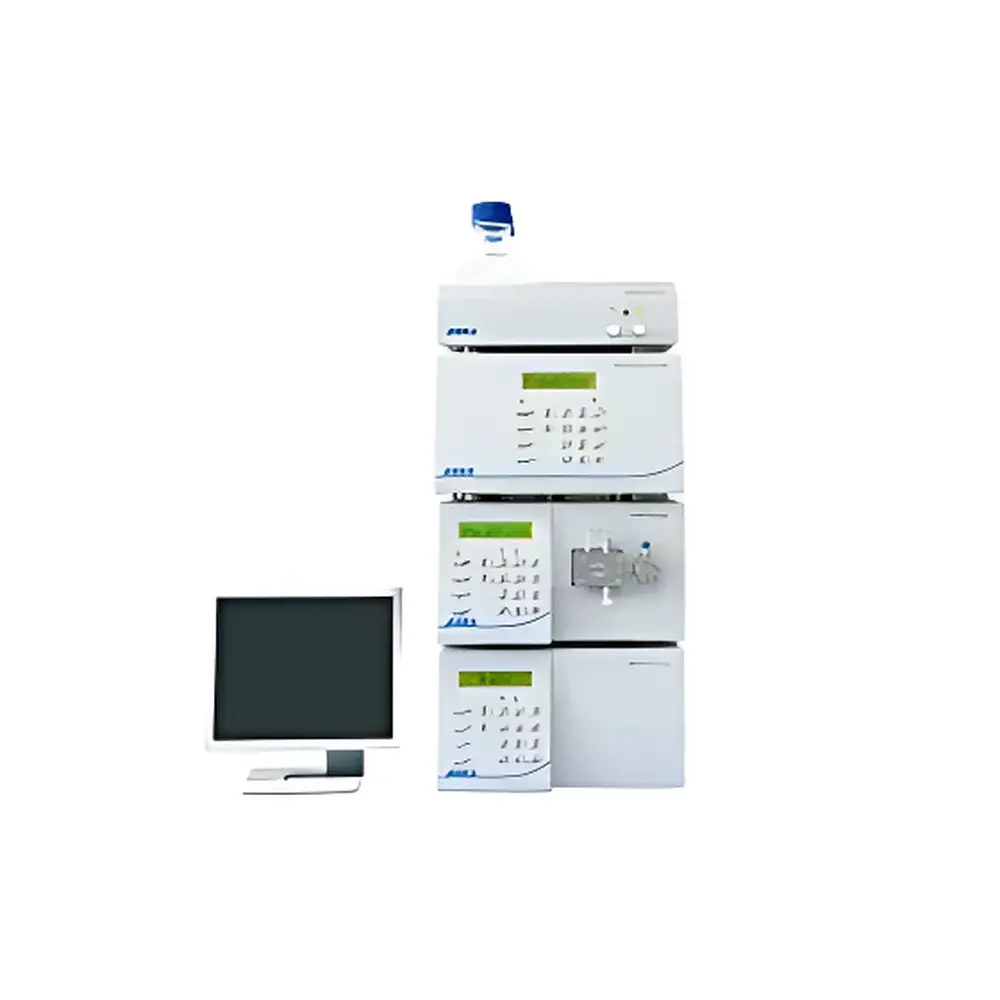
P230II High-Performance Liquid Chromatograph (HPLC) System
| Origin | Shandong, China |
|---|---|
| Manufacturer Type | Authorized Distributor |
| Origin Category | Domestic (China) |
| Model | P230II |
| Price Range | USD 14,000–28,000 |
| Instrument Type | Conventional HPLC System |
| Flow Rate Range | 0.001–9.999 mL/min (setting increment: 0.001 mL/min) |
| Maximum Pressure | 42.0 MPa (0.001–5.000 mL/min) |
| Sample Injection Volume | 1–50 µL |
| Injection Capacity | 4 mL vial tray (standard) |
| Column Oven Temperature Range | +5 °C to 85 °C above ambient |
| UV-Vis Detector Wavelength Range | 190–700 nm |
| Data Acquisition Rate | 100 Hz |
Overview
The P230II High-Performance Liquid Chromatograph (HPLC) System is a modular, research-grade analytical platform engineered for precision, long-term operational stability, and method flexibility in routine and regulated laboratory environments. Based on the widely deployed P230 architecture—with over 1,000 units validated in pharmaceutical QC, environmental testing, food safety, and academic research—the P230II introduces enhanced fluidic control, expanded gradient capability, and improved thermal management without compromising mechanical robustness or user accessibility. Its core separation principle relies on high-pressure liquid mobile phase delivery through packed analytical columns, coupled with UV-Vis absorbance detection governed by the Beer–Lambert law. The system supports isocratic elution, binary high-pressure gradient, quaternary low-pressure gradient, and specialized configurations such as amino acid analysis (via ELITE-AAK/AAP interface), making it suitable for both small-molecule quantification and moderately complex mixture resolution under GLP- and GMP-aligned workflows.
Key Features
- High-precision dual-piston reciprocating pump with short-stroke cam-driven actuation, delivering ultra-low pulsation (<1.0% pressure ripple) and flow accuracy ≤±0.3% at 1.000 mL/min (water, 8.5 MPa, 25 °C)
- Real-time flow compensation across pressure fluctuations, with ±15% user-adjustable flow correction and compressibility factor input for organic/aqueous mobile phases
- Triple pressure unit display and conversion (MPa, psi, bar) with programmable high/low pressure alarms and automatic shutdown upon threshold breach
- UV230II UV-Vis detector featuring holographic concave grating optics, thermally stabilized deuterium lamp, and 100 Hz data acquisition for high-resolution peak tracking
- ZW230II column oven with PID-controlled heating module, ±0.5 °C temperature uniformity, and dual-line digital display of setpoint vs. actual temperature
- Modular architecture supporting plug-and-play integration of additional detectors (e.g., fluorescence, conductivity), autosamplers, and fraction collectors
Sample Compatibility & Compliance
The P230II accommodates standard stainless-steel or PEEK-lined analytical columns (ID: 2–10 mm; length ≤250 mm) and operates reliably with common reversed-phase solvents (acetonitrile, methanol, aqueous buffers), normal-phase systems (hexane/isopropanol), and ion-pairing reagents. Its hardware design conforms to IEC 61010-1 safety standards for laboratory equipment. While not pre-certified for 21 CFR Part 11 compliance out-of-the-box, the system’s RS-232 interface, audit-trail-capable Chinese-language chromatography workstation (with optional English firmware upgrade), and deterministic hardware timing enable validation pathways for regulated environments—including pharmaceutical release testing aligned with USP , EP 2.2.46, and ISO/IEC 17025 requirements. All pressure, flow, wavelength, and temperature parameters are digitally logged with timestamped metadata.
Software & Data Management
The native chromatography data system (CDS) provides dual-mode operation: instrument-panel-only control for rapid method execution, or full PC-based control via USB/RS-232 with real-time chromatogram visualization, peak integration (tangent skim, valley-to-valley, baseline correction), and customizable report templates. The software supports wavelength programming (up to 9 time-segment steps), spectral scanning during pump pause, and reference-beam normalization for enhanced photometric stability. Raw data files are stored in vendor-neutral ASCII format (.txt) with embedded acquisition parameters, facilitating third-party processing in tools such as OpenChrom or Chromeleon. Audit trail functionality includes operator login, method modification history, injection sequence logs, and detector lamp usage metrics (ignition count, total on-time, energy decay trend).
Applications
- Pharmaceutical quality control: assay of active pharmaceutical ingredients (APIs), related substances testing per ICH Q2(R2), dissolution profile analysis
- Food and beverage analysis: detection of preservatives (sorbic acid, benzoic acid), sweeteners (aspartame, sucralose), mycotoxins (aflatoxin B1), and pesticide residues
- Environmental monitoring: quantification of polycyclic aromatic hydrocarbons (PAHs), phenolic compounds, and endocrine-disrupting chemicals in water and soil extracts
- Life sciences: separation and quantification of amino acids, nucleotides, and small peptides using pre-column derivatization or direct UV detection
- Academic research: method development for chiral separations, polymer molecular weight distribution (GPC mode with appropriate columns), and stability-indicating assays
FAQ
What gradient configurations does the P230II support?
The system natively supports isocratic, binary high-pressure gradient, and quaternary low-pressure gradient modes. Optional hardware modules enable active solvent selection valves and proportioning pumps for extended multi-solvent methods.
Is the UV230II detector compliant with pharmacopeial wavelength accuracy requirements?
Yes—its ±1.0 nm wavelength accuracy and ±0.1 nm repeatability meet USP and EP 2.2.25 specifications for UV-Vis detector qualification.
Can the P230II be integrated into a LIMS environment?
Via its RS-232 port and ASCII-formatted output files, the system supports automated data export to LIMS platforms using middleware scripts or OPC-UA adapters (custom configuration required).
What maintenance intervals are recommended for routine operation?
Pump seal replacement every 6–12 months (depending on solvent aggressiveness), detector lamp replacement every 1,500–2,000 hours, and column oven calibration annually—per manufacturer-recommended preventive maintenance schedule.
Does the system support GMP-compliant electronic signatures?
The base CDS does not include built-in electronic signature functionality; however, validated third-party e-signature add-ons compatible with Windows-based deployment may be implemented under documented change control procedures.





