
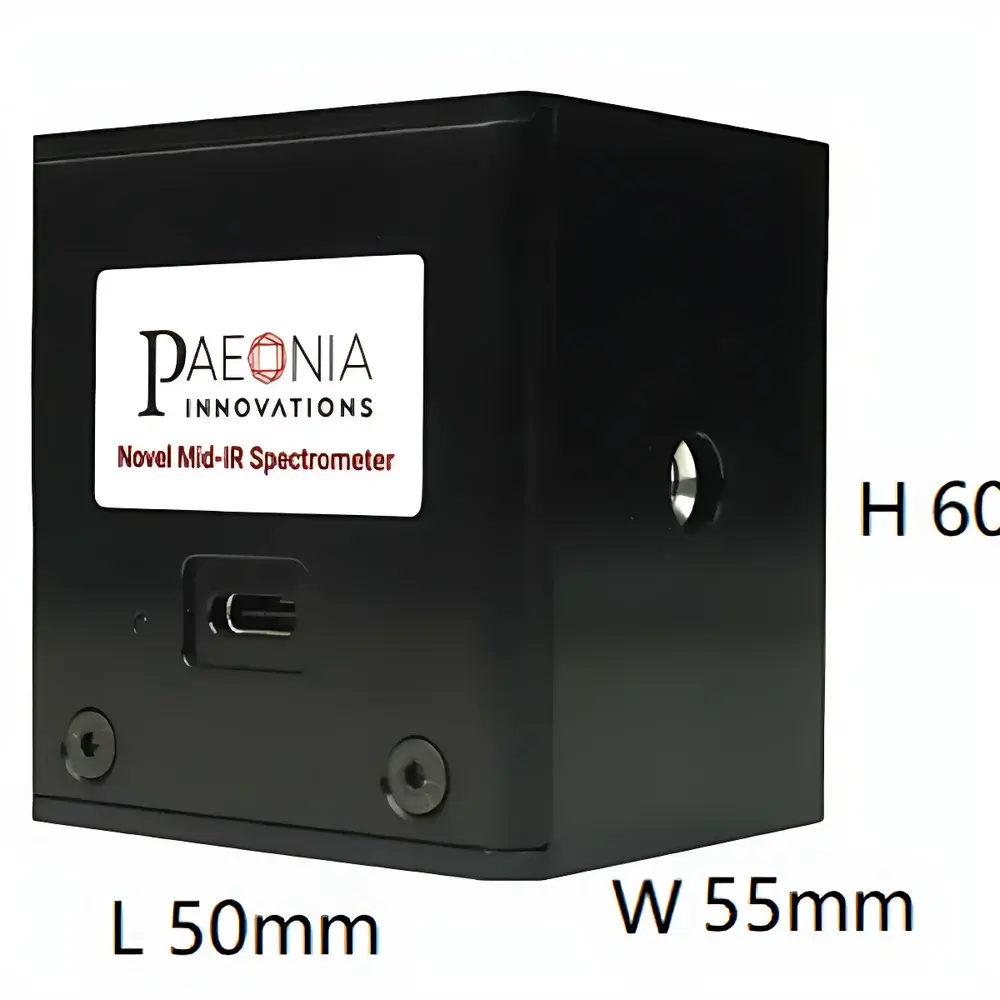
Paeonia Innovations Paeonia IR Online Mid-Infrared Spectrometer
| Brand | NC Technologies |
|---|---|
| Origin | Italy |
| Manufacturer Type | Authorized Distributor |
| Origin Category | Imported |
| Model | Paeonia IR |
| Price Range | USD 1,400 – 140,000 |
Overview
The Paeonia Innovations Paeonia IR Online Mid-Infrared Spectrometer is an engineered solution for real-time, in situ molecular characterization in continuous-flow and batch chemical processes. Leveraging Fourier-transform-free, direct-absorption mid-infrared spectroscopy (MIR), the instrument operates within the critical fingerprint region (900–1800 cm⁻¹), enabling selective identification and quantification of functional groups—including C=O, O–H, N–H, C–O, and C–N bonds—without sample preparation or optical contact. Its compact optomechanical architecture integrates a thermoelectrically stabilized quantum cascade laser (QCL) source and a high-sensitivity pyroelectric detector, delivering robust signal-to-noise performance under industrial process conditions. Designed for deployment at the point-of-use—directly coupled to reactors, mixers, or inline manifolds—the Paeonia IR supports closed-loop process analytical technology (PAT) strategies aligned with ICH Q8(R3), Q9, and Q10 frameworks.
Key Features
- Ultra-compact form factor (50 × 55 × 60 mm; 450 g) enables integration into space-constrained reactor skids, gloveboxes, or modular flow chemistry platforms.
- Sub-second spectral acquisition (response time ≤ 300 ms) facilitates high-temporal-resolution kinetic profiling of fast reactions (e.g., Grignard additions, nitration, hydrogenation).
- Process-rated environmental tolerance: operational range from −15 °C to +60 °C ambient temperature and 0–5 bar process pressure, validated per IEC 60068-2 environmental testing standards.
- Direct wetted-path interface via standard 1/8″ stainless-steel or Hastelloy tubing connections, compatible with corrosion-resistant process fittings (e.g., Swagelok® VCR™).
- Low-power operation (5 VDC via USB-C) eliminates need for external power supplies—enabling seamless connection to industrial PCs, embedded controllers, or laptop-based supervision systems.
- Optical path sealed against particulates and condensables per IP65 rating; no moving parts or consumable optics ensure long-term measurement stability without recalibration drift.
Sample Compatibility & Compliance
The Paeonia IR is compatible with liquid-phase, vapor-phase, and multiphase reaction streams containing organic solvents (e.g., THF, MeOH, DMF, DCM), aqueous solutions, and catalytic slurries—provided suspended solids remain below 5 µm nominal diameter to prevent window fouling. It complies with CE marking requirements (2014/30/EU EMC Directive and 2014/35/EU LVD Directive) and meets RoHS 3 (2015/863/EU) material restrictions. For regulated environments, the system supports audit-ready data integrity through configurable user access levels, electronic signatures, and timestamped raw spectral logs—fully traceable to ALCOA+ principles and aligned with FDA 21 CFR Part 11 expectations when deployed with validated software configurations.
Software & Data Management
The Windows 10/11-native Paeonia Control Suite provides real-time spectral visualization, baseline correction, peak integration, and multivariate calibration (PLS, PCR) workflows. All spectra are stored in HDF5 format with embedded metadata (timestamp, pressure, temperature, flow rate if externally synced), ensuring FAIR (Findable, Accessible, Interoperable, Reusable) data stewardship. The software exposes a documented REST API and OPC UA server interface for bidirectional integration with DCS, MES, or LIMS platforms (e.g., Siemens Desigo, Rockwell FactoryTalk, LabVantage). Raw data exports comply with ASTM E2500-21 (Standard Guide for Specification, Design, and Verification of Pharmaceutical and Biopharmaceutical Manufacturing Systems) for retrospective analysis and regulatory submission packages.
Applications
- Real-time monitoring of esterification, amidation, and oxidation kinetics in continuous-flow reactors.
- In-process verification of catalyst activation state and deactivation pathways via time-resolved carbonyl stretch tracking.
- Quantitative determination of residual monomer conversion in polymerization processes (e.g., acrylic acid, ε-caprolactam).
- Thermodynamic parameter estimation (ΔH, ΔS) through variable-temperature spectral series collected during ramped exotherms.
- Green chemistry metric optimization—e.g., atom economy validation and solvent recovery efficiency assessment via functional group stoichiometry.
- Reaction mechanism elucidation using chemometric mapping of transient intermediates in multi-step cascade syntheses.
FAQ
Is the Paeonia IR suitable for hazardous area installations (e.g., Zone 1 or Class I Div 1)?
No—this model is rated for general-purpose industrial use (non-explosion-proof). Intrinsically safe variants with ATEX/IECEx certification are available under custom configuration (lead time: 12–16 weeks).
Can the instrument be calibrated against NIST-traceable standards?
Yes—factory calibration uses polystyrene film and gas-phase reference cells (e.g., CO, N₂O) traceable to NIST SRM 1921b. End-user revalidation protocols are included in the IQ/OQ documentation package.
Does the system support automated cleaning cycles for fouling-prone streams?
Not natively—but optional purge gas (N₂ or dry air) manifolds and heated flow cells (up to 120 °C) can be integrated via OEM collaboration to mitigate condensation and deposit formation.
What spectral resolution is achievable across the 900–1800 cm⁻¹ range?
Fixed resolution of 4 cm⁻¹ (unapodized), optimized for high signal throughput and dynamic response—sufficient to resolve most functional group bands in complex reaction matrices.
How is long-term photometric stability maintained without internal reference channels?
Stability is ensured by active thermal stabilization of the QCL source (±0.02 °C) and detector housing, combined with proprietary dark-current compensation algorithms applied during each acquisition cycle.



