
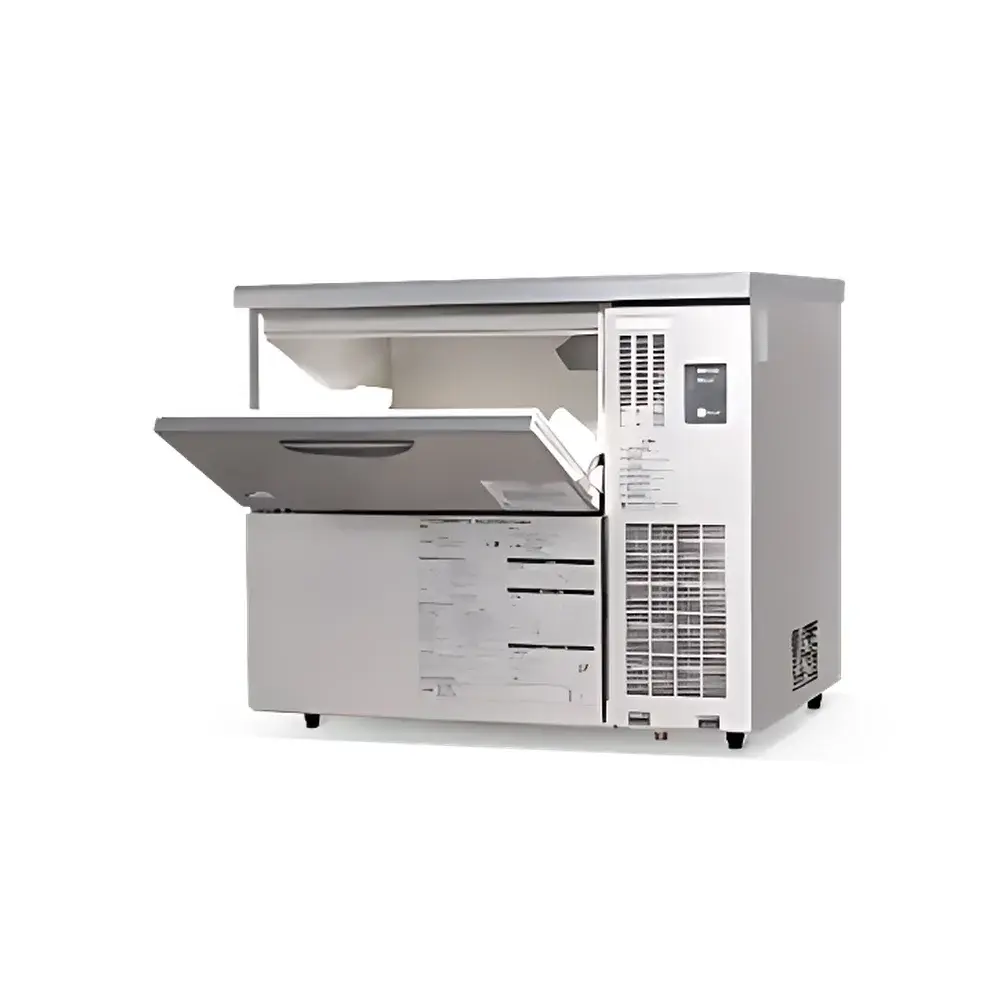
Panasonic SIM-F140LBDL Laboratory Flake Ice Machine
| Brand | Panasonic |
|---|---|
| Origin | Japan |
| Model | SIM-F140LBDL |
| Ice Type | Flake |
| Ice Production Capacity | 130 kg/24h (at 20°C ambient, 15°C water) |
| Storage Capacity | 46 kg |
| Water Consumption | 160 kg/day |
| Cooling Method | Compressor-based refrigeration |
| Ice Formation Principle | Dual-screw extrusion |
| Compressor | Hermetic type (300 W) |
| Refrigerant | HFC |
| Rated Input Power | 435 W |
| External Dimensions (W×D×H) | 900 × 600 × 800 mm |
| Net Weight | 83 kg |
| Operating Ambient Temperature Range | 5–35°C |
| Water Inlet Temperature Limit | ≤35°C |
| Antimicrobial Treatment | Applied to door handle, ice scoop, ice storage bin, and water reservoir |
Overview
The Panasonic SIM-F140LBDL is a purpose-engineered laboratory flake ice machine designed for consistent, hygienic, and low-moisture ice production in demanding scientific environments. Unlike conventional cube or nugget ice systems, this unit employs dual-screw extrusion technology — a mechanical compression process where water is frozen under controlled pressure between rotating stainless-steel screws, then shaved into thin, irregular flakes with high surface area and rapid thermal transfer characteristics. The resulting flake ice exhibits low residual moisture content (typically <1.5% surface water), minimizing drip and condensation during handling — a critical attribute for sample cooling, biological specimen preservation, PCR setup, and cold-chain integrity in analytical workflows. Engineered for continuous operation in regulated laboratories, the SIM-F140LBDL integrates a hermetically sealed compressor (300 W), HFC refrigerant, and precision microcomputer control to maintain stable ice output across ambient conditions from 5°C to 35°C. Its compact footprint (900 × 600 × 800 mm) and modular service design support integration into ISO Class 5–7 cleanrooms, QC labs, and clinical research facilities where spatial efficiency and contamination control are prioritized.
Key Features
- Antimicrobial surface treatment applied to all high-touch components — including door handle, stainless-steel ice scoop, ice storage bin interior, and water reservoir — inhibiting microbial colonization per JIS Z 2801 and ISO 22196 standards.
- Dual-screw extrusion system with Panasonic-original motor (rated for 18,000 hours MTBF), ensuring reliable performance even with suboptimal inlet water temperature or intermittent supply.
- Low-moisture flake ice output (~−5°C surface temperature, minimal meltwater generation), optimized for cryopreservation, tissue sectioning, and enzymatic reaction quenching.
- Full insulation via in-situ rigid polyurethane foam (foamed-in-place), providing uniform thermal resistance and minimizing energy loss during standby or partial-load operation.
- Modular refrigeration unit designed for tool-free extraction — enabling rapid field replacement without system evacuation or refrigerant recovery.
- Microprocessor-based diagnostics with real-time fault logging, audible/visual alerts, and self-detection of water flow interruption, temperature deviation, or compressor overload.
Sample Compatibility & Compliance
The SIM-F140LBDL meets essential requirements for use in GLP-compliant laboratories and GMP-aligned bioprocessing environments. All wetted surfaces contacting potable water or ice — including ABS resin ice storage chamber, stainless-steel water tank, and food-grade silicone gaskets — comply with NSF/ANSI Standard 12 for commercial ice makers and FDA 21 CFR Part 110 (Current Good Manufacturing Practice in Manufacturing, Packing, or Holding Human Food). The antimicrobial additives are certified non-leaching and registered under EPA Pesticide Registration Number for material preservatives. Unit construction adheres to IEC 61000-6-3 (EMC emissions) and IEC 61000-6-2 (immunity), ensuring electromagnetic compatibility with adjacent analytical instrumentation such as HPLC systems, mass spectrometers, and automated liquid handlers.
Software & Data Management
While the SIM-F140LBDL operates via embedded microcontroller without external software dependency, its diagnostic interface supports audit-ready event logging. Critical operational parameters — including cumulative run time, compressor cycles, water inlet temperature history, and alarm timestamps — are stored in non-volatile memory for up to 12 months. Optional RS-485 communication module (sold separately) enables integration into LabVantage or Thermo Fisher SampleManager LIMS platforms via Modbus RTU protocol, supporting traceability requirements under ISO/IEC 17025 Clause 7.7 (Reporting of Results) and FDA 21 CFR Part 11 (electronic records and signatures). All firmware updates are delivered via secure USB key with SHA-256 signature verification.
Applications
- Cooling of centrifuged samples prior to nucleic acid extraction or protein precipitation
- Temperature stabilization during histological tissue embedding and cryosectioning
- Pre-chilling of reagents, buffers, and enzyme stocks in molecular biology workflows
- Controlled-rate cooling of cell suspensions in stem cell banking and CAR-T manufacturing
- Backup cold source during power failure or ultra-low temperature freezer maintenance
- On-demand flake ice supply for pharmaceutical stability testing chambers requiring precise humidity and thermal gradients
FAQ
What is the expected ice dryness level and how does it affect sample integrity?
Flake ice produced by the SIM-F140LBDL maintains ≤1.5% surface moisture under standard operating conditions, reducing condensate formation on vials and pipette tips — thereby minimizing cross-contamination risk and preserving assay sensitivity.
Can this unit be installed in a temperature-controlled room set to 4°C?
No. The minimum recommended ambient temperature is 5°C per manufacturer specification; operation below this threshold may trigger evaporator frost lock and impair ice ejection reliability.
Is the antimicrobial coating compatible with routine ethanol or hydrogen peroxide decontamination?
Yes. The silver-ion infused polymer surfaces retain efficacy after repeated exposure to 70% ethanol and vaporized hydrogen peroxide (VHP) cycles, validated per ASTM E2149-20.
Does the unit require a dedicated water filtration system?
A 5 µm particulate filter and activated carbon pre-filter are strongly recommended to prevent scale deposition in the water distribution manifold and extend heat exchanger service life beyond 5 years.
How is calibration and performance verification documented for regulatory audits?
Daily ice output verification (±5% tolerance vs. rated 130 kg/24h at reference conditions) and weekly visual inspection of antimicrobial surface integrity constitute the core QA checklist — both recordable in paper-based or electronic lab notebooks compliant with ALCOA+ principles.
Related Products



