
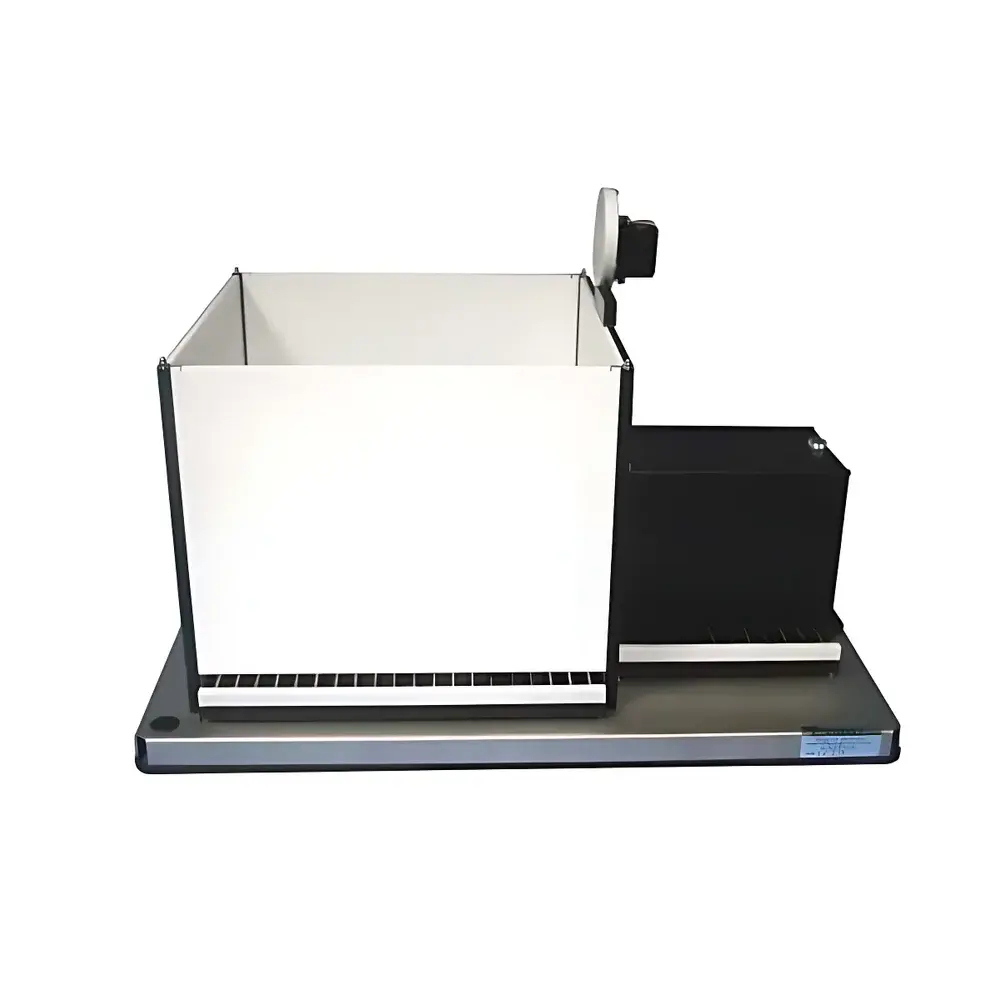
Panlab LE870/872 Passive Avoidance Chamber System
| Origin | Spain |
|---|---|
| Manufacturer Type | Authorized Distributor |
| Origin Category | Imported |
| Model | LE870 (Rat), LE872 (Mouse) |
| Price | USD 13,500 (FOB) |
| Power Supply | 110–220 V AC, 50/60 Hz |
| Construction Materials | Acrylic (PMMA), Anodized Aluminum, Stainless Steel |
| Animal Compatibility | Mice (min. 10 g), Rats (min. 40 g) |
| Chamber Dimensions (White/Black) | Mouse — 250 × 250 × 240 mm / 195 × 108 × 120 mm |
| Stimulus Delivery | Programmable DC current pulse generator (0–2 mA, adjustable step resolution ≤ 0.01 mA) |
| Detection Method | High-precision load-cell-based weight sensing (no optical beams or tilt switches) |
| Software Control | SHUTAVOID v3.2 (supports up to 8 independent chambers via USB interface, no PCI card required) |
| Primary Output Metric | Latency-to-enter black compartment (ms resolution) |
| Application Scope | Short-term & long-term memory assessment, fear-motivated passive avoidance learning, neuropharmacological screening, hippocampal-dependent behavioral phenotyping |
Overview
The Panlab LE870/872 Passive Avoidance Chamber System is a CE-certified, laboratory-grade behavioral apparatus engineered for rigorous, reproducible assessment of associative learning and memory retention in rodents. Based on the well-established passive avoidance paradigm, this system quantifies latency—the time elapsed between presentation of an aversive conditioned stimulus (typically a mild foot shock delivered in the dark compartment) and the animal’s voluntary entry into that compartment following prior exposure. Unlike active avoidance paradigms requiring operant response, passive avoidance relies on natural aversion to darkness (scototaxis) and learned suppression of approach behavior, making it highly sensitive to hippocampal, amygdalar, and prefrontal cortical function. The LE870/872 eliminates common methodological confounds associated with optical beam interruption or mechanical tilt detection by employing dual high-resolution load cells embedded beneath each compartment floor. This gravity-sensing architecture ensures stable, contact-independent position tracking across repeated trials—even during subtle postural shifts or grooming—thereby enhancing inter-session reliability and reducing false-positive event registration.
Key Features
- Load-cell-based spatial detection: Eliminates reliance on infrared beams or conductive grids, mitigating signal dropout due to dust, fur shedding, or moisture.
- Dual-chamber design with optimized volume ratio: Illuminated white compartment (larger volume) promotes exploratory motivation, while the enclosed black compartment (fixed dimensions across mouse/rat models) provides consistent contextual aversiveness.
- Precision-controlled electrostimulation: Integrated current generator delivers calibrated, constant-current DC pulses (0–2 mA range, 0.01 mA resolution) directly to stainless-steel grid flooring—ensuring stimulus fidelity and compliance with IACUC-recommended intensity thresholds.
- Species-specific chamber configurations: Interchangeable white compartments for mice (250 × 250 × 240 mm) and rats (310 × 310 × 240 mm), paired with standardized black compartments (195 × 108 × 120 mm) to maintain uniform shock context across subjects.
- USB-native architecture: No internal expansion cards required; full system control and real-time data streaming via standard USB 2.0 interface compatible with Windows 10/11 (64-bit).
- Robust mechanical construction: Acrylic (PMMA) walls for optical clarity and chemical resistance; anodized aluminum frame and stainless-steel shock grids ensure long-term dimensional stability and corrosion resistance under routine disinfection protocols.
Sample Compatibility & Compliance
The LE870/872 supports standardized behavioral testing in both Mus musculus (minimum weight: 10 g) and Rattus norvegicus (minimum weight: 40 g), accommodating common outbred (e.g., CD-1, Sprague-Dawley) and inbred strains (e.g., C57BL/6, BALB/c). All hardware components comply with EU Directive 2014/30/EU (EMC) and 2014/35/EU (LVD), bearing CE marking for safe operation within GLP-compliant preclinical research environments. The system adheres to NIH Guide for Care and Use of Laboratory Animals standards for stimulus delivery parameters and housing geometry. While not FDA 21 CFR Part 11–validated out-of-the-box, SHUTAVOID software supports audit-trail-enabled user authentication, electronic signature logging, and immutable raw-data export—facilitating alignment with GCP and internal SOPs governing behavioral pharmacology studies.
Software & Data Management
SHUTAVOID v3.2 is a dedicated, modular acquisition and analysis platform designed exclusively for Panlab avoidance and shuttle-box systems. It enables synchronized control of up to eight independent LE870/872 units via a single host PC, with timestamped event logging at 100 Hz temporal resolution. The software records latency-to-entry, total session duration, immobility bouts, and shock-triggered response patterns. Export formats include CSV (for statistical packages such as GraphPad Prism or R), MATLAB-compatible .mat files, and PDF reports compliant with journal submission requirements (e.g., Nature Protocols, eNeuro). Built-in calibration wizards verify load-cell zero-offset and shock amplitude prior to each session, and automated QC logs are archived alongside experimental datasets to support regulatory inspections.
Applications
This system is routinely deployed in academic and industrial neuroscience laboratories for: evaluation of hippocampal-dependent memory consolidation following systemic or intracerebroventricular drug administration; longitudinal assessment of cognitive deficits in transgenic Alzheimer’s disease models (e.g., APP/PS1); validation of novel nootropic or neuroprotective compounds; mechanistic studies of fear extinction and reconsolidation; and cross-species translational modeling of anxiety-related decision-making under uncertainty. Its quantitative output—latency—is statistically robust for parametric analysis (ANOVA, mixed-effects modeling) and correlates strongly with molecular markers of synaptic plasticity (e.g., pCREB, BDNF expression) and structural MRI metrics of medial temporal lobe integrity.
FAQ
What is the minimum animal weight supported for reliable detection?
The system reliably detects mice ≥10 g and rats ≥40 g using factory-calibrated load cells. Below these thresholds, signal-to-noise ratio decreases significantly.
Can SHUTAVOID software run on macOS or Linux?
No—SHUTAVOID v3.2 is Windows-only (Windows 10/11, 64-bit required). Virtualization or Boot Camp is not supported for real-time hardware communication.
Is the shock grid grounded, and how is current safety ensured?
Yes—the stainless-steel grid is electrically isolated and referenced to earth ground. Current output is strictly limited to 2 mA maximum, with hardware-enforced current clamping and automatic shutdown after 10 s of continuous delivery.
Does the system support integration with third-party video tracking software?
Not natively. Position data is derived solely from weight distribution; however, synchronized TTL triggers can be exported to external DAQ systems for hybrid multimodal recording (e.g., simultaneous EEG or calcium imaging).
How often does the load-cell system require recalibration?
Annual verification is recommended per ISO/IEC 17025 guidelines. In-house daily zero-checks are performed automatically during software startup.



