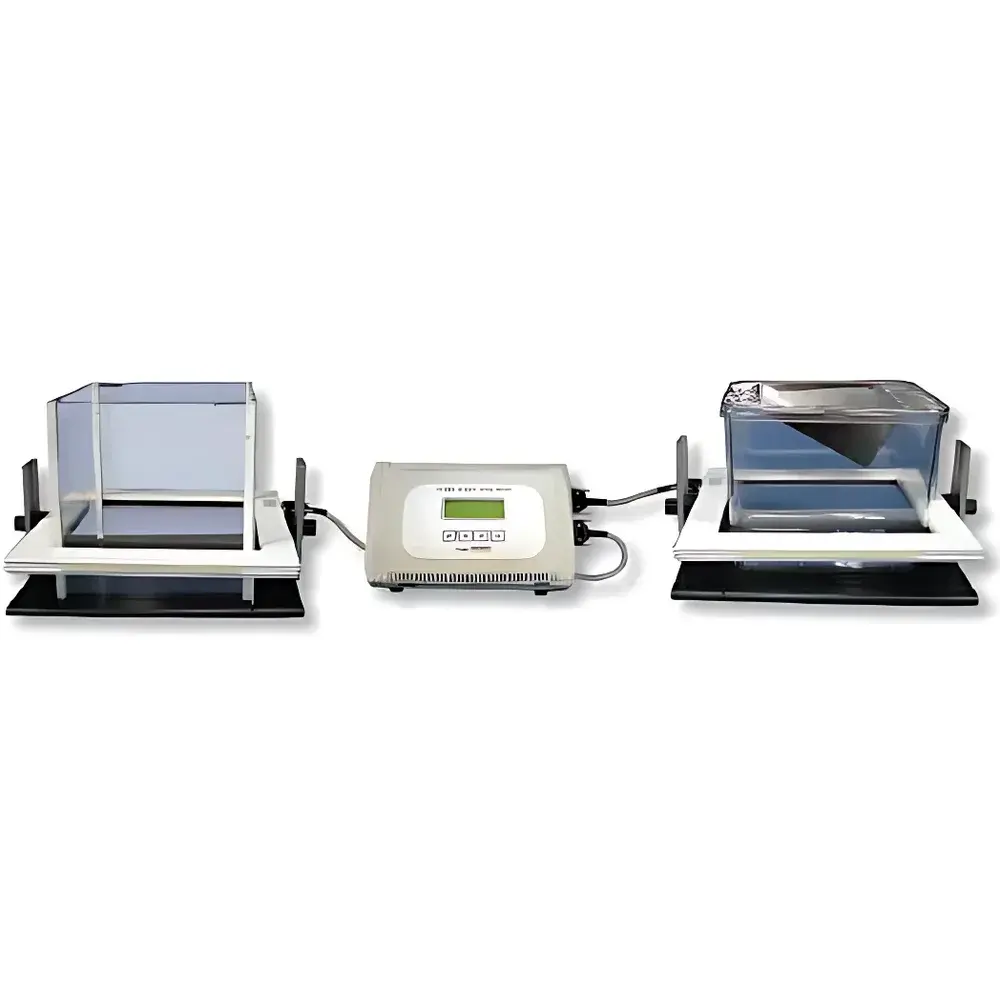
Panlab LE8815/LE8816 Infrared Open-Field System for Animal Behavior Analysis
| Brand | Harvard Apparatus |
|---|---|
| Origin | USA |
| Model | LE8815 / LE8816 |
| External Dimensions | 450 × 450 × 200 mm or 220 × 220 × 200 mm |
| Infrared Frame Options | 450 × 450 mm (32 sensors, 25 mm spacing) or 250 × 250 mm (32 sensors, 13 mm spacing) |
| IR Wavelength | 950 nm |
| Sampling Frequency | 40 Hz |
| Software | Acti-Track v5.x |
| Max Concurrent Channels | 32 |
| Configurable Zones | Single-animal or dual-animal (split-zone) mode |
| Behavioral Metrics | Distance traveled, velocity profiles (max/min/mean), time-in-zone, zone entries, rearing count & duration, rotation counts, trajectory-based path analysis, nose-poke detection (threshold-defined), ambulation classification (fast/slow/immobility) |
Overview
The Panlab LE8815/LE8816 Infrared Open-Field System is a purpose-engineered behavioral phenotyping platform designed for quantitative, non-invasive monitoring of rodent locomotor activity and exploratory behavior in controlled laboratory environments. Operating on the principle of infrared beam interruption, the system employs a precisely calibrated matrix of 32 photodiode-based IR emitters and detectors—16 aligned along the X-axis and 16 along the Y-axis—to define a two-dimensional coordinate grid over the testing arena. Each beam operates at 950 nm wavelength with a stable 40 Hz sampling rate, ensuring high temporal resolution and minimal latency in event detection. Unlike video-based tracking systems, this IR architecture eliminates computational overhead associated with image processing, background subtraction, or animal segmentation—yielding deterministic, reproducible positional data with negligible frame drop or motion blur artifacts. The system supports both standard open-field configurations (using perforated activity boards) and confined home-cage–like setups (with acrylic enclosures), enabling experimental flexibility across paradigms including spontaneous locomotion assessment, novelty-induced exploration, circadian rhythm profiling, and preclinical screening for psychomotor modulation.
Key Features
- Modular infrared frame design available in two physical footprints: 450 × 450 mm (25 mm inter-beam spacing) and 250 × 250 mm (13 mm inter-beam spacing), optimized for mice or rats respectively.
- Dual-layer capability: Optional vertical IR frame mountable above the primary plane to detect rearings and vertical exploratory behavior—critical for anxiety- and dopaminergic-related phenotyping.
- Acti-Track software v5.x provides real-time data acquisition, configurable spatial zoning (including irregular polygonal regions), and user-definable behavioral thresholds for ambulation speed, rearing velocity, and nose-poke kinetics.
- Supports simultaneous monitoring of up to 32 independent test units via scalable USB hub architecture; each unit operates autonomously with local timestamping to ensure synchronization integrity.
- Acrylic enclosure options (450 × 450 × 200 mm and 220 × 220 × 200 mm) comply with IACUC-compliant housing dimensions and facilitate integration with environmental control systems (e.g., temperature, light-dark cycle controllers).
- Hardware-level beam validation ensures continuous self-diagnostic feedback—any misalignment or occlusion triggers immediate system alert, preserving data continuity and audit readiness.
Sample Compatibility & Compliance
The LE8815/LE8816 system is validated for use with C57BL/6, BALB/c, CD-1, and Sprague-Dawley rodents (adult mice and young rats). Its non-contact sensing modality eliminates handling stress artifacts and avoids interference from fur pigmentation or coat texture—unlike video-based methods susceptible to contrast variability. All mechanical components meet ISO 13485-aligned manufacturing tolerances, and the acrylic housing conforms to USP Class VI biocompatibility standards. Data output formats (CSV, HDF5) are compatible with downstream statistical platforms including MATLAB, R, and Python-based neuroethology toolkits. While not FDA-cleared as a medical device, the system adheres to GLP principles for preclinical study documentation: Acti-Track enforces immutable audit trails, user-access logging, electronic signatures, and version-controlled protocol archiving—fully compliant with 21 CFR Part 11 requirements when deployed on validated Windows OS configurations.
Software & Data Management
Acti-Track software serves as the central analytical engine, offering deterministic event classification without reliance on machine learning inference. Users define behavioral states via empirically grounded velocity thresholds (e.g., ≥12 cm/s = fast ambulation; ≤2 cm/s = immobility; ≥3 cm/s vertical displacement = rearing). The software generates standardized reports aligned with NIH Behavioral Core Facility reporting templates, including total distance, center-periphery ratio, thigmotaxis index, habituation slope (over sequential 5-min bins), and path tortuosity metrics. Raw beam-interruption timestamps are stored with microsecond precision, enabling post-hoc reconstruction of sub-second behavioral sequences. Exported datasets include full trajectory coordinates (X,Y,t), classified event logs, and zone-transition matrices—structured for direct ingestion into longitudinal mixed-effects modeling frameworks.
Applications
- Baseline locomotor activity profiling in transgenic and knockout models.
- Pharmacological screening of CNS-active compounds (e.g., anxiolytics, stimulants, antipsychotics) using standardized open-field protocols per OECD TG 425 and ASTM E1847.
- Circadian entrainment studies under controlled photoperiods, leveraging built-in time-stamping synchronized to NIST-traceable clocks.
- Neurodevelopmental assessment in juvenile rodents, where low-latency IR detection captures rapid, fragmented movement patterns missed by lower-frame-rate video systems.
- High-throughput phenotyping pipelines requiring >20 concurrent subjects—enabled by distributed USB acquisition and centralized database aggregation.
- Integration with electrophysiology or optogenetics rigs via TTL-compatible trigger outputs for behaviorally gated stimulation.
FAQ
What is the minimum detectable movement resolution?
The system resolves discrete beam breaks at 13 mm (250 mm frame) or 25 mm (450 mm frame) spatial intervals; sub-beam interpolation is not performed—ensuring traceability of every recorded event to a physical sensor pair.
Can Acti-Track export data compatible with EthoVision XT or ANY-maze?
Yes—CSV exports contain X/Y/t columns and event annotations in standardized column headers, permitting direct import into third-party behavioral analysis suites without transformation.
Is calibration required before each experiment?
No routine recalibration is needed; factory calibration is retained across power cycles. Beam alignment verification is performed automatically during initialization and logged in the session metadata.
How is rearing behavior distinguished from horizontal movement?
Rearing is detected exclusively by the upper IR frame: a valid event requires ≥3 consecutive beam breaks in the vertical plane within a 500 ms window, with minimum vertical displacement exceeding 3 cm.
Does the system support dark-phase testing?
Yes—IR illumination is invisible to rodents; no additional lighting is required, eliminating confounding photic stimulation during nocturnal assays.