
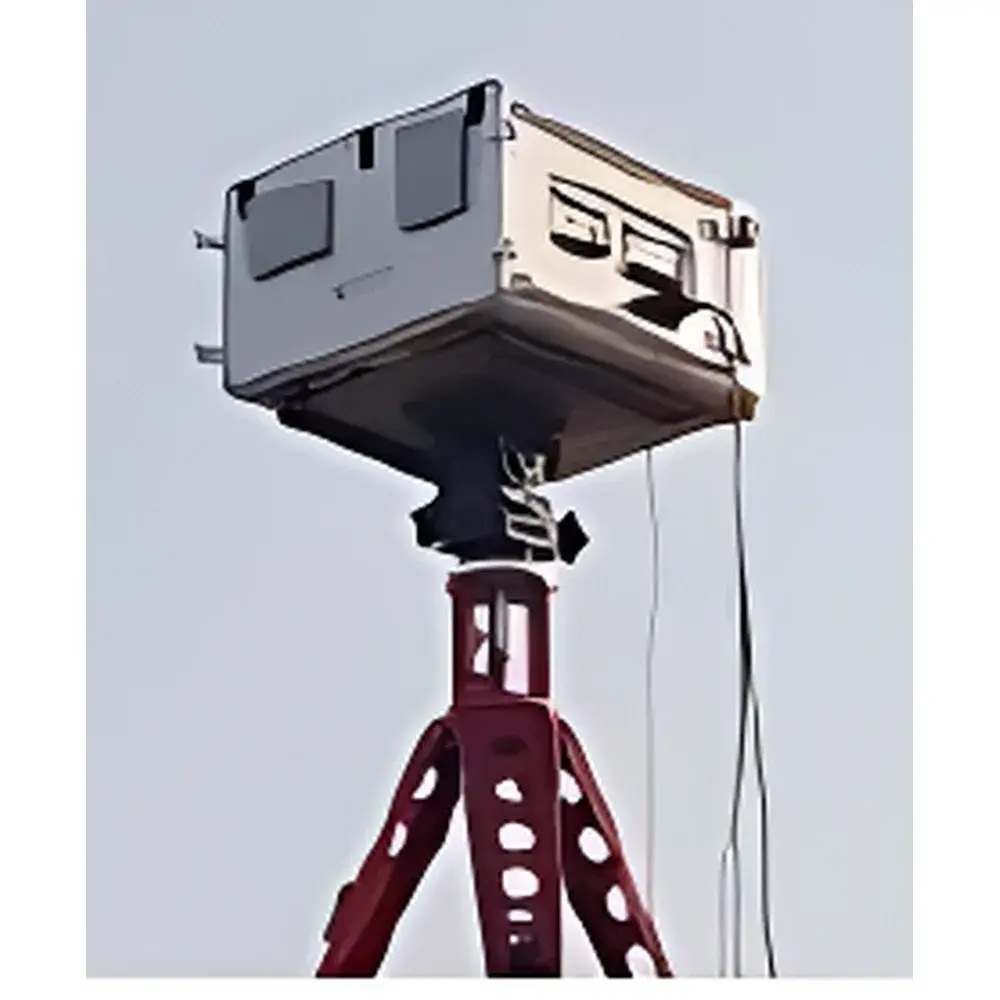
Parma Weather Radar Calibration System
| Origin | Switzerland |
|---|---|
| Manufacturer Type | Distributor |
| Origin Category | Imported |
| Model | Parma |
| Price | Upon Request |
Overview
The Parma Weather Radar Calibration System is a precision-engineered dual-polarization radar target simulator designed for traceable, repeatable calibration and performance verification of operational weather radar systems. Built in Switzerland and developed in close collaboration with meteorological agencies and radar operators, the system operates on the principle of active coherent signal retransmission—receiving incident radar pulses, digitally processing them with user-defined target parameters (range, Doppler velocity, polarization state), and re-emitting calibrated echoes with sub-millisecond timing fidelity. Unlike passive corner reflectors or natural targets, this system generates synthetic reference targets with fully controllable radar cross-section (RCS), differential reflectivity (Zdr), specific differential phase (Kdp), and spectral width—enabling quantitative assessment of radar sensitivity, polarimetric consistency, beam pointing accuracy, antenna pattern distortion, and pulse-to-pulse phase stability.
Key Features
- Active dual-polarization echo synthesis with independent control over horizontal (H) and vertical (V) channel amplitude, phase, and delay
- Calibrated RCS generation from −10 dBsm to +40 dBsm with ±0.5 dB absolute uncertainty (traceable to NIST/PTB standards)
- Doppler velocity simulation resolution of 0.1 m/s and stability better than ±0.05 m/s over 60-minute continuous operation
- Zdr accuracy of ±0.2 dB and Kdp accuracy of ±0.05°/km across full dynamic range
- Real-time digitization and analysis of every received radar pulse—including I/Q sampling at ≥100 MS/s, pulse width measurement (±0.5 ns), RF frequency deviation (±10 Hz), and phase coherence tracking
- Graphical user interface (GUI) supporting scenario scripting, automated calibration sequences, and export of raw I/Q data in HDF5 and NetCDF-4 formats
- IP66-rated portable enclosure with integrated thermal management, GPS-synchronized timing, and battery-backed operation for field deployment
- Optional integrated microwave radiometer module (22–30 GHz) for concurrent brightness temperature validation and attenuation correction profiling
Sample Compatibility & Compliance
The Parma system is natively configured for X-band (9.3–9.5 GHz) weather radars and supports full compatibility with WSR-88D, C-Band Doppler, and research-grade polarimetric radars via firmware-upgradable front-end modules. It complies with ITU-R RS.1857-1 (radar calibration methodologies), WMO Guide to Meteorological Instruments and Methods of Observation (CIMO Guide, Chapter 12), and EN 61000-6-4 (EMC emissions). All calibration coefficients are stored with digital signatures and audit trails compliant with ISO/IEC 17025:2017 requirements for testing laboratories. Traceability documentation—including calibration certificates issued by METAS (Swiss Federal Institute of Metrology)—is provided with each unit.
Software & Data Management
The Parma Control Suite runs on Windows 10/11 (64-bit) and integrates seamlessly with common radar data processing environments including Py-ART, wradlib, and IDL-based operational toolchains. Software features include: time-synchronized multi-radar coordination mode; automated inter-comparison workflows against reference radars; built-in spectral moment validation (Z, Zdr, ρhv, Φdp); and full support for FDA 21 CFR Part 11-compliant electronic records—including user authentication, role-based access control, and immutable audit logs for all parameter changes and test executions. Raw pulse data and processed calibration reports are exportable in CF-compliant NetCDF format for ingestion into national radar archives (e.g., EUMETNET OPERA, NOAA NCEI).
Applications
- Pre-deployment verification and post-maintenance validation of operational weather radars (NEXRAD, DWD, Météo-France, JMA networks)
- Quantitative assessment of polarimetric bias drifts during long-term radar monitoring campaigns
- Ground-truthing of quantitative precipitation estimation (QPE) algorithms under controlled conditions
- Evaluation of antenna pointing errors, sidelobe contamination, and beam broadening effects
- Support for GLP/GMP-aligned radar performance qualification in aviation meteorology and hydrometeorological service accreditation
- Research applications in radar hardware-in-the-loop (HIL) simulation and algorithm development for AI-driven precipitation classification
FAQ
What radar bands does the Parma system support out-of-the-box?
The system ships with full X-band (9.3–9.5 GHz) capability. C-band (5.3–5.5 GHz) and S-band (2.7–2.9 GHz) front-end modules are available as factory-installed options or field-upgrade kits.
Is the system suitable for use in tropical or high-humidity environments?
Yes—the IP66-rated enclosure, condensation-resistant RF windows, and internal desiccant monitoring ensure reliable operation at up to 95% relative humidity and ambient temperatures from −20 °C to +55 °C.
Can the Parma system be used for end-to-end system-level validation of radar signal processors?
Absolutely. Its full-pulse capture capability enables direct injection of known-target waveforms into the radar receiver chain, allowing validation of digital signal processing (DSP), clutter filtering, and moment estimation algorithms without requiring physical antenna coupling.
Does the system provide traceable uncertainty budgets for all reported parameters?
Yes—each delivered unit includes a metrological uncertainty budget aligned with GUM (JCGM 100:2008) principles, covering contributions from RF path loss, ADC quantization, clock jitter, and environmental thermal drift.






