
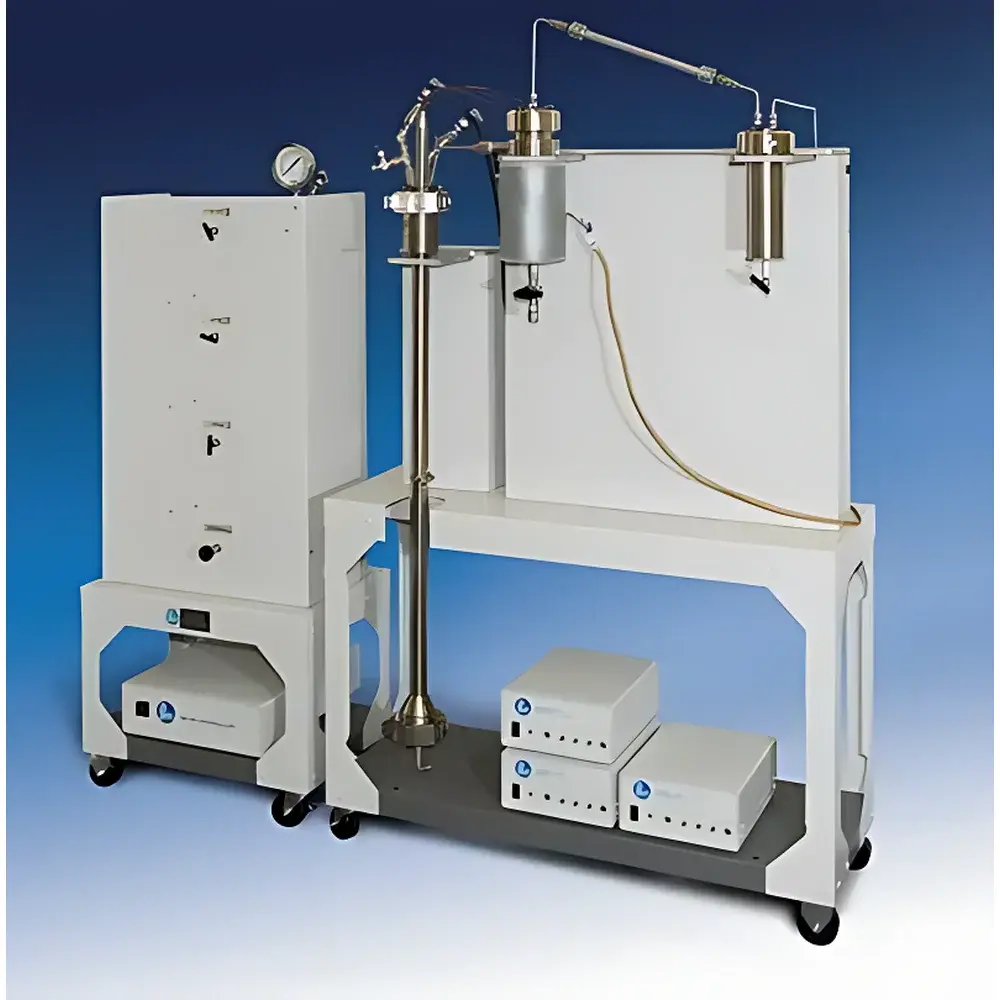
PARR 4871 Fluidized Bed Reactor System
| Brand | PARR |
|---|---|
| Origin | USA |
| Manufacturer Status | Authorized Distributor |
| Origin Category | Imported |
| Model | Parr 4871 |
| Pricing | Available Upon Request |
Overview
The PARR 4871 Fluidized Bed Reactor System is an engineered laboratory-scale process reactor designed for rigorous investigation of gas–solid heterogeneous catalytic reactions under controlled temperature, pressure, and flow conditions. It operates on the principle of fluidization—where upward-flowing process gases suspend solid catalyst particles in a dynamic, turbulent state—enabling continuous catalyst circulation, uniform thermal distribution, and enhanced mass and heat transfer rates compared to fixed-bed configurations. This system is particularly suited for kinetic studies, catalyst deactivation profiling, and process scale-up validation in R&D environments aligned with industrial fluidized-bed processes such as Fischer–Tropsch synthesis, catalytic cracking, hydrodesulfurization, and selective oxidation.
Key Features
- Modular, stainless-steel construction (316 SS) compliant with ASME BPVC Section VIII Div. 1 for safe operation up to 10 MPa (1450 psi) and 600 °C
- 1-meter-long main reaction zone with 2.5 cm internal diameter; bottom-mounted sintered metal gas distributor plate for uniform gas entry and easy replacement
- Expandable top section serving as a disengagement zone to minimize entrainment of fine catalyst particles into downstream units
- Dual-zone electric heating system: independently controlled heating jackets for both the main reactor and disengagement zone, enabling axial temperature gradient management
- Multi-point thermocouple array (Type K, 0.5 mm sheath) installed at ≥5 axial positions for real-time internal temperature mapping and verification of thermal homogeneity
- Integrated hot cyclone separator or high-temperature sintered metal filter (up to 400 °C) for in-line capture of attrited catalyst fines
- Condensation train with jacketed condenser and 600 mL collection vessel rated for cryogenic to ambient operation
- Back-pressure regulation via precision electronic pressure control valve (EPCV), maintaining setpoint stability within ±0.02 MPa
Sample Compatibility & Compliance
The PARR 4871 supports a wide range of solid catalysts—including metal oxides, supported noble metals, zeolites, and carbon-based materials—in particle sizes from 20 µm to 500 µm. It accommodates reactive gas mixtures (e.g., H₂, CO, CH₄, O₂, N₂, NH₃, SO₂) and vapor-phase organics compatible with 316 SS wetted surfaces. The system meets key regulatory expectations for laboratory process equipment: pressure components conform to PED 2014/68/EU; electrical safety complies with UL 61010-1 and IEC 61000-6-3; and data integrity architecture supports ALCOA+ principles when interfaced with validated software. While not pre-certified for GMP manufacturing, its design enables full traceability and audit readiness for GLP-compliant kinetic studies and catalyst qualification protocols.
Software & Data Management
All operational parameters—including gas flow rates (mass flow controllers calibrated per ISO 6358), temperature setpoints, pressure profiles, and heater power outputs—are managed and logged via the PARR 4871 Process Controller. This embedded controller features a 7-inch touchscreen HMI, programmable ramp/soak sequences, real-time trend visualization, and CSV export capability. Optional Ethernet/IP or Modbus TCP interfaces allow integration into centralized SCADA or LIMS platforms. For regulated environments, third-party validation packages (IQ/OQ/PQ) are available to support compliance with FDA 21 CFR Part 11 requirements—including electronic signatures, audit trails, and user-access role definitions.
Applications
- Kinetic modeling of gas–solid catalytic reactions under industrially relevant residence times and conversion regimes
- Catalyst lifetime assessment via continuous operation with periodic sampling and post-run characterization (XRD, BET, SEM)
- Thermal stability testing of supported catalysts under exothermic reaction conditions
- Scale-down validation of commercial fluidized-bed reactor performance metrics (e.g., conversion efficiency, selectivity, pressure drop evolution)
- Development of novel catalyst formulations for low-temperature Fischer–Tropsch or CO₂ hydrogenation pathways
- Reaction engineering studies involving heat-transfer-limited regimes where fixed-bed systems exhibit hot-spot formation
FAQ
What maximum operating temperature and pressure does the PARR 4871 support?
The standard configuration is rated for continuous operation up to 600 °C and 10 MPa. Custom high-pressure or high-temperature variants (e.g., 15 MPa / 750 °C) are available upon engineering review.
Can the system be configured for liquid–solid or three-phase (gas–liquid–solid) operation?
While primarily optimized for gas–solid systems, optional liquid injection nozzles and vaporizer modules enable limited slurry-phase or trickle-bed configurations. Consult PARR Engineering for compatibility assessments.
Is remote monitoring and control supported?
Yes—via optional Ethernet-enabled controller firmware and PARR’s LabView-compatible API, enabling secure remote access, alarm notifications, and automated data archival.
How is catalyst loading and unloading performed?
Catalyst is charged through a top flanged port using vacuum-assisted transfer; unloading occurs via bottom discharge valve after cooling and purging—both procedures follow standardized lockout/tagout (LOTO) protocols.
Does the system include calibration documentation?
Each unit ships with NIST-traceable calibration certificates for all MFCs, thermocouples, and pressure transducers, valid for 12 months from shipment date.



