
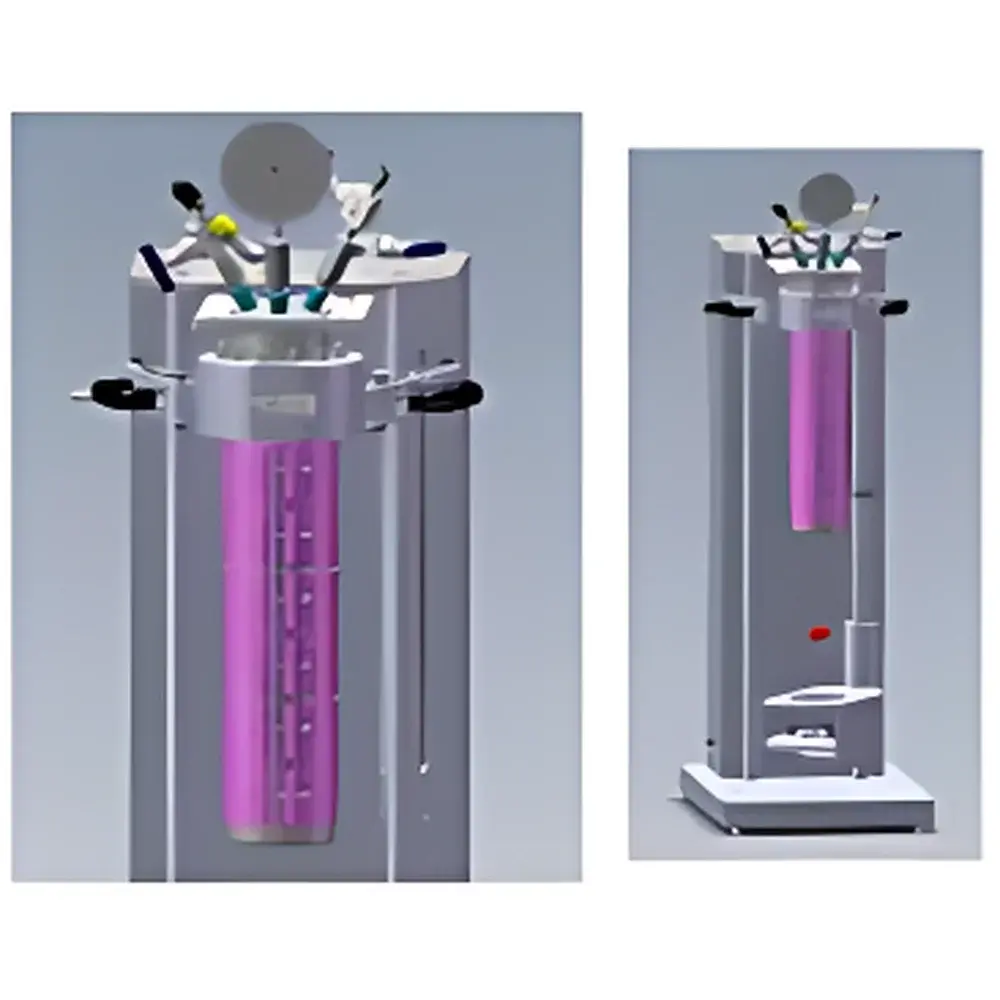
PARR 4871 High-Pressure, Precision-Temperature-Controlled Corrosion Research System
| Brand | PARR |
|---|---|
| Origin | USA |
| Manufacturer Status | Authorized Distributor |
| Origin Category | Imported |
| Model | 4871 High-Pressure, Precision-Temperature-Controlled Corrosion Research System |
| Pricing | Upon Request |
Overview
The PARR 4871 High-Pressure, Precision-Temperature-Controlled Corrosion Research System is an engineered solution for long-duration, accelerated corrosion testing of nuclear-grade structural alloys—particularly zirconium-based cladding materials—under simulated pressurized water reactor (PWR) and supercritical water reactor (SCWR) coolant conditions. Designed around Couette-type static autoclave principles, the system operates without mechanical agitation to eliminate shear-induced artifacts, enabling true thermodynamic equilibrium studies of oxide layer growth, hydrogen pickup, and intergranular degradation kinetics. Its core architecture centers on a 3.7 L non-stirred, thick-walled alloy C-276 reaction vessel rated to 275 bar at 450 °C—conditions approaching the critical point of water (374 °C, 221 bar)—thereby supporting research into subcritical, near-critical, and pseudo-supercritical aqueous corrosion mechanisms.
Key Features
- Triple-zone resistive furnace with independent power regulation via PARR 4871 digital controller, enabling axial thermal uniformity of ±1 °C across a 30 cm active test zone along the reactor centerline
- Integrated multi-point thermocouple array (Type K, mineral-insulated, sheathed) for real-time spatial temperature profiling and closed-loop feedback control
- High-integrity pressure containment: ASME Section VIII Div. 1–certified vessel with dual redundant pressure transducers (0–300 bar full scale, 0.1% FS accuracy) and burst disc safety system
- Dedicated inert gas purge manifold with mass flow-controlled argon/nitrogen inlet and vent valves for oxygen-free startup and headspace conditioning
- Automated data acquisition: Controller logs temperature, pressure, and time-synchronized timestamps at user-defined intervals (1 s to 1 h resolution), with exportable CSV/Excel-compatible output
- Modular design supports custom internal fixtures—including sample holders with electrical isolation, reference electrodes, and in situ pH/ORP probes—for electrochemical corrosion monitoring integration
Sample Compatibility & Compliance
The system accommodates cylindrical or plate-form specimens up to 25 mm in diameter and 50 mm in length, with standardized mounting configurations compatible with ASTM G31 (Laboratory Immersion Corrosion Testing), ASTM G123 (Corrosion Testing in Supercritical Water), and ISO 9223 (Corrosion of Metals and Alloys — Corrosivity of Atmospheres). All wetted surfaces are fabricated from Hastelloy C-276 or Inconel 625 to prevent galvanic coupling and ensure chemical inertness under reducing, oxidizing, and chloride-containing aqueous environments. The entire system meets requirements for GLP-compliant test execution, including audit-ready electronic records, user access control, and FDA 21 CFR Part 11–compatible data integrity features when paired with optional PARR DataLink software.
Software & Data Management
The embedded PARR 4871 controller provides local HMI operation with password-protected parameter configuration, alarm thresholds (e.g., overtemperature, overpressure, sensor fault), and real-time trend visualization. For extended campaigns exceeding 4000 hours, the system supports remote monitoring via Ethernet TCP/IP interface and integration with LabVIEW™, MATLAB®, or custom SCADA platforms using Modbus RTU/TCP protocol. Raw data files include metadata headers specifying operator ID, test ID, calibration dates, and sensor serial numbers—enabling traceability per ISO/IEC 17025 and NQA-1 quality assurance frameworks. Optional PARR DataLink software adds automated report generation, statistical process control (SPC) charts, and deviation alerting based on historical baseline performance.
Applications
- Long-term zirconium alloy (Zr-4, ZIRLO™, M5®) corrosion kinetics in high-purity deaerated water at 350–450 °C and 150–275 bar
- Oxide scale adhesion and spallation behavior under thermal cycling protocols mimicking reactor startup/shutdown transients
- Hydrogen embrittlement susceptibility assessment via post-test thermal desorption spectroscopy (TDS) specimen recovery
- Effect of lithium/boron chemistry and dissolved hydrogen concentration on corrosion rate acceleration or inhibition
- Validation of predictive corrosion models (e.g., cubic parabolic law, defect-mediated diffusion models) under prototypic PWR/SCWR boundary conditions
- Qualification testing of alternative fuel cladding materials (e.g., FeCrAl, SiC composites) for Gen IV reactor systems
FAQ
What is the maximum allowable operating temperature and pressure for continuous operation?
The system is rated for continuous operation at 450 °C and 275 bar, with safety margins validated per ASME BPVC Section VIII Division 1 fatigue and creep analysis.
Can the system accommodate electrochemical measurements during exposure?
Yes—custom feedthroughs support three-electrode potentiostatic setups; reference electrodes (Ag/AgCl, Pt quasi-reference) and Luggin capillaries can be integrated with prior engineering review.
Is validation documentation available for IQ/OQ/PQ protocols?
PARR provides factory-assembled verification reports (including temperature mapping, pressure decay tests, and controller calibration certificates); site-specific OQ/PQ templates are supplied upon request.
How is temperature uniformity verified and maintained over multi-month tests?
Pre-test qualification includes ASTM E220-compliant thermal mapping using NIST-traceable thermocouples; real-time deviation correction is executed via the 4871’s adaptive PID algorithm with zone-specific gain scheduling.
Does the system comply with nuclear regulatory documentation standards?
All controller firmware, calibration records, and mechanical design files conform to 10 CFR 50 Appendix B and NEI 08-09 requirements for safety-related instrumentation used in nuclear materials research.



