
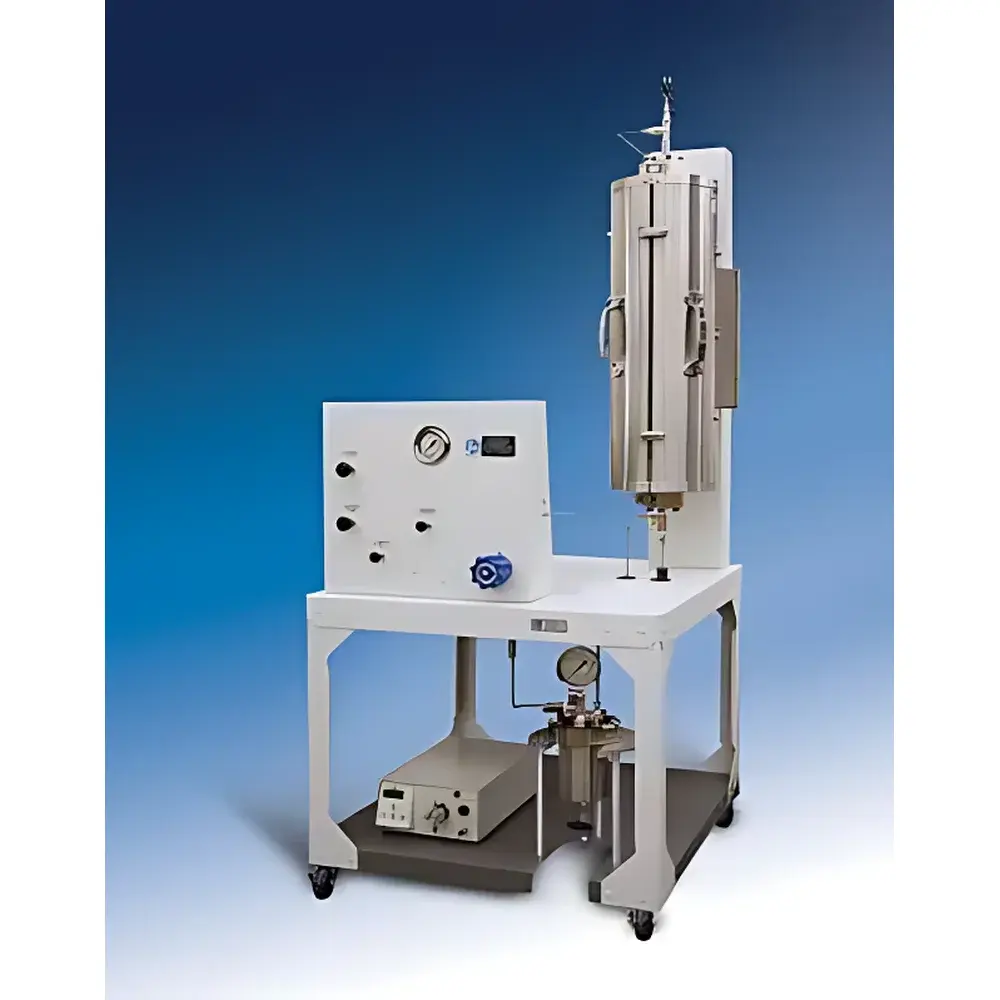
Parr 5400 Tubular Reactor System
| Brand | Parr |
|---|---|
| Origin | USA |
| Model | 5400 |
| Type | Continuous Tubular High-Temperature High-Pressure Reactor System |
| Maximum Temperature | 300–600 °C (customizable) |
| Maximum Pressure | 200–350 bar (customizable) |
| Tube Diameter | 1/2″ to 4″ |
| Tube Length | 12″ to 70″ |
| Construction Materials | Stainless Steel, Alloy 400, Hastelloy C-276, Hastelloy B3, Titanium Grades 2/4/7, Monel 400, Nickel 200 |
Overview
The Parr 5400 Tubular Reactor System is a precision-engineered continuous-flow high-temperature, high-pressure reaction platform designed for rigorous catalytic and kinetic studies under industrially relevant process conditions. Based on fundamental principles of plug-flow reactor (PFR) hydrodynamics, the system enables controlled residence time distribution, minimizes axial dispersion, and supports steady-state operation essential for reaction mechanism elucidation, catalyst deactivation profiling, and scale-up validation. Unlike batch stirred-tank reactors, the 5400 operates with defined volumetric flow rates, consistent thermal gradients, and precise pressure regulation—critical for simulating refinery hydrotreating, petrochemical cracking, pharmaceutical hydrogenation, and advanced oxidation processes. Its modular architecture integrates seamlessly into existing laboratory infrastructure while maintaining full ASME Section VIII Div. 1 compliance for pressure containment.
Key Features
- Modular tubular reactor core with customizable internal diameter (1/2″–4″) and length (12″–70″) to accommodate diverse throughput requirements and residence time targets.
- Independent dual-zone electric heating capability with PID-controlled furnace sections, enabling precise axial temperature profiling—including hot-spot simulation and gradient control across catalyst beds.
- Integrated high-pressure liquid and gas feed systems featuring mass flow controllers (MFCs), back-pressure regulators (BPRs), and heated transfer lines to prevent condensation or phase separation.
- Robust pressure containment rated up to 350 bar at 600 °C, certified per ASME BPVC Section VIII, Div. 1; optional third-party hydrostatic test certification available.
- Multi-material compatibility: reactor tubes and fittings available in ASTM-certified stainless steel (316/304), Alloy 400, Hastelloy C-276/B3, Titanium Gr. 2/4/7, Monel 400, and Nickel 200—ensuring chemical resistance for aggressive media including H₂S, HF, Cl₂, and supercritical CO₂.
- Standardized flange interfaces (ANSI B16.5 Class 300–2500) and Swagelok®/VCR® connections facilitate integration with downstream analyzers (e.g., GC, FTIR, online MS) and product separation units (e.g., high-pressure separators, membrane modules).
Sample Compatibility & Compliance
The Parr 5400 accommodates heterogeneous, homogeneous, and enzymatic catalytic systems—including fixed-bed, trickle-bed, spray-bed, and fluidized configurations—via interchangeable reactor internals and distributor plates. It supports gaseous, liquid, supercritical, and multiphase feed streams under stoichiometric or excess reactant conditions. All wetted components comply with ASTM A269 (tubing), ASTM B423 (nickel alloys), and NACE MR0175/ISO 15156 for sour service applications. The system meets GLP and GMP documentation requirements when configured with audit-trail-capable controllers and calibrated transducers traceable to NIST standards. Pressure relief devices conform to ASME Section I and PED 2014/68/EU directives.
Software & Data Management
The reactor is compatible with Parr’s proprietary Process Control Software (PCS v5.x), supporting real-time monitoring and automated sequencing of temperature ramps, pressure holds, flow rate changes, and multi-step reaction protocols. Data logging occurs at ≥1 Hz resolution with timestamped metadata (operator ID, method file hash, calibration status). Export formats include CSV, HDF5, and XML for integration with LIMS platforms and statistical modeling tools (e.g., MATLAB®, Python pandas). Optional FDA 21 CFR Part 11 compliance package includes electronic signatures, role-based access control, and immutable audit trails for regulated environments.
Applications
- Petroleum refining: Hydrodesulfurization (HDS), hydrodenitrogenation (HDN), and hydrocracking kinetics under simulated distillate feed conditions.
- Chemical synthesis: Catalytic hydrogenation of nitroaromatics, alkenes, and carbonyls; selective partial oxidation of alkanes and alcohols.
- Pharmaceutical development: Continuous-flow API synthesis requiring strict impurity control and reproducible thermal history.
- Environmental engineering: Supercritical water oxidation (SCWO) of persistent organic pollutants and wastewater stream treatment.
- Materials science: Vapor-phase deposition precursors, nanocatalyst synthesis, and metal-organic framework (MOF) crystallization under controlled supersaturation.
- Academic research: Reaction network analysis, intrinsic kinetics measurement, and catalyst stability benchmarking per ISO 10857 and ASTM D7213 protocols.
FAQ
What is the standard pressure and temperature rating for the Parr 5400?
The base configuration is rated for 200 bar at 300 °C; custom designs extend to 350 bar and 600 °C with appropriate material selection and ASME code stamping.
Can the system handle corrosive feedstocks such as HCl or HF?
Yes—reactor tubes and internal components can be fabricated from Hastelloy C-276, Titanium Grade 7, or Monel 400, all validated for use in highly acidic environments per NACE MR0175/ISO 15156.
Is it possible to integrate online analytical instrumentation?
Absolutely—the system features standardized 1/4″ and 3/8″ VCR ports, heated sample loops, and pressure-matched transfer lines compatible with GC, FTIR, Raman, and mass spectrometry interfaces.
Does Parr provide catalyst loading and reactor packing support?
Yes—Parr offers application engineering services including catalyst bed design, distributor plate optimization, and cold-flow visualization studies to ensure uniform flow distribution and minimize channeling.
What documentation accompanies the system for regulatory submissions?
Each unit ships with ASME U-1 data report, material test reports (MTRs), calibration certificates for all transducers, and FAT/SAT protocols aligned with ISO 9001 and ICH Q7 requirements.



