
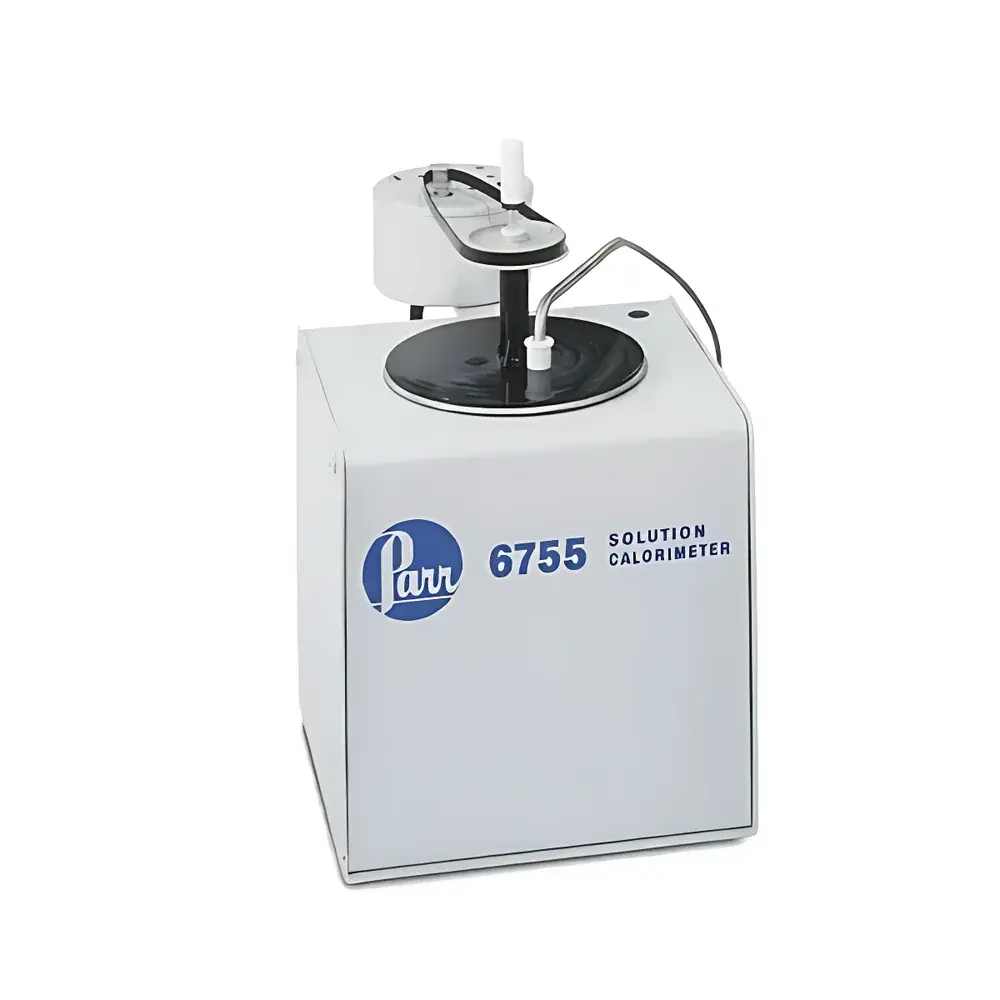
Parr 6755 Isothermal Dissolution Calorimeter
| Brand | Parr Instruments |
|---|---|
| Origin | USA |
| Model | 6755 |
| Measurement Mode | Isothermal Calorimetry |
| Instrument Type | Oxygen-Bomb-Based Dissolution Calorimeter |
| Automation Level | Fully Automated |
| Temperature Range | 10 °C to 50 °C |
| Temperature Resolution | 0.0002 °C |
| Precision | ±0.1 cal |
| Relative Standard Deviation | 0.4% (ΔT = 1.5–5 °C), 1.0% (ΔT < 0.5 °C or >6 °C) |
| Heat Capacity Equivalent | 100–145 cal/°C |
| Sample Volume (Solute) | 20 mL |
| Solvent Volume | 90–120 mL |
| Configuration | Dual-Wall Compensation Jacket with Dewar Inner Vessel |
| Connectivity | RS-232, Ethernet (LAN), Analog Output (Real-Time Plot on LCD), Printer & PC Interface |
Overview
The Parr 6755 Isothermal Dissolution Calorimeter is a precision-engineered, microprocessor-controlled thermal measurement system designed for high-reproducibility quantification of enthalpy changes associated with dissolution, dilution, mixing, reaction, and wetting processes. Operating on the principle of isothermal heat conduction calorimetry, the instrument maintains a constant jacket temperature while precisely measuring minute heat flows between the sample cell and its thermally compensated environment. Unlike adiabatic or dynamic scanning calorimeters, the 6755 employs a dual-wall jacketed Dewar configuration—comprising an outer compensation jacket and an inner reaction vessel—to minimize thermal lag and parasitic heat exchange. This architecture enables direct integration of heat flow signals over time, yielding quantitative ΔH values in cal or J with traceable calibration against certified benzoic acid standards. The system is optimized for laboratory environments requiring compliance with ASTM D240, ISO 19772, and USP guidelines for solution calorimetry in pharmaceutical, chemical, and materials R&D.
Key Features
- Fully automated temperature acquisition and enthalpy calculation with real-time display on a full-color LCD interface
- High-resolution temperature sensing (0.0002 °C) via platinum resistance thermometers (PRTs) calibrated to NIST-traceable references
- Thermal compensation architecture featuring active jacket control and passive Dewar insulation for baseline stability ≤ ±10 µW over 60-minute measurement cycles
- Configurable measurement range from 2 to 1000 cal, supporting both low-energy dissolution events (e.g., salt hydration) and exothermic reactions (e.g., acid–base neutralization)
- Integrated analog output channel enabling real-time signal plotting on external oscilloscopes or data loggers without software dependency
- Multi-modal connectivity including RS-232 serial port, 10/100BASE-T Ethernet (TCP/IP), and parallel printer interface for GLP-compliant audit trail generation
Sample Compatibility & Compliance
The Parr 6755 accommodates aqueous and non-aqueous solvent systems within standard volumetric constraints: 20 mL solute capacity and 90–120 mL total solvent volume. Its sealed, pressure-rated sample tube design permits safe handling of volatile organics, weak acids, and hygroscopic salts under inert atmosphere (N₂ purge optional). The instrument meets mechanical and electrical safety requirements per UL 61010-1 and IEC 61010-1. Data integrity protocols support 21 CFR Part 11 compliance when paired with validated third-party LIMS or ELN platforms—enabling electronic signatures, user access controls, and immutable audit logs. Routine operation aligns with ISO/IEC 17025 accreditation criteria for calorimetric testing laboratories.
Software & Data Management
While the 6755 operates autonomously via its embedded controller, optional Parr CalWin™ software (v5.2+) provides advanced post-processing capabilities: baseline correction using polynomial fitting, peak deconvolution for multi-step dissolution profiles, and export to CSV, XML, or ASTM E1382-compliant report formats. All raw thermogram data—including time-stamped temperature, power, and integrated heat—reside in non-volatile memory with timestamped metadata (operator ID, ambient conditions, calibration history). Ethernet-enabled remote monitoring allows centralized fleet management across multi-instrument labs, with HTTPS-secured API endpoints for integration into enterprise QA/QC workflows.
Applications
- Pharmaceutical solid-state characterization: quantifying enthalpies of solvation for polymorph screening and salt selection
- Chemical process development: determining heats of neutralization, hydrolysis, and complexation in catalytic systems
- Materials science: evaluating hydration thermodynamics of cementitious binders and metal–organic frameworks (MOFs)
- Food science: measuring enthalpic contributions of sugar dissolution and protein unfolding in buffer systems
- Environmental chemistry: assessing energy balances in soil–water partitioning and contaminant leaching studies
FAQ
What calibration standards are recommended for routine verification?
Certified benzoic acid (NIST SRM 39j) is the primary standard; secondary validation may use potassium hydrogen phthalate or sodium chloride solutions with known dissolution enthalpies.
Can the 6755 operate under controlled humidity or inert gas?
Yes—optional N₂ purge fittings and sealed lid adapters enable operation under dry nitrogen or argon atmospheres to prevent oxidation or moisture interference.
Is the instrument suitable for kinetic dissolution studies?
It is optimized for integral (total) enthalpy determination rather than real-time rate profiling; for kinetic analysis, coupling with inline UV-Vis or pH monitoring is recommended.
How frequently must the heat capacity equivalent be re-determined?
Annually or after any hardware modification affecting thermal mass; recalibration is performed using electrical substitution (Joule heating) per ASTM E1269.
Does the system support multi-point temperature ramping?
No—the 6755 is strictly isothermal; for variable-temperature calorimetry, consider the Parr 6770 Series or C80 Microcalorimeter platform.



