
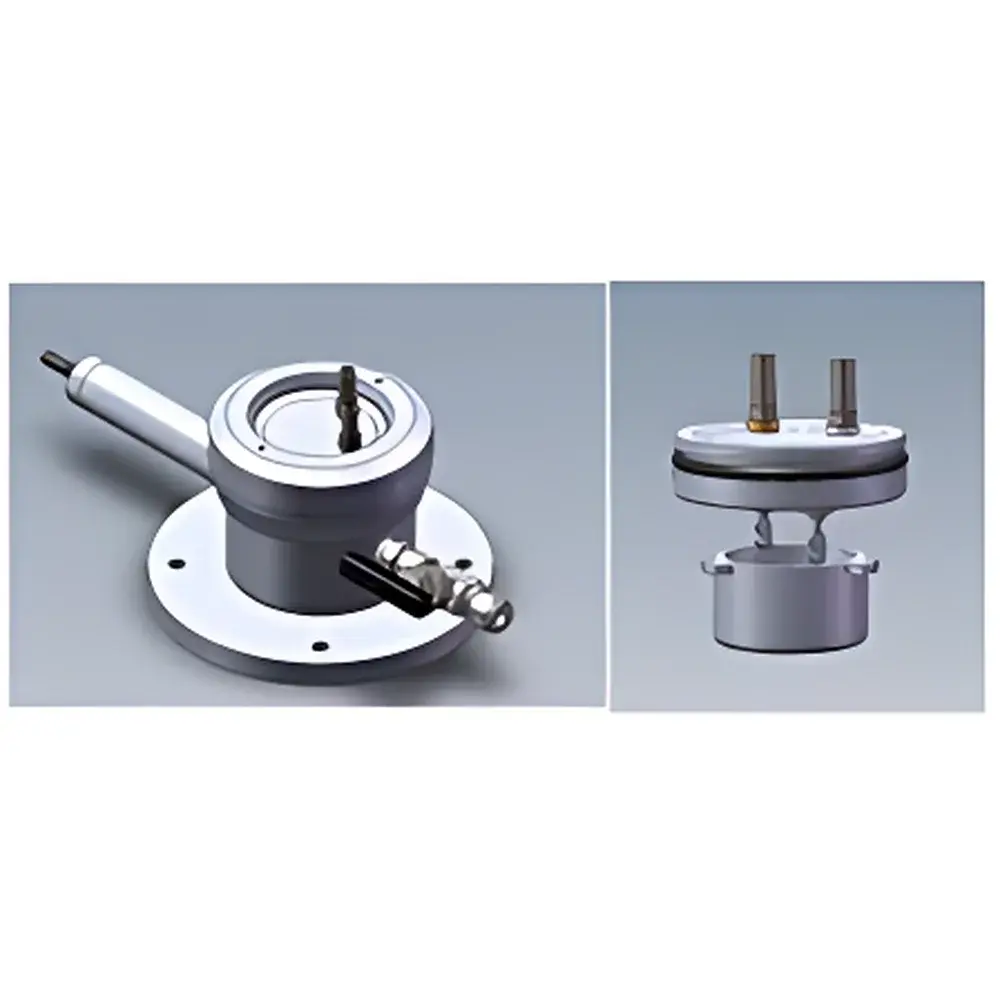
PARR Model 2901 Ignition Propellant Combustion & Ultra-Fast Pressure Release Curve Analyzer
| Brand | PARR |
|---|---|
| Origin | USA |
| Manufacturer Authorization | Authorized Distributor |
| Instrument Type | Imported Laboratory System |
| Model | 2901 Ignition Propellant Combustion & Ultra-Fast Pressure Release Curve Analyzer |
| Pricing | Available Upon Request |
Overview
The PARR Model 2901 Ignition Propellant Combustion & Ultra-Fast Pressure Release Curve Analyzer is a purpose-engineered laboratory system designed for high-fidelity, time-resolved characterization of pressure transients during the rapid combustion of ignition propellants and pyrotechnic initiators. It operates on the principle of confined-volume combustion dynamics, where a precisely weighed sample is ignited under controlled inert or ambient atmospheric conditions inside a sealed, calibrated pressure vessel. The resulting pressure-time profile—captured at microsecond-level temporal resolution—is fundamental to quantifying key combustion parameters including pressurization rate (dP/dt), peak pressure (Pmax), time-to-peak pressure (tPmax), and pressure decay kinetics. This data directly informs burn rate modeling, energy release efficiency, gas generation profiles, and compatibility assessments critical to the design and safety qualification of pyrotechnic initiation systems used in aerospace ordnance, emergency signaling devices (e.g., smoke/flare identifiers), and solid-propellant engine starters.
Key Features
- Stainless steel pressure vessel with 90 mL internal volume and rated working pressure of 500 psig (3.45 MPa), engineered for repeatable containment of energetic combustion events
- Integrated high-speed piezoresistive pressure transducer with 1 kHz sampling frequency (1 ms resolution), traceable to NIST standards
- Dedicated PARR 2901 electrically isolated ignition module providing precise, low-jitter spark initiation synchronized with data acquisition
- USB 2.0 interface for real-time streaming of raw pressure vs. time datasets to host PC; compatible with Windows-based acquisition software supporting trigger delay adjustment and baseline drift compensation
- Removable, chemically resistant sample cup accommodating up to 12 g of fuel-rich compositions—including PbO2/CuO/Si blends, boron-potassium nitrate mixtures, and other low-sensitivity ignition formulations
- Passive thermal management architecture minimizing thermal noise during signal capture; vessel surface temperature monitored via embedded thermocouple (Type K)
Sample Compatibility & Compliance
The system is validated for use with Class 1.1–1.4 pyrotechnic compositions per UN Transport Regulations and complies with ASTM E2554–22 “Standard Practice for Determining Combustion Characteristics of Pyrotechnic Compositions Using Confined Pressure Vessels.” Sample handling protocols align with DoD Handbook MIL-HDBK-338B (Reliability Design Handbook) and NASA SP-8010 “Safety Standard for Pyrotechnic Systems.” All operational procedures support GLP-compliant documentation requirements, including electronic audit trails for ignition timing, sensor calibration history, and raw data file metadata (timestamp, operator ID, environmental conditions). The vessel design conforms to ASME BPVC Section VIII Division 1 for pressure boundary integrity.
Software & Data Management
Acquisition and analysis are performed using PARR’s proprietary Ignition Dynamics Suite v3.2, which supports automated curve fitting to empirical combustion models (e.g., Vieille’s law, Jones-Wilkins-Lee approximations). Software features include batch processing of multiple runs, derivative calculation (dP/dt), statistical comparison across formulation variants, and export of ASCII/CSV files compatible with MATLAB, Python (NumPy/Pandas), and JMP for multivariate regression. Audit logs record all user actions per FDA 21 CFR Part 11 requirements, including electronic signatures for calibration verification and report generation. Raw binary data files are stored with SHA-256 checksums to ensure long-term data integrity.
Applications
- Quantitative evaluation of ignition delay and pressurization kinetics in lead-free and environmentally compliant initiators
- Formulation screening for optimized gas output and pressure rise characteristics in military flare and decoy cartridges
- Thermal stability assessment via comparative pressure-time profiling under varied ambient temperatures (−20 °C to +60 °C)
- Validation of computational fluid dynamics (CFD) and thermochemical equilibrium (NASA CEA) simulations against experimental dP/dt benchmarks
- Supporting hazard classification per GHS and DOT regulations through reproducible combustion severity indexing
- Root-cause analysis of ignition failure modes in fielded pyrotechnic devices
FAQ
What is the maximum sample mass the vessel can safely contain?
The standard configuration supports up to 12 g of low-brisance ignition compositions; mass limits are composition-dependent and must be verified against adiabatic flame temperature predictions prior to testing.
Is the pressure sensor calibrated in-house or by an accredited third party?
All transducers ship with NIST-traceable calibration certificates issued by an A2LA-accredited metrology lab; recalibration is recommended annually or after 500 firings.
Can the system interface with external DAQ hardware or custom LabVIEW environments?
Yes—the USB interface exposes a documented serial protocol; PARR provides API libraries for Python and C++ enabling integration into automated test benches.
Does the system meet requirements for explosive safety certification (e.g., NFPA 495)?
While the analyzer itself is not classified as explosive equipment, its operation falls under NFPA 495 Chapter 9 (Laboratory Testing) when used with authorized personnel and facility-specific SOPs for energetic materials handling.
How is data integrity ensured during high-noise electromagnetic environments typical of ignition events?
The system employs galvanic isolation between ignition circuitry and sensor electronics, shielded coaxial cabling, and digital filtering algorithms to suppress EMI-induced artifacts above 10 kHz.
Related Products



