
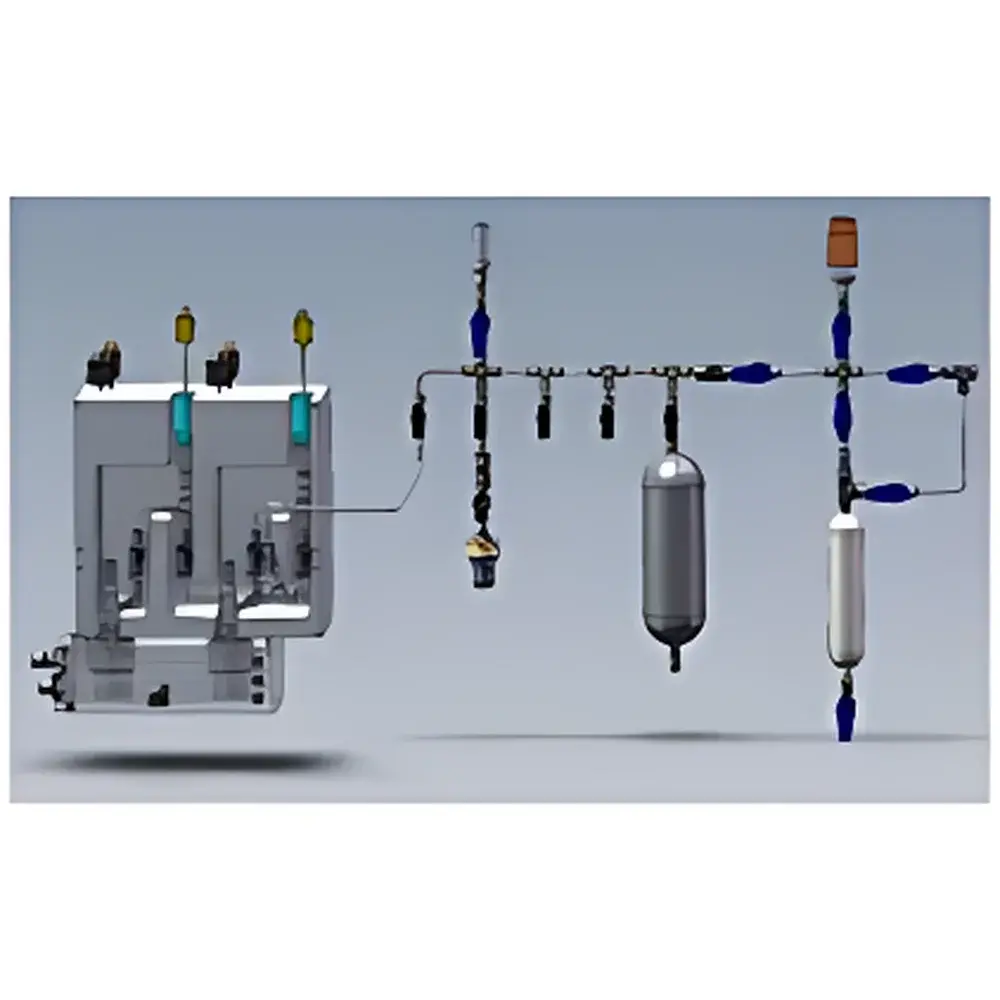
PARR Model VLE-2000 Vapor Pressure Measurement System for Vapor-Liquid Equilibrium Studies
| Brand | PARR |
|---|---|
| Origin | USA |
| Manufacturer Authorization | Authorized Distributor |
| Import Status | Imported |
| Model | VLE-2000 Vapor-Liquid Equilibrium (VLE) Vapor Pressure Measurement System |
| Pricing | Available Upon Request |
Overview
The PARR Model VLE-2000 Vapor Pressure Measurement System is an engineered laboratory instrument designed for the precise determination of saturated vapor pressure (VP) of pure components and multicomponent mixtures under controlled vapor–liquid equilibrium (VLE) conditions. It operates on the fundamental thermodynamic principle that, at equilibrium, the chemical potential of each component in the liquid phase equals that in the vapor phase—enabling direct measurement of partial pressures and total system pressure as a function of temperature. The system employs a static, isothermal, closed-cell methodology compliant with ASTM D2878 and ISO 1171 standards for vapor pressure characterization. Its fully jacketed, thermostatically regulated measurement chamber minimizes axial and radial thermal gradients across the sample cell, pressure transducers, valves, and connecting capillaries—ensuring thermodynamic consistency and measurement repeatability within ±0.1 kPa under stabilized conditions.
Key Features
- Integrated temperature-controlled enclosure housing the entire fluidic path—including sapphire-view measurement cell, high-stability piezoresistive pressure sensors (0–500 kPa full scale), stainless-steel microvalves, and fused-silica capillary manifolds—to eliminate interfacial thermal lag and ensure uniform isothermal operation.
- Programmable PID-controlled heating system with dual-zone thermal regulation (±0.02 °C stability over 25–200 °C range), validated per ASTM E77 calibration protocol.
- Automated vacuum-purge-fill sequence with integrated inert gas (N₂ or Ar) manifold to remove residual air and establish defined initial compositions prior to equilibration.
- Modular design supporting both static (zero-flow) and quasi-dynamic (stepwise temperature ramping with dwell stabilization) measurement modes.
- Corrosion-resistant 316L stainless-steel and Hastelloy C-276 wetted surfaces compatible with organic solvents, acids, bases, and halogenated compounds.
- CE-marked electrical architecture with intrinsically safe pressure interface (ATEX Zone 2 / IECEx certification optional).
Sample Compatibility & Compliance
The VLE-2000 accommodates liquid-phase samples ranging from volatile hydrocarbons (e.g., propane, benzene) to high-boiling polar solvents (e.g., ethylene glycol, DMF) and ionic liquids. It supports binary, ternary, and quaternary mixtures with known or unknown activity coefficient behavior. All operational procedures align with Good Laboratory Practice (GLP) documentation requirements, including audit-trail-enabled parameter logging, user-access controls, and electronic signature support compliant with FDA 21 CFR Part 11 when paired with optional PARR DataVault™ software. System validation protocols satisfy ISO/IEC 17025 traceability criteria for pressure and temperature metrology, with calibration certificates traceable to NIST standards.
Software & Data Management
Control and data acquisition are managed via PARR VLE-Suite™ v4.2, a Windows-based application featuring real-time pressure–temperature synchronization, automatic dew-point detection algorithms, and built-in thermodynamic regression tools (Wilson, NRTL, UNIQUAC). Raw sensor outputs are recorded at 10 Hz resolution with timestamped metadata (operator ID, ambient conditions, calibration status). Export formats include CSV, Excel (.xlsx), and ASTM E1985-compliant XML for third-party process simulation platforms (Aspen Plus®, CHEMCAD®, PRO/II®). Audit logs retain all configuration changes, measurement starts/stops, and manual overrides for regulatory review cycles.
Applications
- Determination of Antoine equation coefficients and Wagner-type vapor pressure correlations for pure-component modeling.
- Experimental validation of phase equilibrium predictions in process design workflows for distillation, extraction, and solvent recovery units.
- Measurement of partial pressures and activity coefficients in non-ideal mixtures to refine excess Gibbs energy models.
- Thermophysical property generation for safety databases (e.g., CCPS, NFPA 325) and regulatory submissions (REACH, TSCA).
- Research into low-volatility organic compound (LVOC) partitioning behavior relevant to atmospheric chemistry and aerosol formation studies.
- Support for formulation development in pharmaceuticals (solvent selection, crystallization pathway analysis) and battery electrolyte screening (vapor pressure–thermal stability trade-offs).
FAQ
What temperature range is supported for vapor pressure measurements?
The system operates continuously from 25 °C to 200 °C, with extended-range options available up to 250 °C upon request.
Can the VLE-2000 measure systems containing reactive or corrosive components?
Yes—wetted materials include 316L SS, Hastelloy C-276, and sapphire; custom fluoropolymer seals and valve configurations are available for HF, Cl₂, or Br₂ service.
Is automated data export compatible with AspenTech or gPROMS?
Yes—CSV and XML exports conform to ASTM E1985 and include all required metadata fields for direct import into major process simulators.
Does the system support GLP-compliant electronic records?
When configured with PARR DataVault™ and enabled audit-trail settings, it meets FDA 21 CFR Part 11 and EU Annex 11 requirements for electronic record integrity.
How is temperature uniformity verified across the measurement cell?
Pre-shipment validation includes multi-point RTD mapping per ISO/IEC 17025; users receive a thermal gradient report showing ≤0.05 °C deviation across the 50 mL active volume.



