
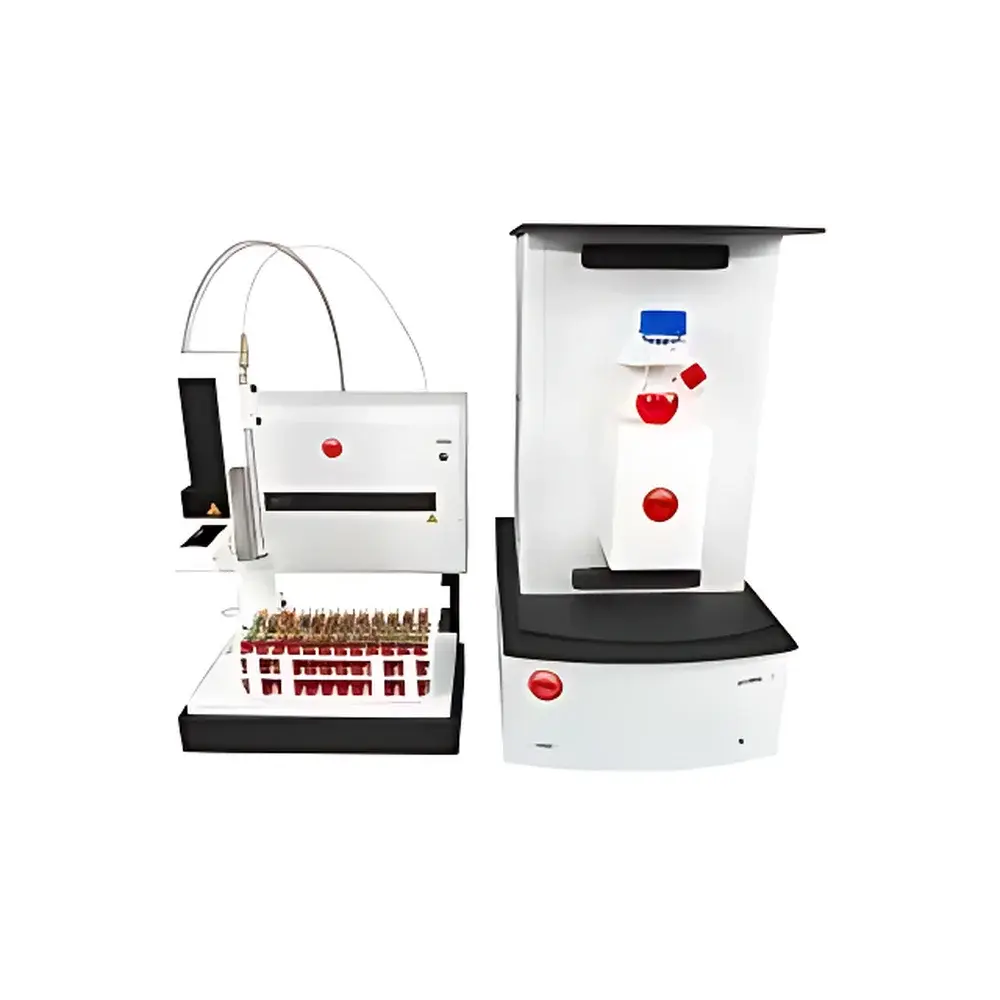
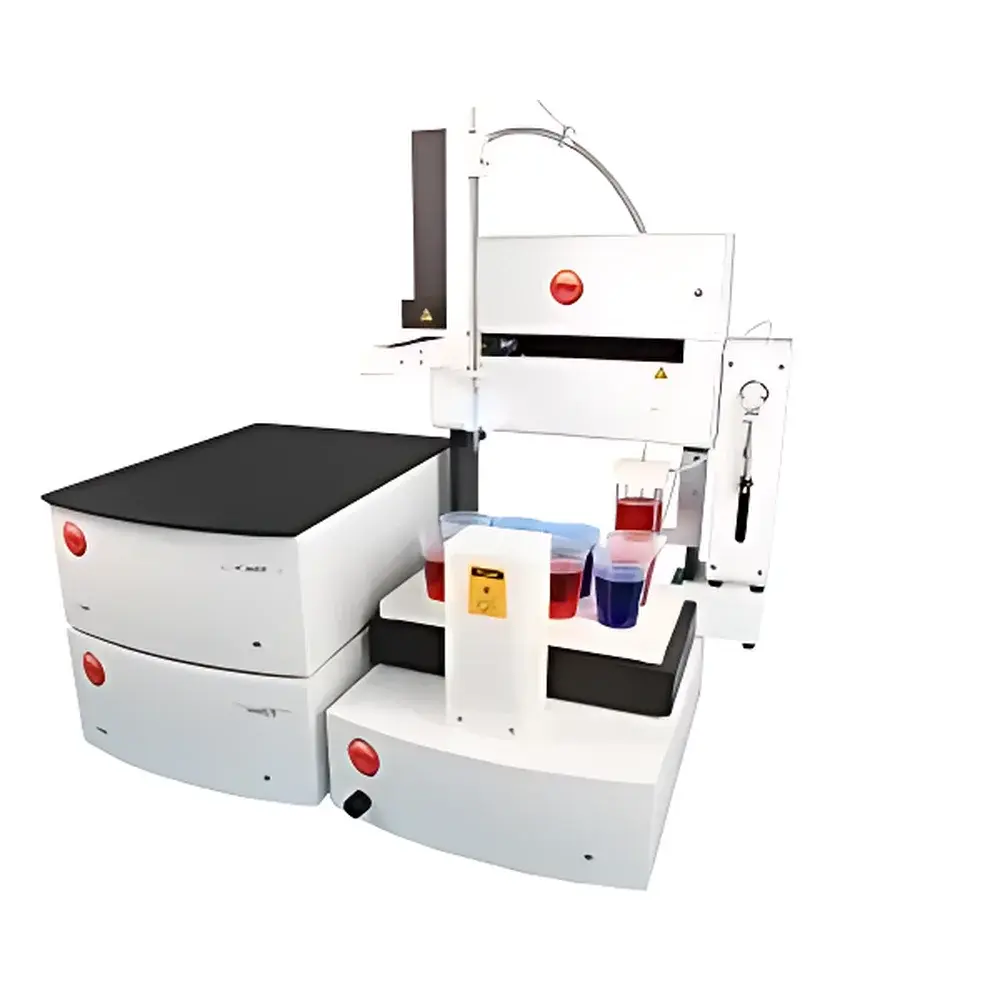
Particle Sizing Systems AccuSizer A7000 AD Optical Particle Counter
| Brand | Particle Sizing Systems (PSS) |
|---|---|
| Origin | USA |
| Model | AccuSizer A7000 AD |
| Measurement Principle | Single Particle Optical Sensing (SPOS) with Dynamic Auto-Dilution |
| Particle Size Range (selectable) | 0.5–400 µm, 1.0–400 µm, or 3.0–1000 µm |
| Detection Method | Combined light extinction and light scattering |
| Solvent Compatibility | Aqueous and most organic solvents |
| Sample Volumes (optional) | 50 mL, 60 mL, 100 mL, 250 mL (with dynamic dilution) |
| Dilution Flow Rate | 30–120 mL/min |
| Stirring Control | Adjustable magnetic stirrer speed |
| Software Options | Windows-based analysis software |
| Power Supply | 100–120 VAC, 60 Hz or 220–240 VAC, 50 Hz |
| Dimensions | Counter Unit: 20 × 45 × 20 cm |
| Auto-Dilution Unit | 25 × 45 × 56 cm |
| Weight | ~28 kg |
| Compliance | Designed for GLP/GMP environments |
Overview
The Particle Sizing Systems AccuSizer A7000 AD is a high-precision optical particle counter engineered for quantitative, statistically robust analysis of heterogeneous particulate dispersions. It employs Single Particle Optical Sensing (SPOS), a first-principles measurement technique in which individual particles traverse a precisely defined laser-sensing zone and generate discrete optical signals proportional to their cross-sectional area (via light extinction) and surface structure (via light scattering). Unlike ensemble-averaging methods such as laser diffraction or dynamic light scattering, SPOS provides true number-weighted particle size distributions—enabling detection and sizing of trace-level oversized particles (e.g., aggregates, undispersed clusters, or process contaminants) within submicron-dominated systems. This capability is critical in applications where low-abundance large particles dictate product safety, stability, or functional performance—such as CMP slurries, injectable biologics, liposomal drug carriers, and semiconductor-grade polishing fluids.
Key Features
- True single-particle counting and sizing via dual-mode optical detection (light extinction + light scattering), delivering high-resolution, number-based distributions without mathematical inversion or assumption-dependent modeling.
- Integrated dynamic auto-dilution system enabling real-time, programmable sample dilution during analysis—eliminating manual pre-dilution errors and preserving particle integrity across wide concentration ranges (10²–10⁶ particles/mL).
- Modular sensor architecture with interchangeable optical sensors (e.g., LE400-05, LE400-1, LE1000-3) optimized for specific size ranges and refractive index contrasts—supporting both aqueous and organic-phase analysis.
- Configurable sample handling: selectable sample volumes (50–250 mL), adjustable magnetic stirring speed, and flow-controlled delivery (30–120 mL/min) ensure representative sampling of non-homogeneous suspensions and emulsions.
- Rugged benchtop design with dual-unit architecture: compact counter module (20 × 45 × 20 cm) and dedicated auto-dilution unit (25 × 45 × 56 cm), totaling ~28 kg—engineered for stable operation in QC laboratories and cleanroom-adjacent environments.
Sample Compatibility & Compliance
The AccuSizer A7000 AD accommodates a broad spectrum of liquid-phase samples, including water-based suspensions (e.g., pharmaceutical colloids, vaccine formulations), polar and non-polar organic solvents (e.g., IPA, acetone, ethyl acetate), and complex multiphase systems (e.g., oil-in-water emulsions, polymer dispersions). Its fluidic path is chemically resistant to common solvents and compatible with USP , ISO 8573-1, and ASTM F312-19 standards for particulate contamination testing. When configured with the 21 CFR Part 11-compliant software package, the system supports full audit trail generation, role-based user access control, electronic signatures, and secure, tamper-evident data storage—meeting regulatory expectations for GMP manufacturing, pharmaceutical development, and medical device quality assurance.
Software & Data Management
Data acquisition and analysis are performed using PSS’s proprietary AccuSizer software suite, running natively on Windows platforms. The software provides real-time visualization of particle events, automated threshold calibration, customizable reporting templates (PDF, CSV, Excel), and statistical tools for batch-to-batch comparison, trend analysis, and outlier identification. For regulated environments, the 21 CFR Part 11 option includes full electronic record management: time-stamped audit logs, operator authentication, instrument configuration history, and encrypted database archiving. All raw event data—including pulse height, width, and duration—are retained for retrospective reprocessing without loss of resolution.
Applications
- Pharmaceutical & Biotech: Quantitative assessment of subvisible particles in parenterals (USP , ), liposomes, viral vectors, mRNA-LNPs, and ophthalmic solutions—where oversized particles correlate with immunogenicity, occlusion risk, or reduced bioavailability.
- Semiconductor Manufacturing: Monitoring CMP slurry cleanliness per SEMI F39 specifications; detecting abrasive agglomerates and metallic contaminants that cause wafer scratching or dielectric failure.
- Advanced Materials: Characterization of nanomaterials, pigment dispersions, conductive inks, and catalyst suspensions—particularly where trace coarse fractions compromise film uniformity or catalytic efficiency.
- Industrial Quality Control: Filtration validation, cleaning verification (ISO 16232), lubricant degradation monitoring, and cosmetic emulsion stability profiling.
FAQ
How does SPOS differ from laser diffraction or DLS in terms of resolution and accuracy?
SPOS measures each particle individually, yielding direct number-based distributions with no assumptions about particle shape or optical properties—unlike laser diffraction (intensity-weighted, model-dependent) or DLS (hydrodynamic diameter only, biased toward small particles).
Can the A7000 AD analyze concentrated slurries without manual dilution?
Yes—the integrated dynamic auto-dilution system continuously adjusts dilution ratio in real time based on real-time particle count rate, enabling direct analysis of slurries up to 10⁶ particles/mL without operator intervention.
Is method validation support available for regulated applications?
PSS provides IQ/OQ documentation templates, sensor calibration certificates traceable to NIST standards, and technical application notes aligned with ICH Q5A, USP , and ASTM E2456—facilitating internal validation and regulatory submission.
What maintenance is required for long-term operational reliability?
Routine maintenance includes quarterly optical alignment verification, annual sensor performance validation using NIST-traceable latex standards, and periodic replacement of fluidic tubing and filters—procedures fully documented in the operator manual and supported by PSS Field Service Engineers.



