
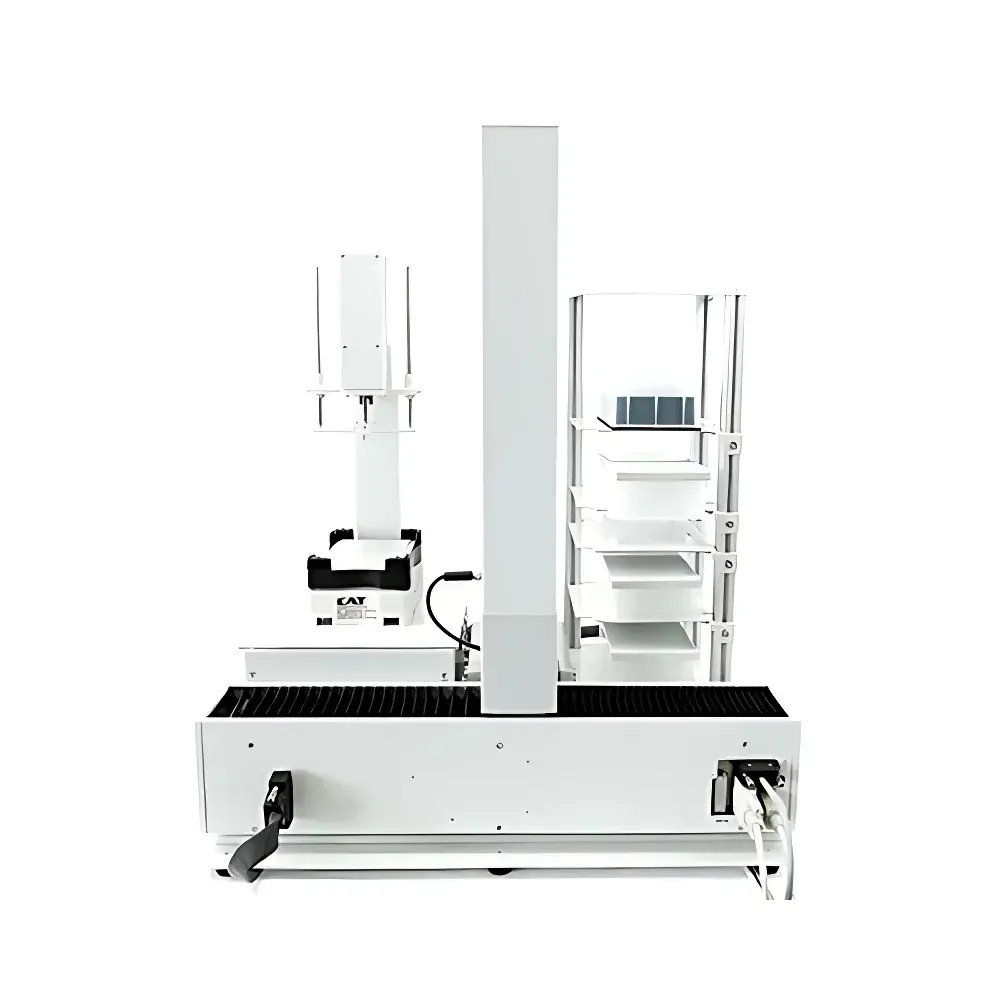
PAS CONCEPT 96 Coated Blade Solid Phase Microextraction System
| Brand | PAS |
|---|---|
| Origin | Germany |
| Model | CONCEPT 96 |
| Configuration | Imported Equipment |
| Distribution Type | Authorized Distributor |
| Pricing | Available Upon Request |
Overview
The PAS CONCEPT 96 Coated Blade Solid Phase Microextraction (CB-SPME) System is an automated, high-throughput sample preparation platform engineered for robust, solvent-free extraction of trace analytes from complex biological, environmental, and food matrices. Unlike conventional fused-silica fiber-based SPME, the CONCEPT 96 implements a planar coated-blade geometry—also referred to as Thin-Film Microextraction (TFME)—where extraction occurs on rigid, disposable or reusable stainless-steel blades coated with chemically bonded stationary phases. This architecture delivers significantly higher surface-area-to-volume ratio while maintaining uniform coating thickness (typically 1–5 µm), enabling rapid equilibration kinetics, improved mass transfer efficiency, and enhanced sensitivity without extended exposure times. The system is designed for integration into regulated laboratory workflows and supports full method development in accordance with ISO/IEC 17025, USP <467>, and FDA guidance on bioanalytical method validation.
Key Features
- 96-position parallel processing capability with independent blade positioning and programmable immersion depth control
- Motorized XYZ robotic arm with ±10 µm positional repeatability for precise blade insertion and retraction
- Integrated thermal desorption module compatible with standard GC and LC-MS autosamplers (e.g., Agilent, Thermo Fisher, Waters)
- On-board blade conditioning station with nitrogen purge, heating (up to 300 °C), and vacuum-assisted activation
- Modular blade holder accommodating up to 96 individually addressable coated blades—each selectable from a library of >20 chemistries including C18, C8, C4, Pan-C18, silica, DEAE, C18-NH₂, C18-Diol, and biocompatible hydrophilic-lipophilic balanced (HLB) variants
- Software-controlled agitation (orbital shaking, vortexing, or magnetic stirring) during extraction to enhance mass transfer in viscous or particulate-laden samples
- Compliance-ready audit trail logging per 21 CFR Part 11 requirements, including user authentication, electronic signatures, and immutable method/version history
Sample Compatibility & Compliance
The CONCEPT 96 demonstrates broad compatibility across low-volume liquid matrices—including cell culture supernatants (≥50 µL), plasma, serum, urine, cerebrospinal fluid, and filtered environmental water extracts. Its biocompatible blade coatings (e.g., PEG-modified C18 or zwitterionic HILIC variants) minimize non-specific protein adsorption and hemolysis during whole blood processing, enabling selective enrichment of small-molecule metabolites (<1.5 kDa) while excluding albumin, immunoglobulins, and cellular debris. Each blade undergoes rigorous lot-release testing per ISO 8573-1 (particle contamination) and ISO 10993-5 (cytotoxicity screening). System validation documentation supports GLP and GMP environments, with traceability to NIST-traceable reference standards for recovery, precision, and carryover assessments.
Software & Data Management
The CONCEPT Control Suite v4.x provides intuitive graphical workflow configuration, real-time monitoring of extraction parameters (time, temperature, agitation speed, desorption ramp), and export of structured metadata compliant with ASTM E1921-22 (Laboratory Information Management Systems Interoperability). All methods are stored as encrypted XML files with embedded calibration curves, QC checkpoints, and instrument performance logs. Raw data output includes timestamped extraction/desorption profiles, blade usage counters, and automated flagging of out-of-spec events (e.g., incomplete desorption, thermal drift >±2 °C). Integration with third-party LIMS via HL7 or RESTful API enables seamless alignment with enterprise-wide quality management systems.
Applications
- Pharmaceutical R&D: High-throughput ADME screening of drug candidates in hepatocyte incubations and microsomal stability assays
- Clinical Metabolomics: Targeted quantification of endogenous steroids, neurotransmitters, and xenobiotics in pediatric plasma samples (≤100 µL)
- Food Safety: Simultaneous detection of mycotoxins (aflatoxin B1, ochratoxin A) and pesticide residues in infant formula digests
- Environmental Monitoring: Passive air sampling followed by CB-SPME extraction of semi-volatile organic compounds (SVOCs) from PUF-PVDF composite filters
- Forensic Toxicology: Direct analysis of fentanyl analogs and novel psychoactive substances (NPS) in postmortem vitreous humor without protein precipitation
- Proteomics Sample Prep: Depletion of high-abundance proteins prior to bottom-up LC-MS/MS via selective binding on immobilized metal affinity (IMAC) blades
FAQ
What is the maximum recommended sample volume per well for optimal extraction efficiency?
For aqueous matrices, 100–500 µL is optimal; for viscous or protein-rich samples (e.g., whole blood), ≤200 µL ensures complete blade submersion and reproducible phase equilibrium.
Can coated blades be reused, and if so, how many cycles are validated?
Yes—biocompatible blades (e.g., C18-Diol, HILIC) are validated for ≥50 extraction-desorption cycles when conditioned between runs using the integrated thermal/vacuum station.
Is the system compatible with tandem mass spectrometry platforms?
Yes—desorbed analytes are delivered directly to standard GC-MS/MS or LC-MS/MS interfaces via splitless injection or direct loop transfer, with no derivatization required.
Does the CONCEPT 96 support unattended overnight operation?
Yes—the system includes hardware interlocks, ambient temperature monitoring, and automatic shutdown upon completion or anomaly detection, certified for Class II biosafety cabinet integration.
How does TFME compare to traditional SPME fibers in terms of carryover and ruggedness?
Coated blades exhibit <0.05% carryover (measured via blank injections after high-concentration standards) and withstand repeated mechanical handling, centrifugation, and sonication—unlike fragile fused-silica fibers prone to breakage or coating delamination.



