
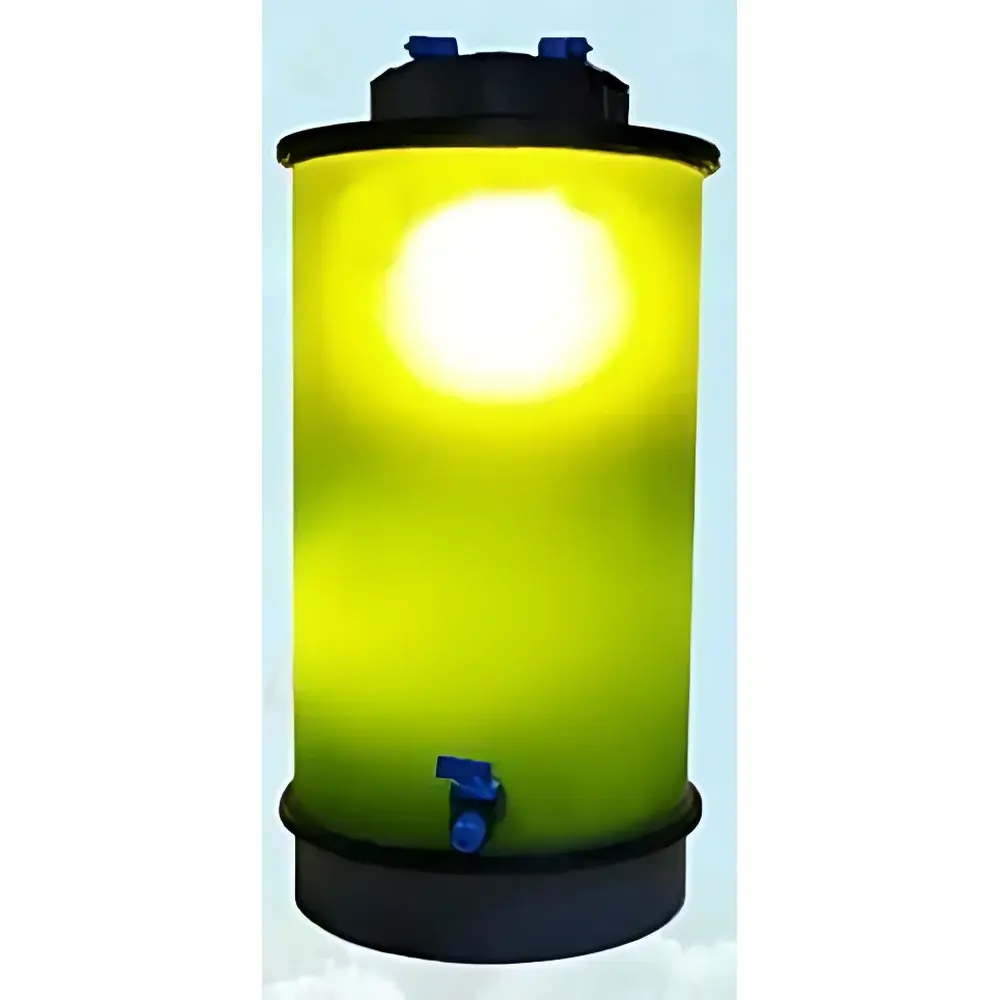
PB200 Laboratory Algal Cultivation System
| Origin | Germany |
|---|---|
| Manufacturer Type | Authorized Distributor |
| Origin Category | Imported |
| Model | PB-200 |
| Pricing | Available Upon Request |
| Cultivation Volume | 12 L |
| Internal Diameter | 200 mm |
| Height | 520 mm |
| Controller Dimensions | 220 × 80 × 70 mm |
| Controller Input Voltage | 85–250 VAC |
| Controller Power Consumption | 5 W |
Overview
The PB200 Laboratory Algal Cultivation System is a purpose-engineered, benchtop photobioreactor designed for controlled, reproducible cultivation of freshwater and marine microalgae—including Chlorella, Scenedesmus, Nannochloropsis, and Dunaliella—under standardized laboratory conditions. Built to ISO 9001-certified manufacturing standards in Germany, the system operates on the principle of continuous or semi-continuous turbidostatic culture, enabling precise regulation of light intensity, gas exchange, mixing dynamics, and nutrient replenishment. Its cylindrical 12 L transparent cultivation vessel facilitates uniform photon distribution via integrated LED illumination and ensures optical clarity for real-time biomass monitoring via spectrophotometric or fluorometric methods. The PB200 is not a generic incubator; it is a closed-loop cultivation platform engineered for physiological consistency across replicate cultures—critical for metabolic studies, lipid profiling, photosynthetic efficiency assays, and pre-scale-up bioprocess development.
Key Features
- Robust borosilicate glass cultivation vessel (ID 200 mm × H 520 mm) with chemically resistant PTFE-sealed threaded lid for rapid, contamination-minimized access.
- Programmable LED lighting unit delivering adjustable spectral output (400–700 nm PAR range) with intensity control up to 500 µmol photons·m⁻²·s⁻¹—calibrated per ASTM E308-22 for photosynthetic photon flux density (PPFD) accuracy.
- Integrated magnetic stirrer providing gentle yet homogeneous suspension (0–300 rpm), preventing cell sedimentation without shear-induced damage—validated for Phaeodactylum tricornutum and Chlamydomonas reinhardtii.
- Dual-gas sparging capability (air + CO₂) via precision mass flow controller-compatible inlet ports; supports pH-stat or CO₂-stat operation when paired with optional external sensors.
- Dedicated PB200 Cultivation Controller (220 × 80 × 70 mm) with industrial-grade AC input (85–250 VAC), low-power design (5 W standby), and relay-driven timed actuation of lighting, nutrient dosing pumps, and gas valves.
- Modular architecture compliant with GLP documentation requirements: all operational parameters (light-on/off cycles, feeding intervals, stir speed) are timestamped and exportable as CSV for audit trails per FDA 21 CFR Part 11 Annex 11 guidelines.
Sample Compatibility & Compliance
The PB200 accommodates unicellular, colonial, and filamentous algae species across diverse taxonomic groups. Its non-leaching glass vessel and food-grade silicone gaskets meet USP Class VI and EU 10/2011 compliance for extractables testing. Culture volumes are optimized for OD750 measurements within linear absorbance ranges (0.1–0.8) using standard spectrophotometers. The system supports adherence to ISO 14442:2021 (microalgal biomass quantification), ASTM D7566 Annex B (biofuel feedstock cultivation), and OECD TG 201 (freshwater algal growth inhibition testing) when operated with validated protocols. Sterilization is performed via autoclaving (121°C, 20 min) or 70% ethanol immersion—no component requires replacement post-sterilization.
Software & Data Management
While the base PB200 operates via hardware-timed logic, its controller features a TTL-level serial interface (RS-232) for integration with third-party SCADA systems or custom Python/LabVIEW acquisition scripts. Time-stamped event logs—including light cycle initiation, 30% medium exchange triggers, and stirrer activation—are stored onboard for ≥30 days and retrievable via USB-C. Optional firmware upgrade enables Modbus RTU communication for centralized lab-wide monitoring under ISO/IEC 17025-accredited quality management systems. All configuration changes require password authentication, satisfying ALCOA+ data integrity principles (Attributable, Legible, Contemporaneous, Original, Accurate).
Applications
- Physiological characterization of algal strains under controlled photo-bioreactor conditions (e.g., light-saturation curves, nitrogen starvation responses).
- Production of high-value metabolites—including astaxanthin, omega-3 fatty acids, and phycobiliproteins—for nutraceutical and cosmetic applications.
- Wastewater remediation research: kinetic modeling of phosphate/nitrate uptake under varying hydraulic retention times.
- Carbon capture efficiency studies using 13C-bicarbonate tracing and GC-MS analysis of fixed carbon products.
- Training platform for bioprocess engineering curricula, emphasizing scale-down principles from pilot photobioreactors (100 L+) to laboratory analogues.
FAQ
Is the PB200 suitable for axenic culture maintenance?
Yes—when used with laminar flow hood inoculation, sterile filtration of media (0.22 µm), and routine viability checks via plating or qPCR, the PB200 maintains axenic status for >14 days across common model strains.
Can the lighting spectrum be customized beyond white LEDs?
The standard unit uses full-spectrum white LEDs; however, OEM spectral modules (blue/red ratio tuning, UV-A supplementation) are available under separate part numbers upon technical consultation.
What maintenance intervals are recommended for long-term reliability?
Magnetic stir bar calibration every 6 months; LED output verification annually using NIST-traceable PAR meter; O-ring replacement every 24 months or after 50 autoclave cycles.
Does the system support automated pH or dissolved oxygen feedback control?
Not natively—but analog voltage inputs (0–10 V) are provided on the controller’s expansion port to accept signals from external pH/DO transmitters, enabling user-configured cascade logic via external PLC.
Is validation documentation (IQ/OQ) included with shipment?
Factory-issued IQ/OQ protocols compliant with ISO 13485 and GMP Annex 15 are supplied electronically; on-site PQ execution requires user-defined acceptance criteria aligned with internal SOPs.



