
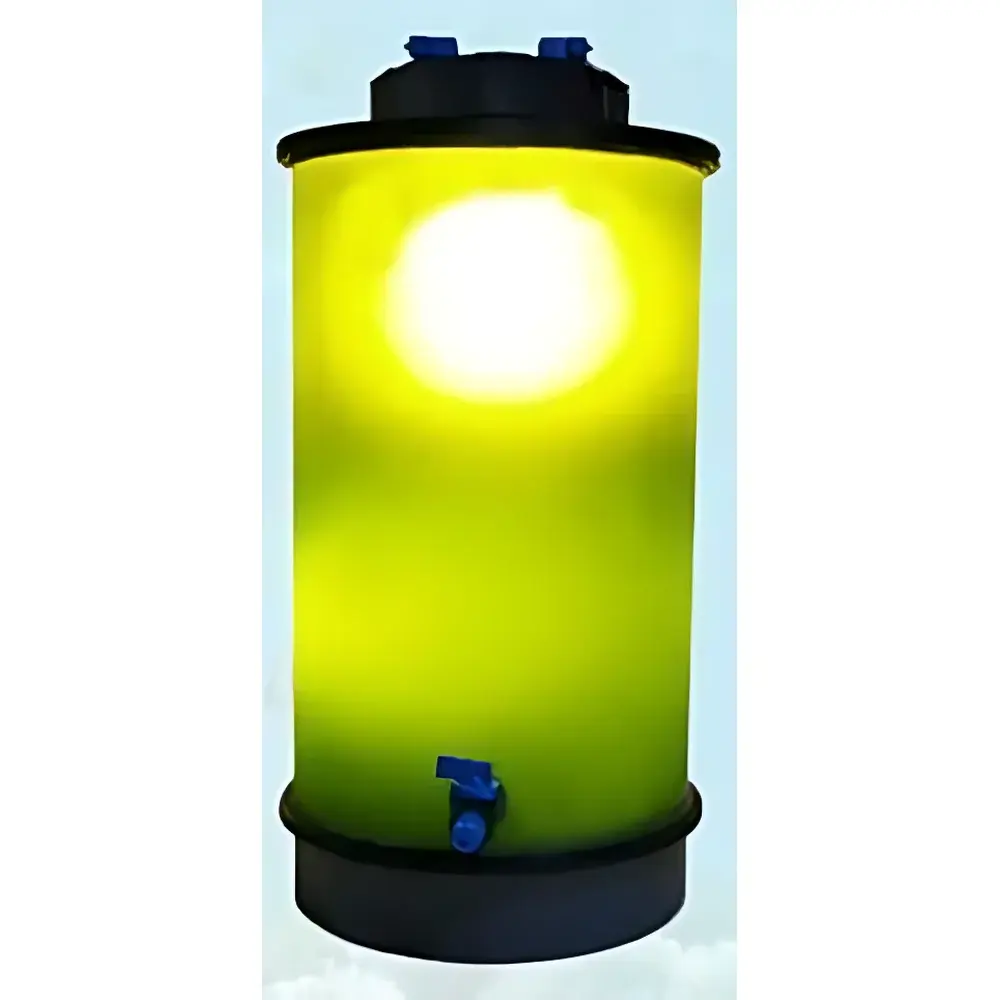
PB250 Algal Cultivation System
| Origin | Germany |
|---|---|
| Manufacturer Type | Authorized Distributor |
| Origin Category | Imported |
| Model | PB_250 |
| Pricing | Available Upon Request |
| Volume | 12 L |
| Internal Diameter | 200 mm |
| Height | 520 mm |
| Controller Dimensions | 220 mm × 80 mm × 70 mm |
| Input Voltage/Power | 85–250 VAC / 5 W |
Overview
The PB250 Algal Cultivation System is a purpose-engineered, benchtop photobioreactor designed for controlled, reproducible cultivation of freshwater and marine microalgae—including Chlorella, Scenedesmus, Nannochloropsis, and diatom species—under standardized laboratory conditions. Based on a cylindrical, vertically oriented stirred-tank configuration, the system operates on the principle of continuous or semi-continuous culture with regulated light exposure, gas exchange, and nutrient replenishment. Its modular architecture integrates illumination, aeration, magnetic stirring, and programmable control into a single cohesive platform, enabling precise modulation of key physiological drivers: photon flux density (PFD), dissolved oxygen (DO), pH stability via CO2 sparging, and volumetric turnover rate. Designed and manufactured in Germany, the PB250 complies with CE marking requirements and adheres to IEC 61000-6-3 (EMC emission) and IEC 61000-6-2 (immunity) standards, ensuring electromagnetic compatibility in shared lab environments.
Key Features
- Optically transparent, borosilicate glass cultivation vessel (12 L working volume; 200 mm internal diameter; 520 mm height) with high UV transmission (>90% at 350–750 nm) for uniform spectral delivery.
- Integrated LED lighting unit with adjustable intensity (0–200 µmol photons·m−2·s−1) and customizable photoperiod programming (on/off cycles down to 1-minute resolution).
- Top-mounted threaded lid with sealed ports for gas inlet (CO2/air mixture), exhaust, and sterile sampling—enabling rapid access without compromising sterility.
- Submersible magnetic stirrer with speed regulation (0–300 rpm) to maintain homogeneous cell suspension and prevent sedimentation while minimizing shear stress on delicate flagellates.
- Dual-mode operation: batch, semi-continuous (with daily 30% medium replacement), or chemostat-like steady-state mode when paired with optional peristaltic pumps.
- Compact, low-power controller (220 × 80 × 70 mm; 5 W max draw) featuring isolated relay outputs for lighting, pump activation, and alarm signaling; supports wall-mount or benchtop deployment.
Sample Compatibility & Compliance
The PB250 accommodates a broad spectrum of photoautotrophic microorganisms, including unicellular green algae, cyanobacteria (Synechocystis, Arthrospira), and eukaryotic phytoplankton requiring defined light spectra and gaseous carbon sources. Its all-glass wetted path eliminates leaching concerns associated with polymer reactors, supporting compliance with OECD Test Guideline 201 (Freshwater Alga and Cyanobacteria, Growth Inhibition Test) and ISO 8692:2012 (Water quality — Fresh water algal growth inhibition test with Scenedesmus subspicatus and Desmodesmus subspicatus). The system’s design facilitates GLP-aligned documentation: all controller events—including light activation, pump triggers, and error flags—are timestamped and retain non-volatile memory for audit-ready traceability.
Software & Data Management
While the PB250 operates as a standalone hardware platform, its controller includes TTL-level digital I/O interfaces compatible with third-party data acquisition systems (e.g., LabVIEW, Python-based DAQ frameworks). Users may log operational parameters—including cumulative illumination hours, pump runtime, and cycle counts—via external USB or RS-485 modules. Firmware supports user-defined scheduling profiles stored across up to eight independent programs, each configurable with multi-step timing logic. For regulatory environments, integration with LIMS or ELN platforms is achievable through Modbus RTU protocol adapters, satisfying basic FDA 21 CFR Part 11 requirements for electronic record integrity when paired with appropriate access controls and audit trail configuration.
Applications
- Physiological studies of photosynthetic efficiency, nutrient limitation responses (N/P/Si), and photoinhibition thresholds.
- Pre-cultivation of inocula for large-scale photobioreactors or outdoor raceway ponds.
- Toxicity screening of nanomaterials, pesticides, or wastewater effluents using standardized algal bioassays.
- Production of high-value metabolites (e.g., astaxanthin, EPA/DHA precursors, phycobiliproteins) under controlled stress induction protocols.
- Education and training in phycology, bioprocess engineering, and environmental toxicology curricula.
FAQ
Is the PB250 suitable for axenic cultures?
Yes—the sealed top assembly, combined with autoclavable glass components and sterile filtration of inlet gases, supports maintenance of contamination-free cultures when standard aseptic techniques are applied.
Can the lighting spectrum be customized?
The base unit uses full-spectrum white LEDs (400–700 nm); narrowband LED modules (e.g., 450 nm blue, 660 nm red) are available as factory-installed options upon request.
What maintenance intervals are recommended?
Routine inspection of O-rings, stir bar magnetism, and LED output degradation is advised every 6 months; annual calibration of timer accuracy and relay contact resistance is recommended for GxP-aligned use.
Does the system support pH or DO feedback control?
No—these parameters require external sensors and proportional-integral-derivative (PID) controllers; the PB250 provides only open-loop actuation of lighting and fluid handling functions.
Is technical documentation available in English?
Yes—complete operating manual, electrical schematics, CE declaration of conformity, and material safety data sheets (MSDS) for all consumables are supplied digitally in English prior to shipment.



