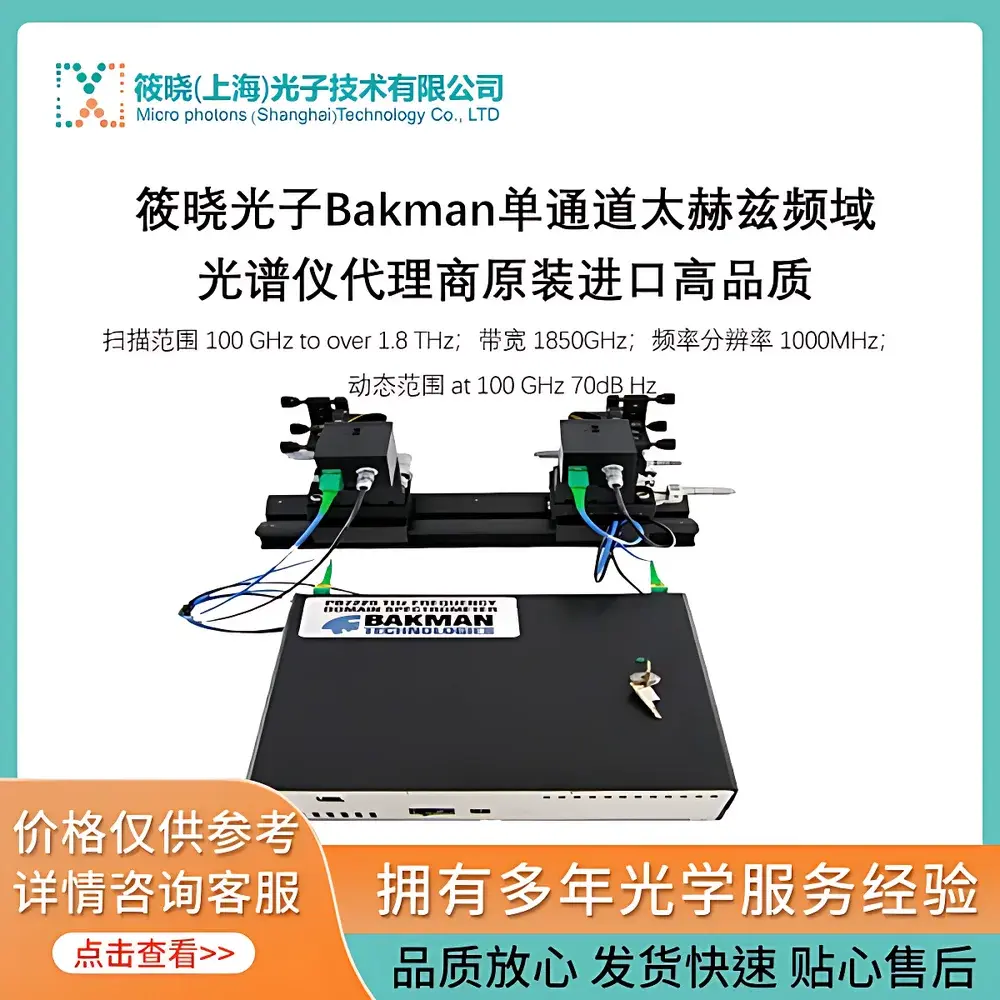
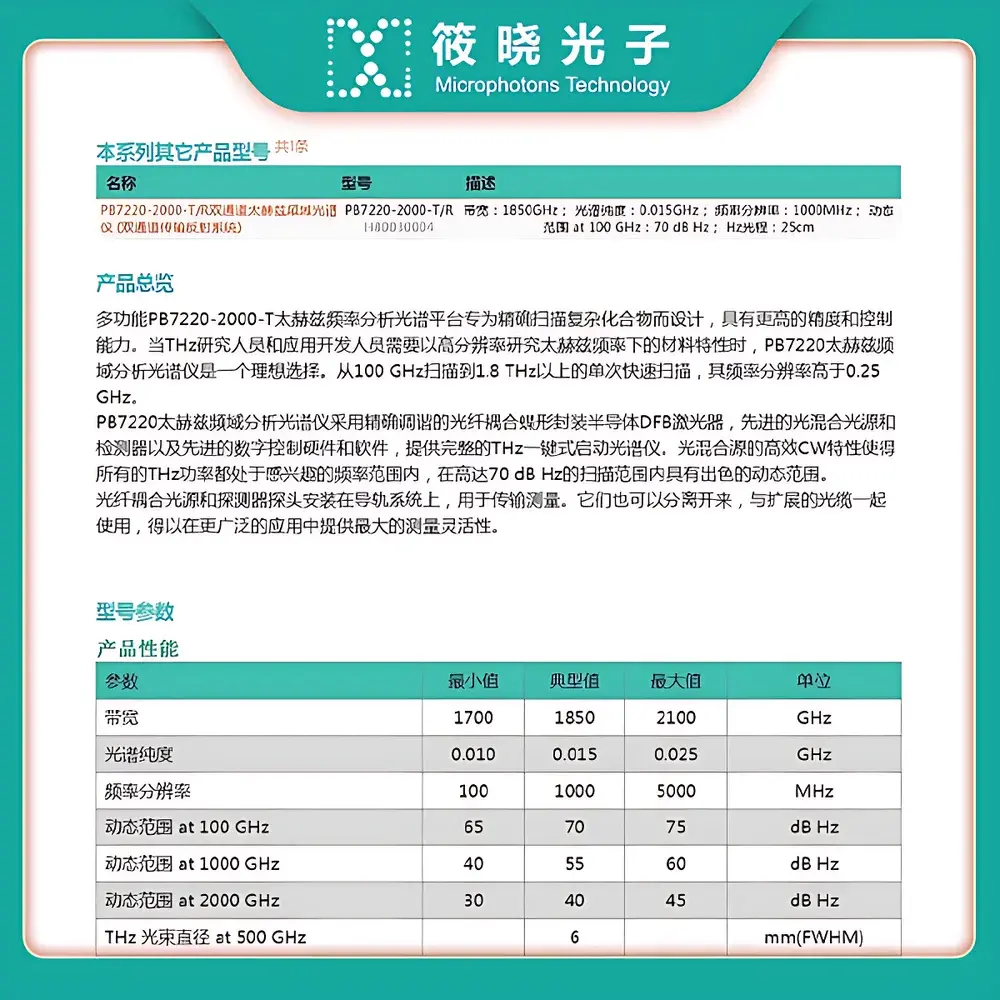
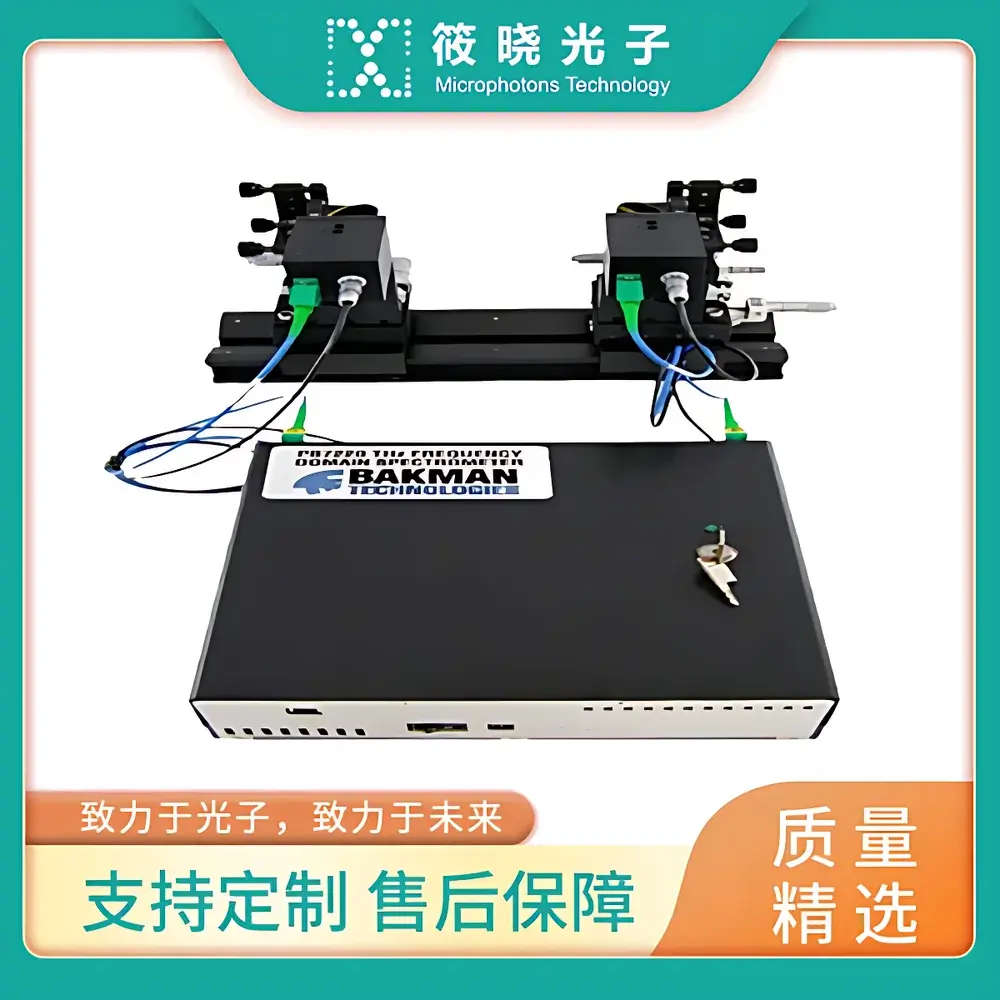
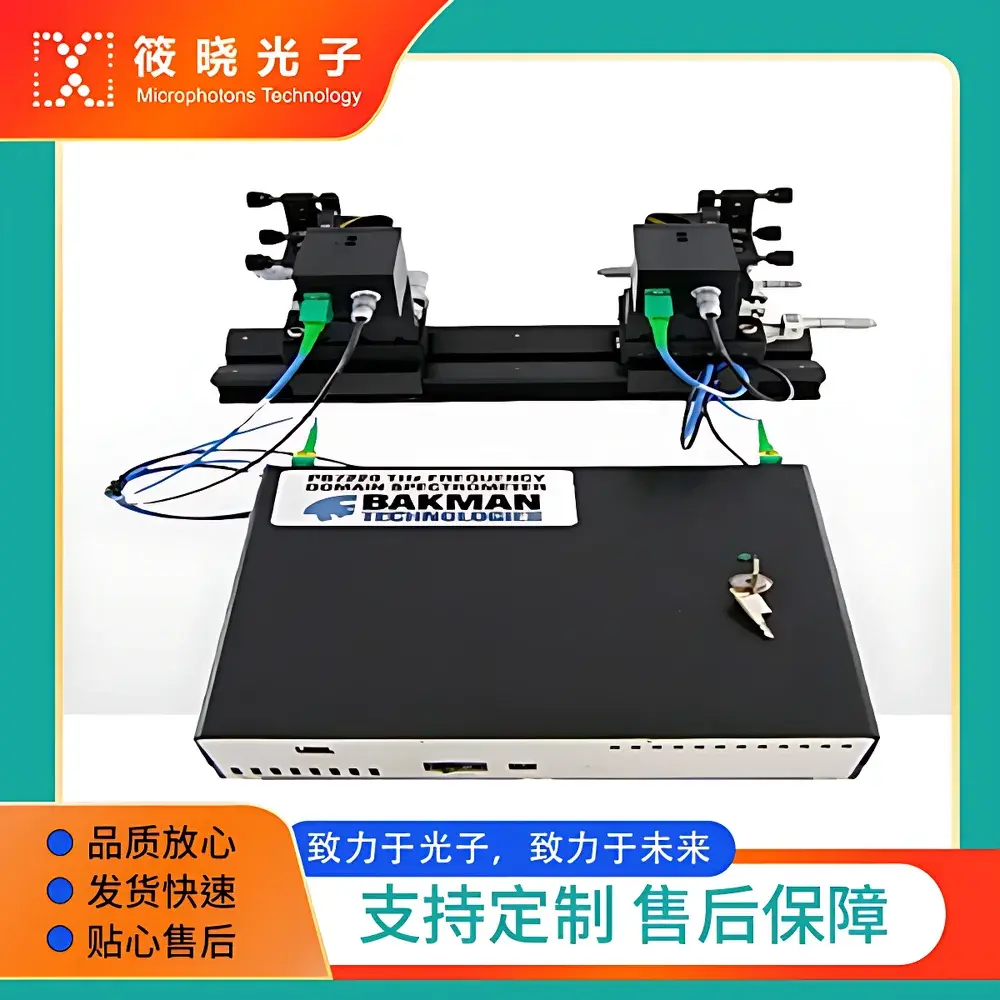
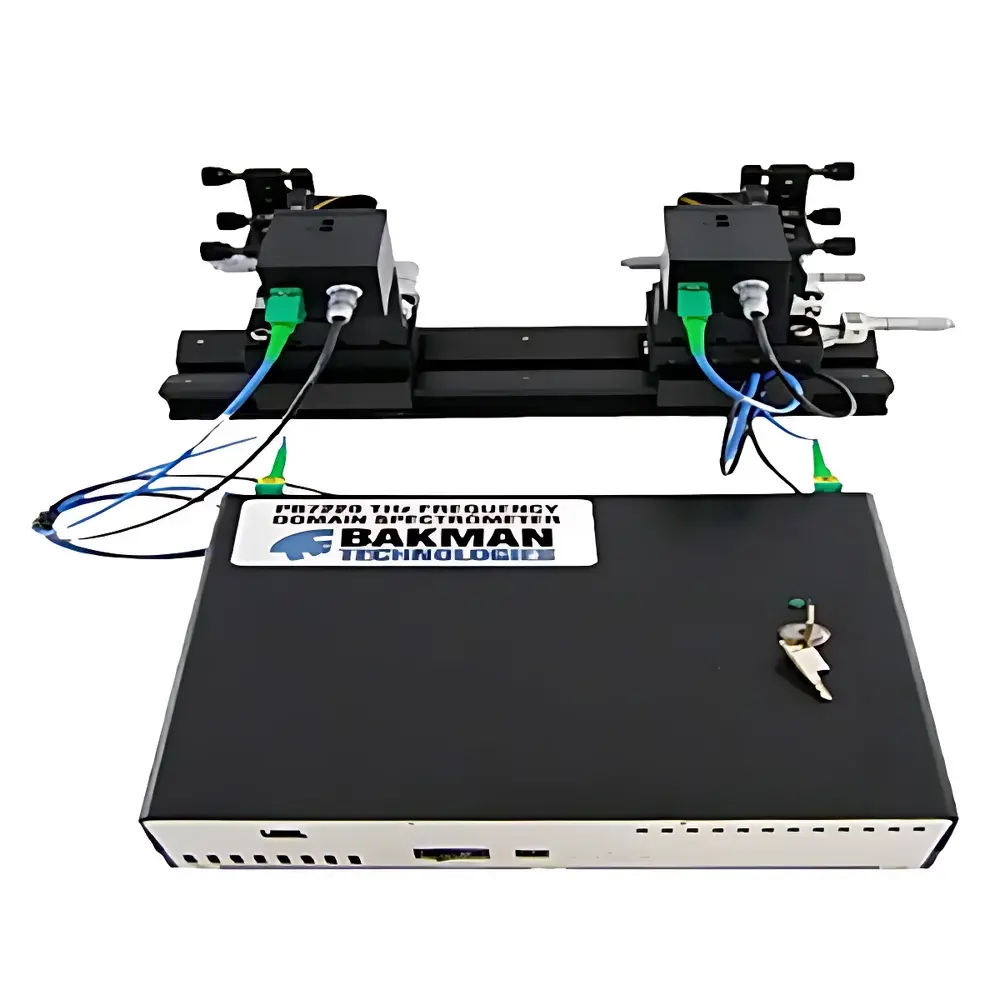
PB7220-2000-T Single-Channel Terahertz Frequency-Domain Spectrometer
| Brand | Bakman |
|---|---|
| Origin | USA |
| Model | PB7220-2000-T |
| Center Frequency | 1850 GHz |
| Frequency Resolution | 1000 MHz |
| Component Type | Optical Component |
| Distribution Status | Authorized Distributor |
Overview
The PB7220-2000-T is a single-channel, frequency-domain terahertz (THz) spectrometer engineered for high-precision spectroscopic characterization in the sub-millimeter wave regime. Operating at a center frequency of 1850 GHz (λ ≈ 162 µm), it leverages heterodyne detection with a stabilized continuous-wave (CW) THz source and coherent mixing to deliver narrowband spectral interrogation. Unlike time-domain systems that rely on ultrafast laser pulses and Fourier transformation, this frequency-domain architecture provides direct, high signal-to-noise ratio (SNR) measurement of absorption and dispersion features with intrinsic frequency accuracy traceable to microwave synthesizer standards. Its design targets applications requiring quantitative line-shape analysis, gas-phase molecular rotational spectroscopy, and non-destructive evaluation of low-loss dielectric materials where narrow linewidth resolution—here specified at 1000 MHz (1 GHz)—is critical for resolving closely spaced rotational transitions.
Key Features
- Single-channel heterodyne architecture optimized for stability and phase coherence in CW THz measurements
- Center operating frequency fixed at 1850 GHz, enabling targeted investigation of rotational transitions in light molecules (e.g., H2O, O2, NH3, CH3OH)
- Frequency resolution of 1000 MHz (1 GHz), sufficient to resolve individual hyperfine components in atmospheric and laboratory gas spectra
- Integrated temperature-stabilized local oscillator and balanced detector for enhanced common-mode noise rejection
- Compact optical layout compatible with standard THz quasi-optical beam paths and vacuum-compatible sample chambers
- Designed for integration into larger metrology or process monitoring platforms via analog voltage output and TTL synchronization I/O
Sample Compatibility & Compliance
The PB7220-2000-T supports transmission-mode measurements of gaseous, solid, and thin-film samples housed in ambient, purged, or vacuum environments. Gas cells with path lengths from 10 cm to 10 m are routinely employed; solid samples—including polymers, pharmaceutical cocrystals, and semiconductor wafers—must exhibit minimal THz absorption (< 50 dB/cm) within the 1800–1900 GHz band. The instrument complies with IEC 61000-6-3 (EMC emission limits) and IEC 61000-6-2 (immunity requirements) for laboratory equipment. While not certified for medical or industrial safety-critical use, its optical output power remains below Class 1 limits per IEC 60825-1:2014 when operated within manufacturer-specified bias conditions. Data acquisition protocols may be configured to support GLP-compliant audit trails when paired with validated third-party software.
Software & Data Management
The spectrometer interfaces via USB 2.0 and RS-232 to host PCs running Windows or Linux-based control suites. Native drivers provide real-time access to raw IF voltage output, LO tuning voltage, and detector bias status. Optional SDKs support integration with LabVIEW, MATLAB, and Python (via PySerial and NumPy) for custom spectral scanning routines, lock-in demodulation, and automated calibration sequences. All acquired spectra are timestamped and stored in HDF5 format, preserving metadata including ambient temperature, pressure, and source modulation parameters. When used in regulated environments, optional software modules enable 21 CFR Part 11–compliant electronic signatures, user role management, and immutable data archiving—subject to site-specific validation.
Applications
- High-resolution rotational spectroscopy of polar gases for atmospheric modeling and isotopic ratio analysis
- Identification and quantification of trace volatiles in sealed packaging (e.g., residual solvents in lyophilized biologics)
- Characterization of phonon modes and carrier dynamics in 2D materials (e.g., graphene, h-BN) under cryogenic conditions
- Calibration reference for broadband THz-TDS systems via known absorption line positions
- Development of THz photonic integrated circuits requiring precise resonance mapping at 1.85 THz
- In-line monitoring of polymer crystallinity during extrusion processes using embedded waveguide coupling
FAQ
Is the PB7220-2000-T suitable for time-resolved measurements?
No. This is a frequency-domain system optimized for steady-state spectral acquisition; it does not support picosecond temporal resolution.
Can the center frequency be tuned across a range?
No. The PB7220-2000-T operates at a fixed center frequency of 1850 GHz; tunability is achieved via external synthesizer modulation within ±500 MHz of the nominal frequency.
What vacuum level is required for optimal gas-phase measurements?
A base pressure ≤1 × 10⁻³ mbar is recommended to minimize pressure-broadening effects and achieve the specified 1000 MHz resolution.
Does Bakman provide NIST-traceable calibration certificates?
Yes—upon request and subject to additional lead time, factory calibration against primary THz frequency standards is available with full uncertainty budgets.
Is the instrument compatible with cryogenic sample stages?
Yes. The optical interface is designed for integration with standard CF-63 or CF-100 flanges; thermal contraction compensation is required for operation below 77 K.