
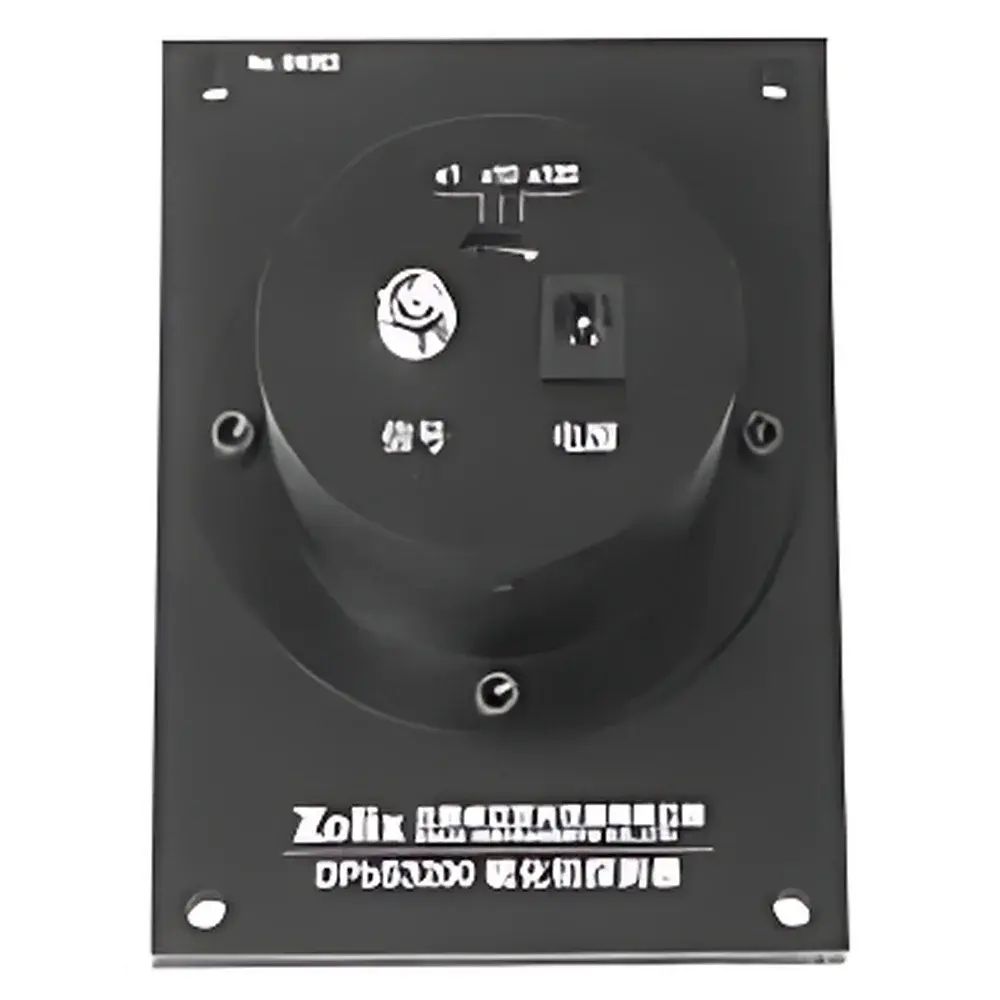
PbS Detector DPbS3200 by ZOLIX
| Brand | ZOLIX |
|---|---|
| Model | DPbS3200 |
| Detector Type | Photoconductive PbS |
| Operating Temperature | Room Temperature |
| Spectral Range | 0.8–3.2 µm |
| Peak Wavelength | ≥2.1 µm |
| Responsivity | ≥300 V/W |
| Dark Resistance | 0.1–0.3 MΩ |
| Specific Detectivity (D*) | ≥1×10⁸ cm·Hz¹ᐟ²/W |
| Time Constant | ≤400 µs |
| Gain Settings | ×1, ×10, ×100 |
| Input Offset Voltage | <±1 µV |
| Input Drift | ±1 µV |
| Recommended Lock-in Frequency | 400 Hz |
| Output Mode | Positive-polarity voltage output |
| Active Area | 6×6 mm |
Overview
The ZOLIX DPbS3200 is a room-temperature-operated photoconductive lead sulfide (PbS) infrared detector engineered for high-sensitivity spectral measurements in the near-infrared (NIR) region. Unlike cryogenically cooled detectors, the DPbS3200 operates without liquid nitrogen or thermoelectric cooling, significantly reducing system complexity and operational cost while maintaining robust performance across 0.8–3.2 µm. Its photoconductive mechanism relies on photon-induced carrier generation in the PbS thin-film layer, resulting in measurable resistance modulation proportional to incident irradiance. This principle enables stable, low-noise detection ideal for Fourier-transform infrared (FTIR) spectrometers, monochromator-based scanning systems, and custom NIR optical setups where ambient-temperature operation is essential. The detector’s peak responsivity at ≥2.1 µm aligns closely with key molecular absorption bands of hydrocarbons, polymers, and biological chromophores—making it particularly suitable for qualitative and semi-quantitative analysis in research and industrial QA/QC environments.
Key Features
- Room-temperature operation eliminates need for cryogenic cooling or Peltier modules
- 6×6 mm active area optimized for beam coupling in monochromators and FTIR interferometers
- High specific detectivity (D* ≥ 1×10⁸ cm·Hz¹ᐟ²/W) ensures reliable signal capture under low-light conditions
- Triple-gain front-end amplifier (×1, ×10, ×100) enables dynamic range adaptation without external hardware reconfiguration
- Low input offset voltage (<±1 µV) and minimal drift (±1 µV) support stable DC-coupled or lock-in measurements
- Optimized frequency response (100–1000 Hz, recommended at 400 Hz) for compatibility with industry-standard lock-in amplifiers including the Stanford Research Systems SR830 and Zurich Instruments DCS500PA
- Positive-polarity voltage output simplifies analog signal conditioning and ADC interfacing
Sample Compatibility & Compliance
The DPbS3200 is designed for integration into open-beam or fiber-coupled spectroscopic platforms where broadband NIR detection is required. It accommodates free-space illumination with collimated or focused beams up to 6 mm diameter and maintains linearity over irradiance levels typical of tungsten-halogen sources, NIR LEDs, and supercontinuum lasers. While not intrinsically certified for regulatory compliance, its electrical and thermal behavior conforms to general laboratory instrument safety standards (IEC 61010-1). When deployed in GxP-regulated environments (e.g., pharmaceutical QC labs), users may validate the detector’s performance per ASTM E1421 (Standard Practice for Describing and Measuring Performance of Fourier Transform Mid-Infrared (FT-MIR) Spectrometers) or ISO 17025 traceable protocols. Its analog output architecture supports integration into systems compliant with FDA 21 CFR Part 11 when paired with validated data acquisition software featuring audit trail and electronic signature capabilities.
Software & Data Management
The DPbS3200 functions as a transducer-level component and does not include embedded firmware or onboard digitization. Signal acquisition is performed externally via compatible lock-in amplifiers or DAQ systems. ZOLIX provides comprehensive technical documentation—including spectral responsivity curves, calibration coefficients, and mechanical mounting drawings—to facilitate system-level integration. Users implementing automated spectral acquisition can interface the detector’s analog output with LabVIEW, MATLAB, or Python-based control frameworks using standard BNC or SMA connections. For GLP/GMP applications, raw voltage outputs should be logged with timestamped metadata, gain setting identification, and environmental monitoring (e.g., ambient temperature stability within ±2 °C during measurement) to ensure data integrity and traceability.
Applications
- Near-infrared spectroscopy (NIRS) for pharmaceutical tablet composition analysis
- Quality control of polymer films and coatings via absorption band ratio quantification
- Gas-phase detection of CO, CH₄, and NH₃ using tunable diode laser absorption spectroscopy (TDLAS)
- Material characterization of quantum dots and perovskite thin films in photovoltaic R&D
- Teaching laboratories for fundamental studies of semiconductor photoconductivity and spectral response modeling
- Custom optical sensing systems requiring compact, uncooled NIR detection with moderate bandwidth requirements
FAQ
Is the DPbS3200 compatible with USB-based data acquisition systems?
Yes—when used with an external lock-in amplifier or low-noise voltage preamplifier, the analog output can be digitized using any USB DAQ device supporting ±10 V input range and ≥16-bit resolution.
Does ZOLIX provide NIST-traceable calibration certificates?
Calibration data (responsivity vs. wavelength) is supplied with each unit; however, NIST-traceable certification requires third-party lab validation per ISO/IEC 17025.
Can the detector be used in vacuum or controlled-atmosphere chambers?
The housing is hermetically sealed with AR-coated window; operation in dry nitrogen or vacuum environments is permissible provided thermal gradients remain below 0.5 °C/min to avoid microcracking.
What is the maximum permissible optical power density?
Continuous exposure above 10 mW/mm² at peak wavelength may induce nonlinearity or accelerated aging; pulsed operation requires duty-cycle derating per manufacturer’s application note AN-DPbS-01.
Is there a recommended warm-up time before stable measurements?
A minimum 15-minute thermal stabilization period is advised after power-on to minimize baseline drift during precision NIR radiometry.




