
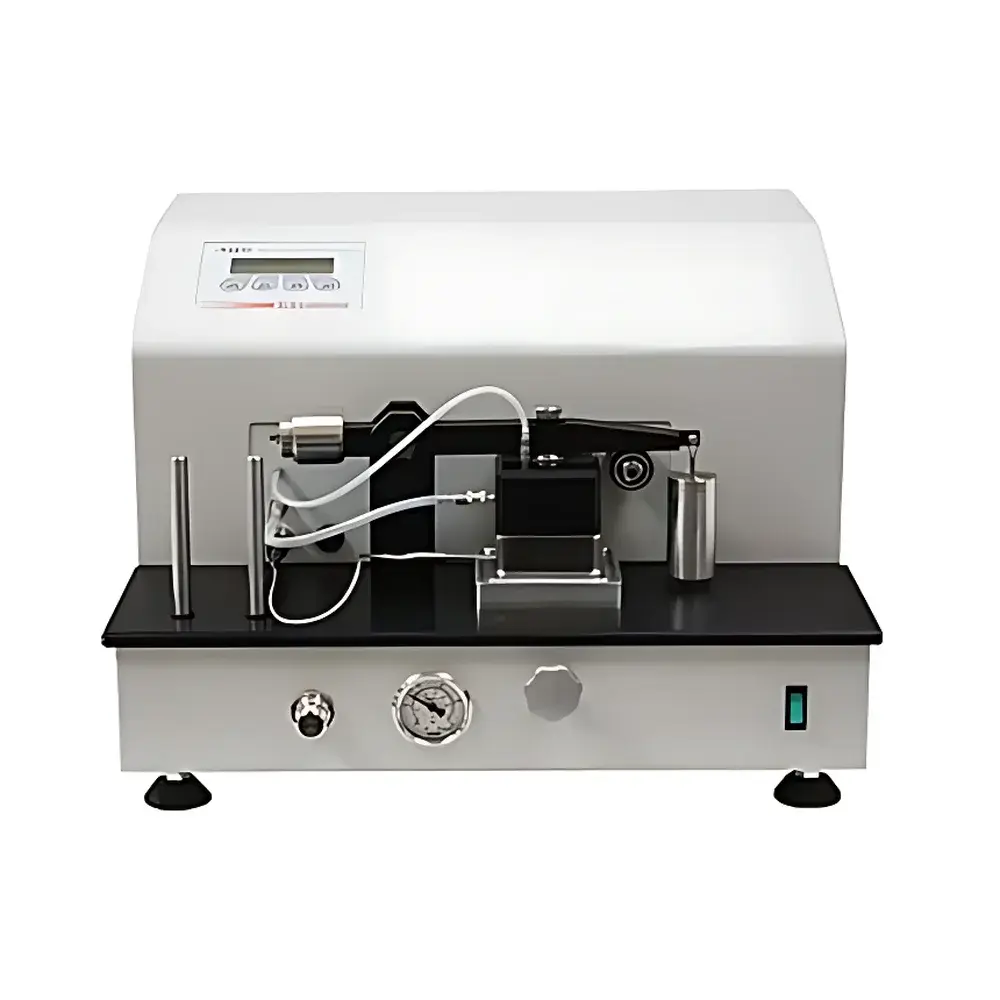
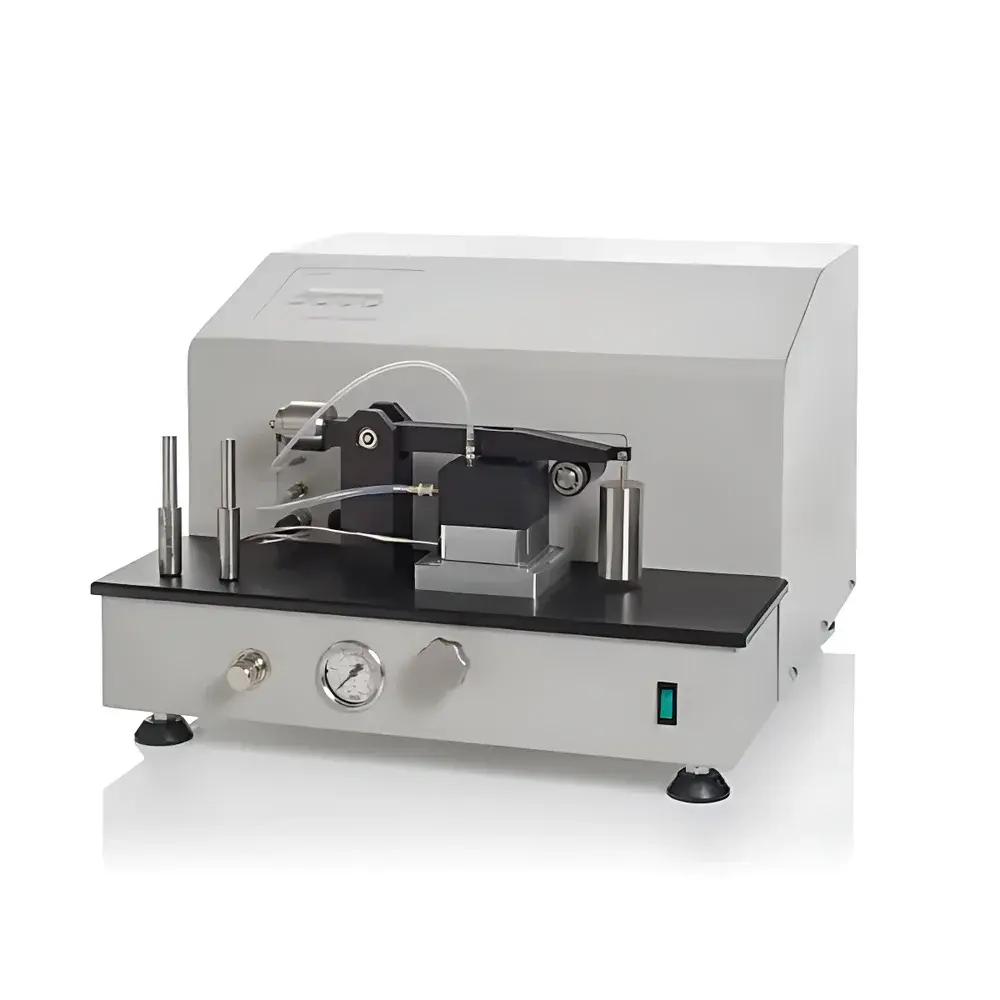
PCS ABS Ball-on-Cylinder Lubricity Tester for Aviation Turbine Fuels
| Brand | PCS Instruments |
|---|---|
| Origin | United Kingdom |
| Model | ABS |
| Power Supply | 100–230 V AC, 750 VA |
| Operating Temperature | 15–35 °C |
| Operating Humidity | 20–80 % RH (non-condensing) |
| Weight | 34 kg |
| Dimensions | Not specified |
| Compressed Air Requirement | ASTM D5001-compliant (≤0.1 ppm hydrocarbons), dry and oil-free |
| Deionized Water Reservoir Capacity | ~1000 tests per fill |
| Control | Microprocessor-based, fully automated |
| Environmental Compliance | Designed for ISO/IEC 17025-aligned laboratories |
| Software Interface | PC-based control and data logging with audit-trail capability |
Overview
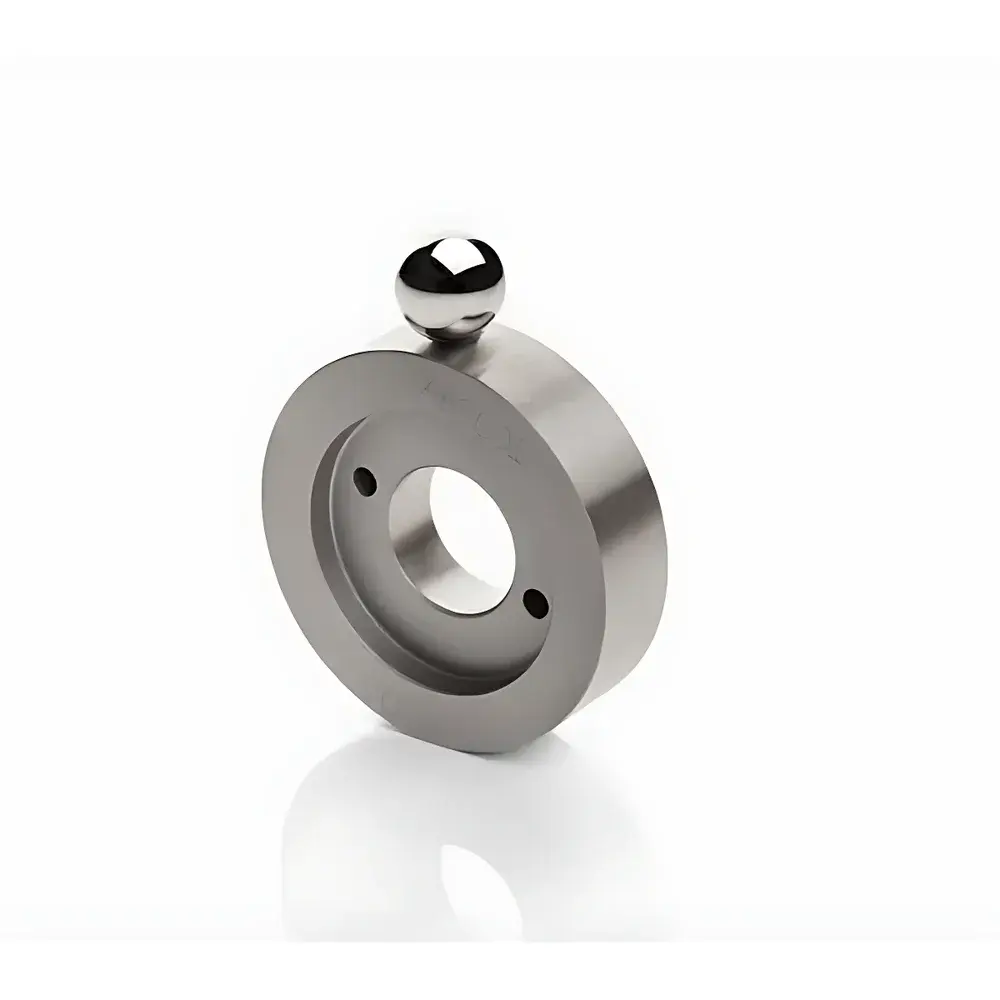
The PCS ABS Ball-on-Cylinder Lubricity Tester is a precision-engineered, benchtop instrument designed specifically to evaluate the lubricating properties of aviation turbine fuels (Jet A, Jet A-1, JP-5, JP-8) in strict accordance with ASTM D5001 – Standard Test Method for Measurement of Lubricity of Aviation Turbine Fuels by the Ball-on-Cylinder Lubricity Evaluator (BOCLE). This method quantifies fuel-induced wear under controlled sliding contact between a hardened steel ball and a rotating cylindrical specimen immersed in the test fuel. The resulting wear scar diameter (WSD), measured in micrometers (µm), serves as the primary metric for assessing fuel lubricity performance—critical for preventing premature wear in high-pressure fuel injection systems of modern gas turbine engines. Unlike empirical or viscosity-based proxies, the ABS delivers direct tribological evidence of fuel film-forming capability under simulated operational shear and thermal conditions. Its solid-state thermoelectric heating/cooling system ensures stable temperature regulation across the full ASTM-specified range (e.g., 135 °C ± 0.5 °C for standard testing), eliminating reliance on external chillers or ovens and enhancing reproducibility.
Key Features
- Fully automated BOCLE test execution: All parameters—including load (392 N), rotational speed (150 rpm), test duration (75 min), temperature setpoint, and air flow profiles—are pre-programmed and executed without manual intervention.
- Integrated deionized water reservoir: Requires refilling only after approximately 1000 consecutive tests, minimizing maintenance downtime and ensuring consistent humidity control during wet-air conditioning cycles.
- Self-calibrating environmental sensing: Replaceable, factory-precalibrated RH and temperature sensor modules eliminate field recalibration; traceable to NIST-traceable standards with documented uncertainty budgets.
- Dual-mode operation: Supports both standalone microprocessor control with intuitive LCD interface and PC-based operation via USB-connected software with real-time graphing, parameter scripting, and export to CSV/PDF.
- ASTM D5001-compliant air management: Built-in mass-flow-controlled dry/wet air mixing with optional external air dryer/purifier integration (to achieve ≤0.1 ppm hydrocarbon contamination per specification).
- Robust mechanical architecture: Precision-ground stainless-steel test chamber, hardened alloy test specimens, and vibration-damped base ensure long-term dimensional stability and measurement repeatability (RSD < 2.5 % across inter-laboratory studies).
Sample Compatibility & Compliance
The ABS accommodates standard 50 mL fuel samples in ASTM D5001-compliant glass vials and supports routine analysis of undiluted aviation turbine fuels, synthetic hydrocarbon blends (e.g., Fischer–Tropsch jet fuels), and hydrotreated esters and fatty acids (HEFA) blends up to 50 % v/v. It meets essential regulatory and quality assurance requirements for fuel certification labs operating under ISO/IEC 17025:2017, API RP 1529, and DEF STAN 91-91. Data integrity complies with FDA 21 CFR Part 11 when used with validated software configurations featuring electronic signatures, audit trails, and role-based access control. Instrument qualification documentation (IQ/OQ/PQ protocols) is available upon request to support GLP and GMP environments.
Software & Data Management
The proprietary PCS ABS Control Suite provides comprehensive test orchestration, real-time monitoring of wear scar evolution, and post-test image capture via integrated high-resolution digital microscopy. All raw data—including time-stamped temperature, humidity, load, rotation, and WSD measurements—are stored with metadata (operator ID, sample ID, calibration status, environmental logs). Export formats include ASTM-compliant XML, CSV for LIMS integration, and PDF reports with embedded digital signatures. Audit trail functionality records all user actions, parameter changes, and system events with immutable timestamps—fully compliant with ALCOA+ principles (Attributable, Legible, Contemporaneous, Original, Accurate, Complete, Consistent, Enduring, Available).
Applications
- Quality control of aviation turbine fuels at refineries, blending facilities, and military depots.
- Evaluation of lubricity improver additives (e.g., diacids, esters) and their thermal stability under simulated engine conditions.
- Compatibility testing of alternative jet fuels (SAF) against legacy infrastructure components.
- Root-cause analysis of fuel pump wear incidents in OEM service bulletins and airworthiness directives.
- Supporting ASTM D5001 round-robin studies and proficiency testing programs administered by ILAC-accredited providers.
FAQ
What standards does the ABS comply with?
ASTM D5001 is the primary standard; it also supports method adaptation for ISO 12156-1 (with appropriate validation) and aligns with DEF STAN 91-91 Annex C requirements.
Is external air drying mandatory?
No—but laboratory-grade compressed air must be conditioned to ≤0.1 ppm hydrocarbons and dew point ≤ −40 °C; the ABS accepts either externally dried air or integrates with optional PCS-certified dryer modules.
How often does the deionized water reservoir require servicing?
Approximately every 1000 tests under standard operating conditions; the system alerts users via software interface when refill is due.
Can the ABS be integrated into an existing LIMS?
Yes—via configurable CSV/XML exports and optional OPC UA or REST API add-ons for direct LIMS synchronization.
Does the instrument support remote diagnostics?
Yes—through secure TLS-encrypted remote desktop access (with customer authorization) and built-in system health monitoring with predictive maintenance alerts.





