
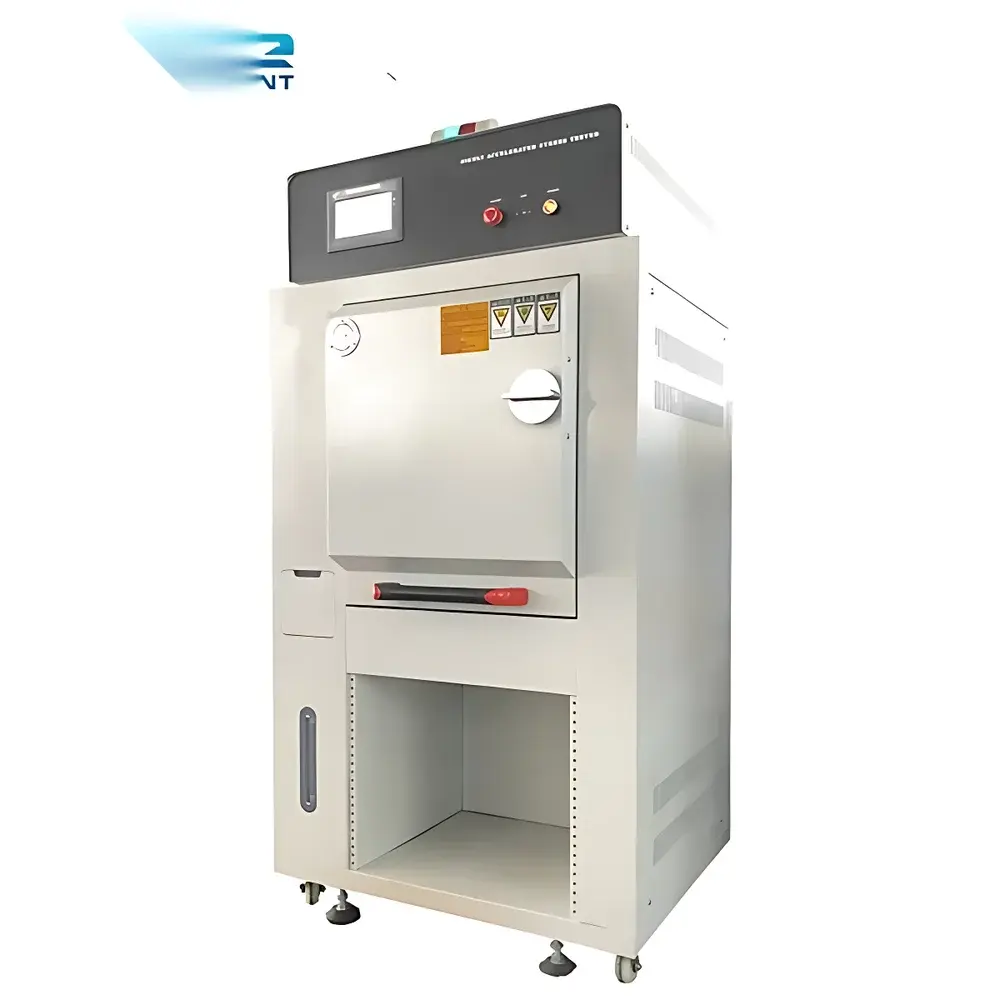
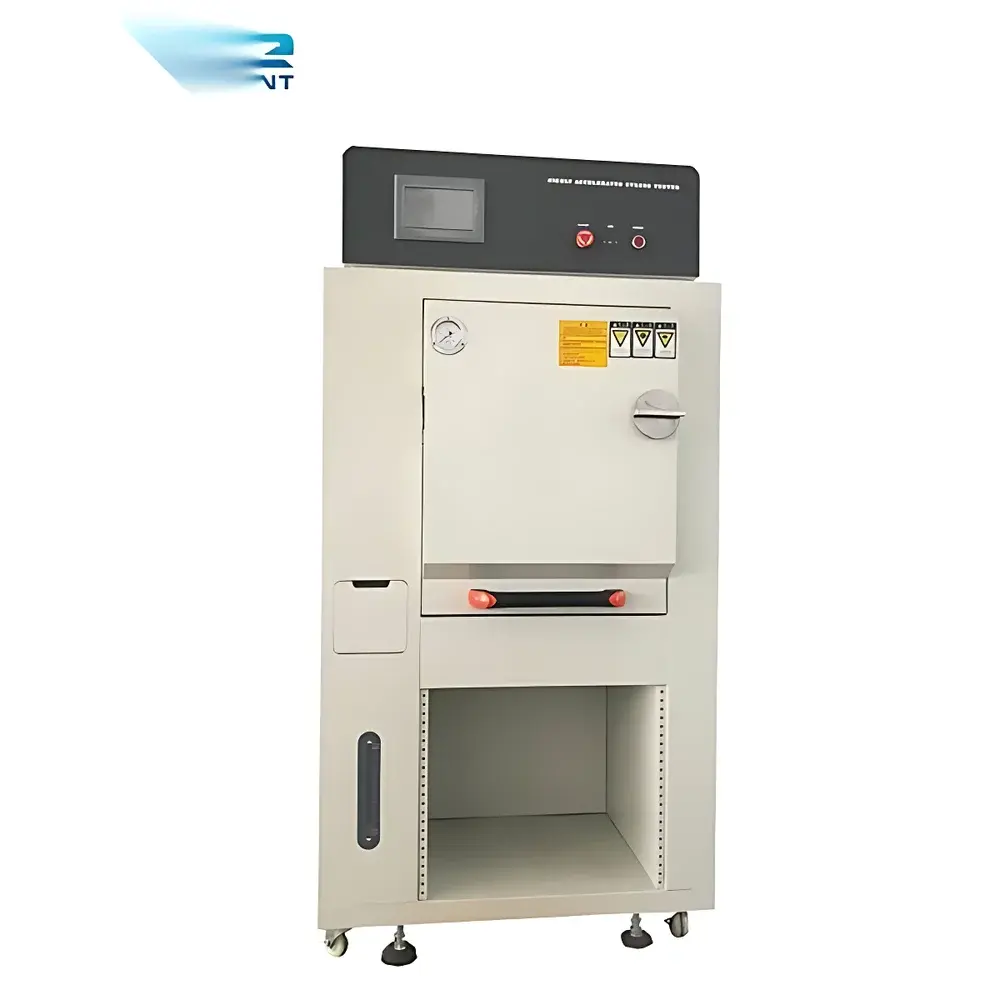
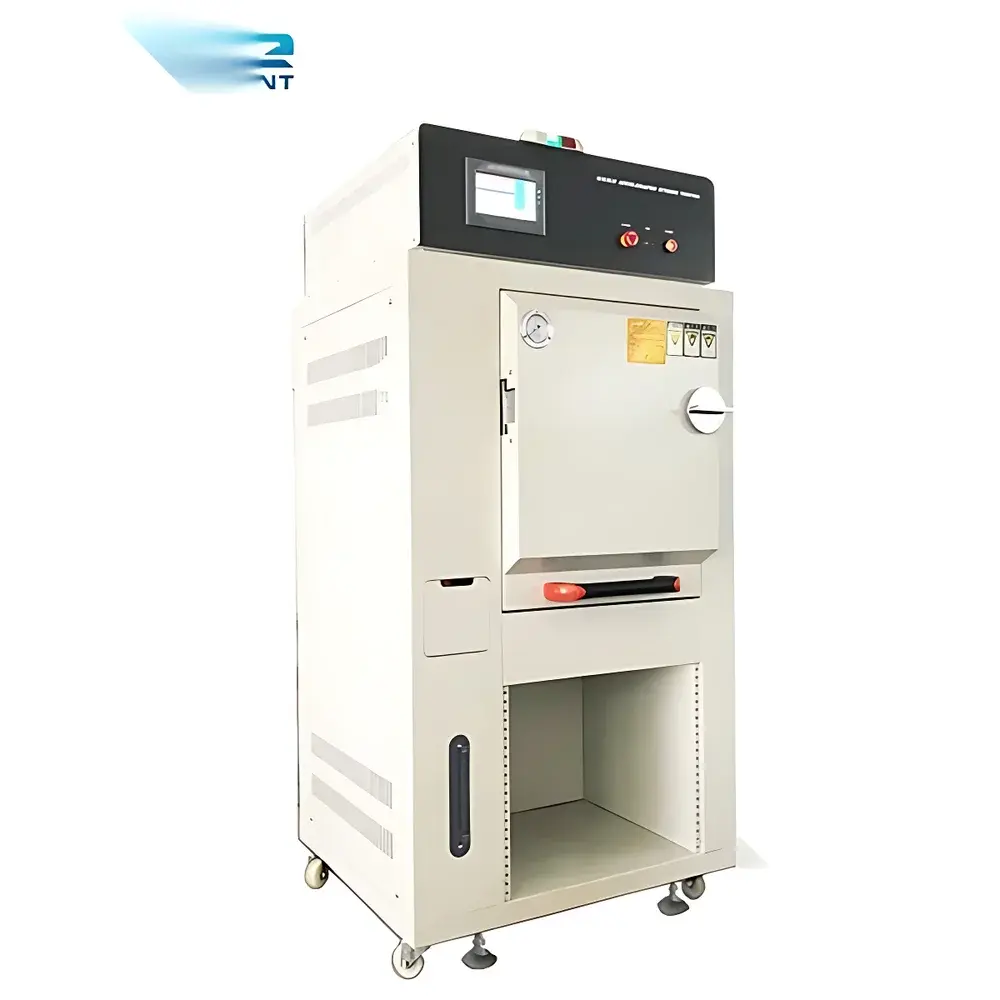
PCT-250 / PCT-350 / PCT-450 / PCT-650 Pressure Cooker Test Chamber for Accelerated Aging and Hermeticity Validation
| Brand | OEM / Third-party Manufacturer |
|---|---|
| Origin | Imported |
| Supplier Type | Authorized Distributor |
| Pricing | USD 3,950–6,800 (FOB) |
| Internal Dimensions (W×H×D) | Ø250×300 mm / Ø350×400 mm / Ø450×500 mm / Ø650×600 mm |
| Chamber Material | ASTM A240 Type 316 Stainless Steel |
| External Casing | Powder-coated or 304 stainless steel |
| Temperature Range | +10°C to 132°C (optional 147°C custom calibration) |
| Pressure Range | 0–2.5 kg/cm² gauge (0–35.5 psi), max absolute pressure 3.5 kg/cm² |
| Heating Method | Immersed electric heating elements |
| Humidification | Direct steam generation via electric heater |
| Water Replenishment | Stainless steel float valve system |
| Cycle Control | LED digital timer with temperature-triggered start (ASTM E2035-compliant timing logic) |
| Safety Interlocks | Dual mechanical pressure lock, overpressure relief valve (ASME BPVC Section VIII compliant), door-seal integrity verification prior to pressurization |
| Power Supply | 220–240 VAC, 50/60 Hz, single-phase |
| Thermal Stability | ±0.5°C at setpoint (121°C) |
| Circulation | Natural convection steam atmosphere |
Overview
The PCT-250/350/450/650 Pressure Cooker Test Chamber is an engineered environmental stress test system designed for accelerated aging, hermeticity validation, and moisture ingress resistance assessment of electronic components, multilayer PCBs, IC packages, medical device housings, and aerospace-grade encapsulants. Operating on the principle of saturated steam pressurization under controlled temperature and relative humidity, the chamber replicates extreme conditions equivalent to years of field exposure in days—enabling rapid identification of latent defects including delamination, wire bond lift, solder joint fatigue, and seal failure. Unlike conventional thermal-humidity chambers, this system maintains a fully saturated vapor environment at elevated pressures (up to 2.5 kg/cm² gauge), ensuring uniform moisture diffusion into micro-gaps and porous substrates per IPC-TM-650 2.6.25, JEDEC JESD22-A102D, and MIL-STD-883 Method 1008. The chamber’s cylindrical geometry and radial inner liner minimize thermal gradients and eliminate localized superheating—critical for reproducible moisture absorption kinetics across heterogeneous assemblies.
Key Features
- Cylindrical pressure vessel with seamless 316 stainless steel interior (ASTM A240), corrosion-resistant to chlorides and condensate acids generated during prolonged steam cycles
- Interlocked rotary door mechanism requiring full mechanical seal engagement before pressurization initiation—compliant with ISO 13857 safety clearance requirements
- Auto-replenishment system using stainless steel float valves to maintain constant water level throughout extended tests (e.g., 200-hour continuous operation)
- Dual-mode pressure regulation: automatic solenoid-controlled venting for gradual depressurization and manual override valve for emergency release (ASME-certified relief capacity)
- LED digital timer synchronized with chamber temperature acquisition—start delay only released when internal sensor confirms stable setpoint, eliminating premature cycle initiation
- Natural convection steam circulation architecture eliminates forced-air turbulence, preserving delicate samples and preventing mechanical displacement during high-pressure phases
- Integrated thermal and pressure redundancy monitoring: independent RTD sensors and piezoresistive transducers feed real-time data to fail-safe controller logic
Sample Compatibility & Compliance
The PCT series accommodates diverse sample geometries—from surface-mount ICs on carrier trays to large-format automotive ECUs and sterilizable medical instrument housings. Its cylindrical chamber design ensures symmetrical steam distribution, critical for testing asymmetric or stacked assemblies where edge effects dominate failure modes. All models comply with key industry standards for reliability qualification: IPC-J-STD-020 (moisture sensitivity level classification), JEDEC JESD22-A110 (steam aging), and IEC 60068-2-66 (damp heat, cyclic). The system supports GLP/GMP-aligned operation through optional audit-trail logging (IEC 62304 Annex C), and its pressure control architecture meets ASME BPVC Section VIII Division 1 requirements for Class I pressure vessels. Not intended for flammable, explosive, or self-heating materials per NFPA 30 and OSHA 1910.106.
Software & Data Management
While the base configuration utilizes embedded microcontroller-based operation with front-panel LED interface, optional RS-485 Modbus RTU or Ethernet TCP/IP connectivity enables integration with centralized lab management systems (LIMS) or MES platforms. Logged parameters include real-time temperature, pressure, elapsed time, and door status—exportable as CSV for traceability. Data integrity conforms to FDA 21 CFR Part 11 requirements when paired with validated software add-ons featuring electronic signatures, role-based access control, and immutable audit trails. Calibration records adhere to ISO/IEC 17025:2017 documentation protocols, with NIST-traceable sensor verification available upon request.
Applications
This chamber serves critical roles across R&D, QA/QC, and reliability engineering workflows. In semiconductor packaging development, it validates mold compound adhesion and die attach integrity under moisture-saturated stress. For automotive electronics, it accelerates corrosion testing of connectors and sensor housings exposed to under-hood condensation cycles. Medical device manufacturers use it to verify barrier performance of sterile packaging per ISO 11607-1. LED module producers apply it to assess phosphor layer delamination and silicone encapsulant hydrolysis. Additionally, it supports qualification of conformal coatings (IPC-CC-830), printed battery electrodes, and MEMS cavity seals—where moisture-induced stiction or electrochemical migration must be quantified prior to field deployment.
FAQ
What is the maximum allowable test duration without manual intervention?
Standard configuration supports unattended operation up to 200 hours with auto-refill functionality; extended cycles require periodic water volume verification per maintenance schedule.
Can the chamber be calibrated to NIST-traceable standards?
Yes—temperature and pressure sensors are supplied with individual calibration certificates; optional on-site recalibration services available with ISO/IEC 17025-accredited providers.
Is the system compatible with automated test sequencing software?
Via optional Modbus RTU or Ethernet interface, it integrates with LabVIEW, Python-based test sequencers, or commercial reliability test suites supporting IEEE 1620 compliance.
Does the chamber meet CE or UKCA marking requirements?
All electrical and pressure safety subsystems comply with EN 61000-6-4 (EMC), EN 61000-6-2 (immunity), and PED 2014/68/EU for pressure equipment—CE marking provided with EU Declaration of Conformity.
What maintenance intervals are recommended for long-term reliability?
Float valve inspection every 500 operating hours; gasket replacement every 12 months or after 500 pressurization cycles; annual pressure relief valve functional verification per ASME PTC 25.



