
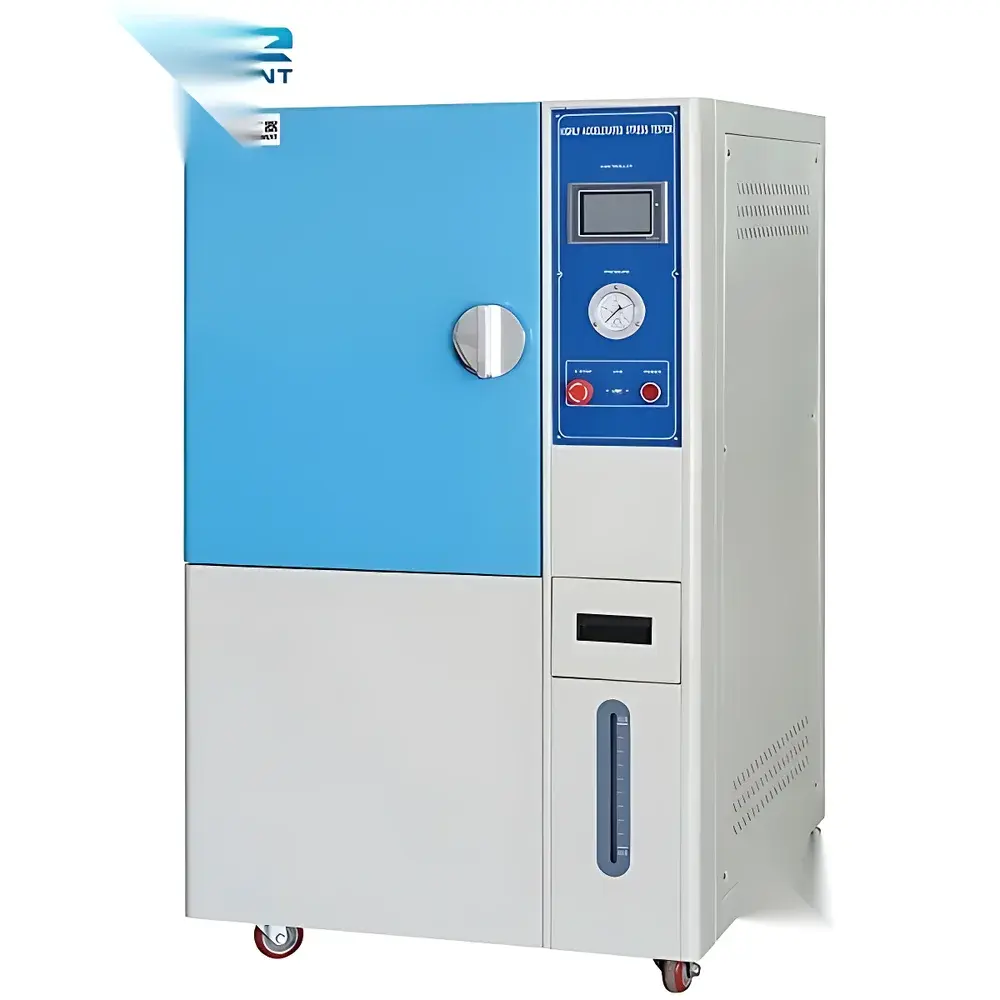
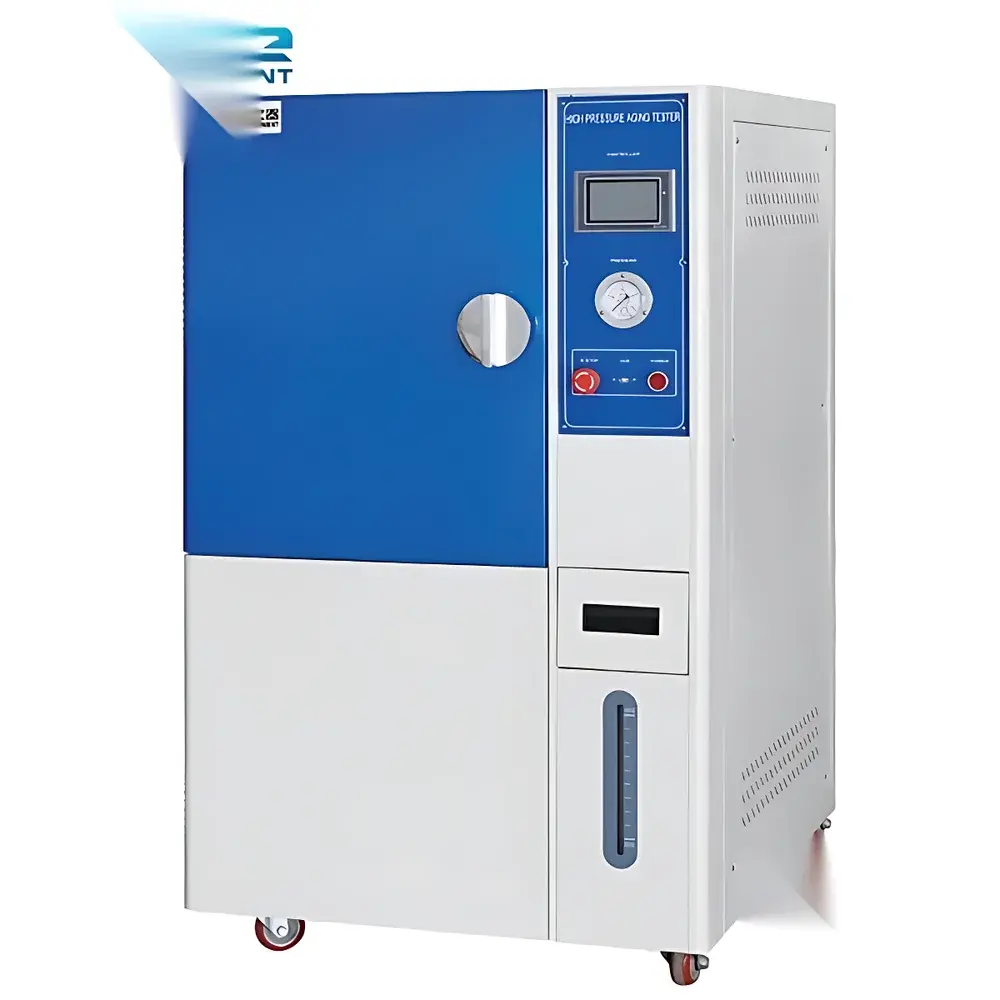
PCT High-Pressure Accelerated Aging Test Chamber for Lighting Products
| Brand | Other Brands |
|---|---|
| Origin | Imported |
| Manufacturer Type | General Distributor |
| Price | USD 4,100 (approx.) |
| Internal Dimensions (W×H×D) | Ø250×300 mm, Ø350×400 mm, Ø450×500 mm, Ø650×600 mm |
| Chamber Material | AISI 316 Stainless Steel |
| External Enclosure | Powder-Coated or Stainless Steel |
| Temperature Range | +10°C to 132°C (optional up to 147°C) |
| Pressure Range | 0–2.5 kg/cm² (gauge), 0–4.0 kg/cm² (relative) |
| Heating Method | Electric Immersion Heaters |
| Humidification | Steam Generation via Electric Heating Elements |
| Water Replenishment | Stainless Steel Float Valve System |
| Vacuum Preconditioning | Integrated Vacuum Pump with Air Filtration |
| Control Interface | LED Digital Timer with Temperature/Pressure Interlock |
| Power Supply | 220–240 V AC, 50/60 Hz, Single Phase |
| Pressure Ramp Time | ~45 min to 2.0 kg/cm² |
| Circulation Mode | Natural Convection Steam Atmosphere |
| Safety Features | Mechanical Pressure Lock, Automatic & Manual Pressure Relief, Low-Water Cut-off, Over-Temperature Protection |
Overview
The PCT High-Pressure Accelerated Aging Test Chamber for Lighting Products is an engineered environmental stress test system designed to evaluate the long-term reliability and hermetic integrity of lighting components—including LED modules, sealed luminaires, optical lenses, and driver assemblies—under accelerated humidity, temperature, and pressure conditions. Operating on the principle of saturated steam pressurization, the chamber subjects samples to elevated partial pressures of water vapor at temperatures above 100°C, significantly accelerating moisture ingress through micro-defects in encapsulants, seals, and solder joints. This methodology aligns with industry-standard accelerated stress testing protocols used in automotive lighting (e.g., ISO 16750-4), consumer electronics (JEDEC JESD22-A102, A110), and military specifications (MIL-STD-883 Method 1030). The chamber’s stainless steel #316 construction ensures corrosion resistance against aggressive condensate and high-purity steam environments, supporting repeatable, traceable qualification testing during design validation and production lot release.
Key Features
- Automated water replenishment system using a corrosion-resistant stainless steel float valve, enabling uninterrupted operation for extended test durations (up to 200 hours without manual intervention).
- Optimized cylindrical internal geometry with radial thermal symmetry to minimize localized superheating and ensure uniform steam distribution across the test volume.
- Interlocked circular door mechanism with dual mechanical pressure latch—operation is disabled unless full sealing pressure is confirmed, preventing accidental opening under load.
- Digital LED timer synchronized with chamber temperature stabilization, initiating countdown only after reaching the target setpoint (per ASTM E145 Table 1 timing logic).
- Real-time analog pressure and temperature gauges with calibrated accuracy: ±0.2 kg/cm² for pressure and ±1.0°C for temperature across the operational range.
- Vacuum preconditioning cycle prior to pressurization removes ambient air and residual oxygen, reducing oxidation risk and ensuring consistent steam saturation levels per IEC 60068-2-66 requirements.
Sample Compatibility & Compliance
The chamber accommodates a broad spectrum of lighting-related specimens—from miniature LED packages and COB arrays to large-scale outdoor luminaires and smart lighting control modules. Its modular internal dimensions (Ø250×300 mm to Ø650×600 mm) support both single-unit and batch-level testing configurations. All models comply with fundamental safety and electromagnetic compatibility standards including IEC 61000-4 series (EMC immunity), IEC 61010-1 (electrical safety for laboratory equipment), and CE marking directives. While not certified to UL 1598 or EN 60598 by default, the unit’s architecture supports integration into GLP/GMP-compliant quality systems when paired with validated SOPs and audit-ready documentation packages.
Software & Data Management
This model operates via hardware-based analog controls with digital display instrumentation—no embedded software or network connectivity is included. However, external data logging is fully supported via 4–20 mA or 0–10 V analog outputs for pressure and temperature signals, compatible with third-party SCADA platforms (e.g., LabVIEW, Siemens Desigo, or DeltaV). Optional RS-485 Modbus RTU interface kits are available for integration into centralized test lab management systems. All critical parameters—including start time, pressure ramp profile, hold duration, and final depressurization sequence—are manually recorded in accordance with ISO/IEC 17025 documentation requirements for accredited laboratories.
Applications
Primary applications include: accelerated life testing of silicone encapsulants and epoxy resins used in LED packaging; evaluation of gasket and O-ring seal performance under combined thermal-hygric stress; detection of latent delamination in multi-layer PCB substrates within automotive headlamps; verification of moisture barrier effectiveness in OLED lighting panels; and qualification of IP-rated ingress protection for outdoor streetlight housings. It is routinely deployed in R&D labs, supplier quality assurance departments, and independent test service providers conducting failure analysis per IPC-TM-650 2.6.25 (PCT) and JEDEC J-STD-020 (MSL classification).
FAQ
What is the maximum allowable test duration without operator intervention?
The integrated float valve system enables continuous operation for up to 200 hours, assuming adequate external water supply and stable power input.
Can this chamber be used for non-lighting applications such as automotive sensors or medical PCBs?
Yes—the chamber meets core PCT test requirements defined in JEDEC JESD22-A102 and is widely applied across electronics, aerospace, and medical device industries for hermeticity screening.
Is vacuum preconditioning mandatory before each test cycle?
While optional per internal protocol, vacuum evacuation is strongly recommended to eliminate air pockets and ensure reproducible steam saturation—critical for comparative aging studies.
Does the chamber support automated pressure ramp profiles?
No—pressure ramping is passive and governed by heating rate and chamber volume; however, ramp times to common setpoints (e.g., 2.0 kg/cm² in ~45 min) are repeatable and documented in the user manual.
How is calibration traceability maintained for pressure and temperature sensors?
Each unit ships with factory calibration certificates referencing NIST-traceable standards; annual recalibration using certified deadweight testers and dry-block calibrators is advised for ISO/IEC 17025 compliance.



