
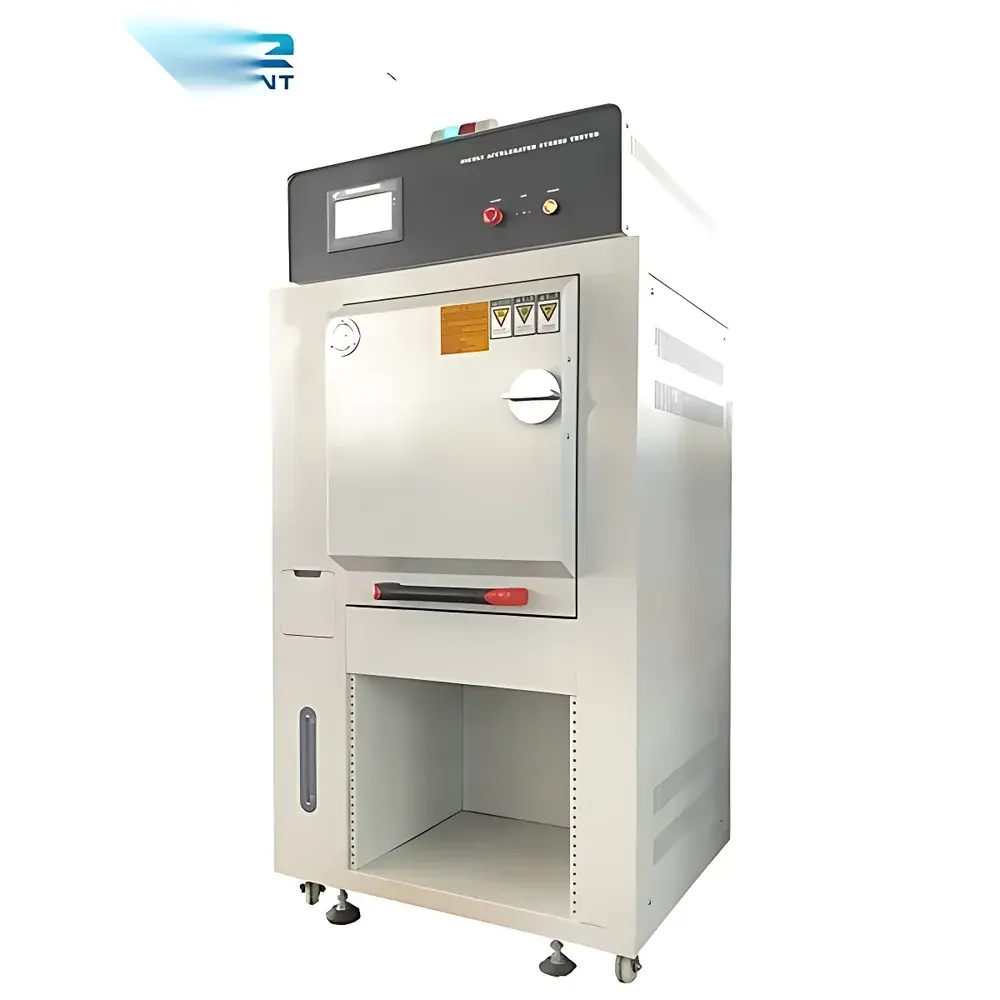
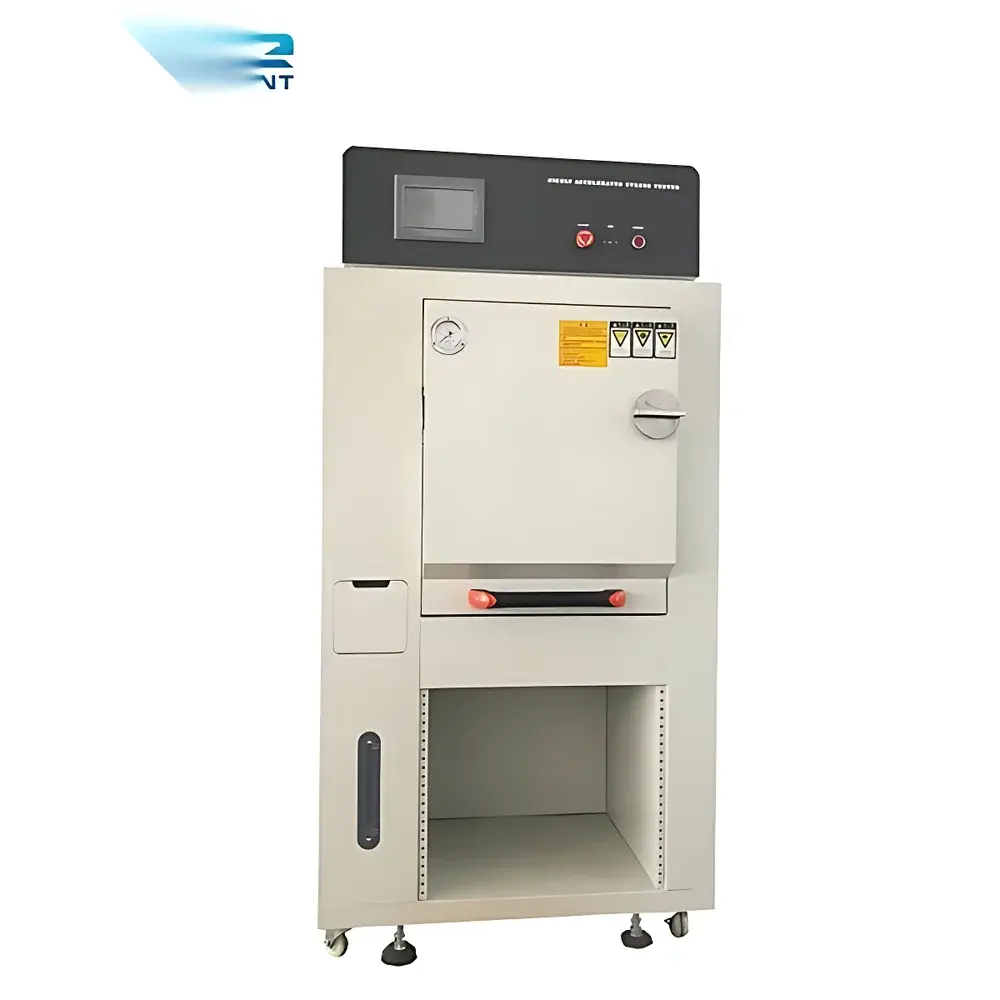
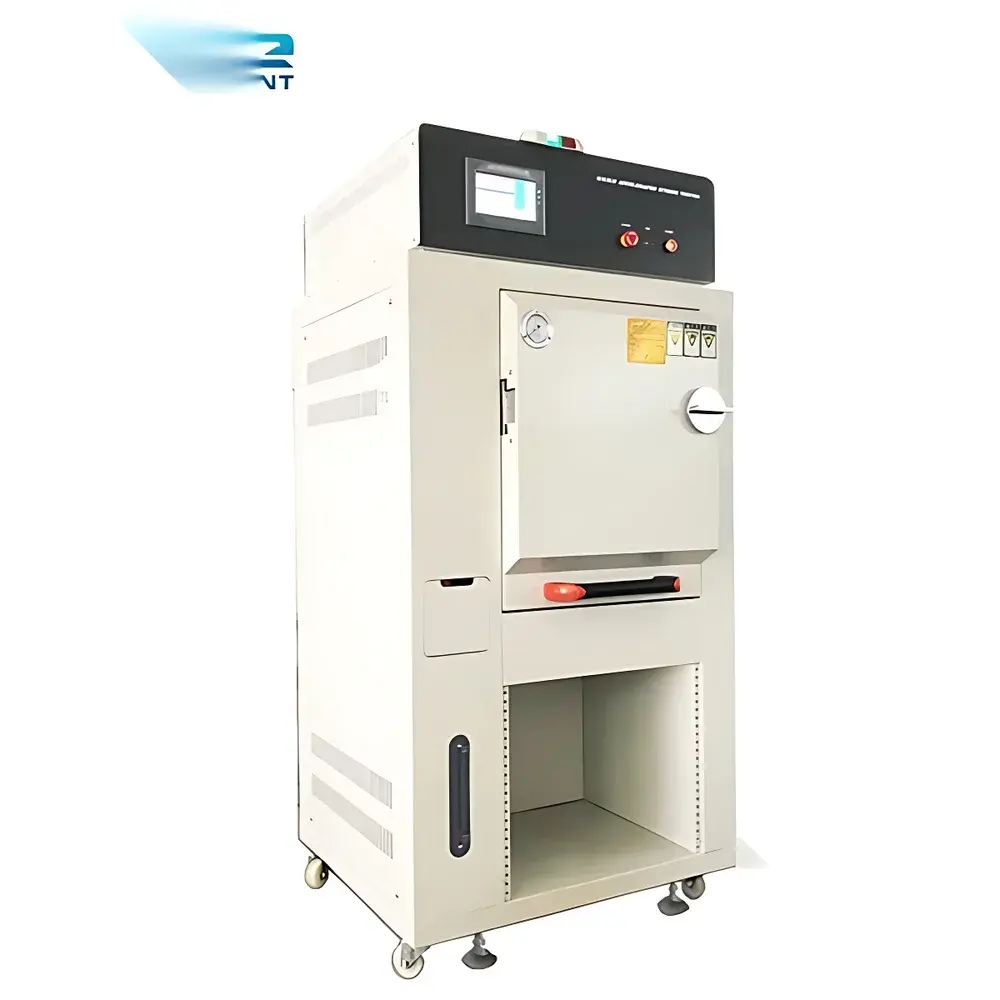
PCT High-Pressure Accelerated Life Aging Test Chamber
| Brand | Other Brands |
|---|---|
| Origin | Imported |
| Manufacturer Type | Authorized Distributor |
| Temperature Range | 100–132 °C (saturated steam) |
| Humidity Range | 100 % RH |
| Pressure Range | 0.2–2.4 kgf/cm² |
| Internal Chamber Dimensions | Ø300 × 450 mm |
| External Dimensions | 660 × 1050 × 1250 mm |
| Chamber Material | SUS316 stainless steel |
| Temperature Uniformity | ±2.0 °C |
| Temperature Control Accuracy | ±0.5 °C |
| Temperature Resolution | 0.1 °C |
| Test Duration | 0–999 h adjustable |
| Heating Time | ≤45 min (RT to 132 °C) |
| Pressurization Time | ≤40 min (0 to 2.0 kgf/cm²) |
| Safety Features | Dual-stage overpressure protection, automatic pressure relief, dry-out cycle, filtered air purge (<1 µm), triple-level thermal cutoffs, water level monitoring |
Overview
The PCT High-Pressure Accelerated Life Aging Test Chamber is an engineered environmental stress test system designed for reliability validation of moisture-sensitive electronic packages under accelerated saturated steam conditions. Based on the principle of pressure-cooker testing (PCT), it subjects semiconductor devices—including ICs, QFN/DFN packages, BGA assemblies, and multilayer PCBs—to simultaneous elevated temperature, 100 % relative humidity, and controlled hydrostatic pressure. Under these conditions, water vapor diffuses through polymer encapsulants or along die-attach interfaces, accelerating failure mechanisms such as corrosion of aluminum metallization, intermetallic growth at bond wires, and conductive anodic filament (CAF) formation between adjacent traces. This chamber complies with industry-standard test methods including JEDEC JESD22-A102 (PCT), IPC-9701A (Performance Qualification of Printed Board Materials), and MIL-STD-883 Method 1030.5 (Moisture Resistance). Its operation is grounded in thermodynamic saturation—maintaining precise equilibrium between temperature, pressure, and vapor density—enabling reproducible acceleration factors critical for qualification of high-reliability components used in automotive, aerospace, and medical electronics.
Key Features
- Cylindrical inner chamber fabricated from ASTM A240 Grade SUS316 stainless steel—resistant to chloride-induced stress corrosion cracking during prolonged exposure to saturated steam.
- Optimized thermal and pressure dynamics via curved chamber geometry and arc-shaped inner lining, minimizing localized superheating and condensate pooling.
- High-integrity sealing system using fluorosilicone elastomer gaskets (rated to 150 °C), engineered with self-tightening compression behavior—seal force increases proportionally with internal pressure, extending service life beyond conventional static seals.
- Integrated 16-L bottom-mounted water reservoir with auto-refill function and real-time level sensing, ensuring uninterrupted test cycles without manual intervention.
- Dual-stage safety architecture: primary protection includes PID-controlled thermal cutoffs, heater dry-run detection, and pressure transducer redundancy; secondary protection comprises mechanical burst discs, programmable emergency venting, and manual override valves compliant with ASME BPVC Section VIII Div. 1 requirements.
- Pre-test vacuum purge cycle with HEPA-filtered (≤1 µm) ambient air intake, reducing oxygen content and particulate contamination to mitigate oxidation-related degradation pathways.
- Post-test automated depressurization sequence followed by timed dry-out cycle—eliminating residual moisture from test specimens prior to retrieval.
Sample Compatibility & Compliance
The chamber accommodates standard JEDEC trays, wafer carriers, and bare-die fixtures up to Ø300 mm diameter. It supports qualification testing of ceramic and plastic-encapsulated microcircuits, flex-rigid PCBs, MEMS sensors, and hermetic and non-hermetic optoelectronic modules. All operational parameters align with JEDEC J-STD-020 (Moisture Sensitivity Levels), IPC-J-STD-033 (Handling, Packing, Shipping and Use of Moisture/Sensitivity SMDs), and ISO/IEC 17025-accredited laboratory workflows. Data logging meets FDA 21 CFR Part 11 requirements when paired with validated software—audit trails, electronic signatures, and immutable record retention are supported via optional GMP-compliant firmware modules.
Software & Data Management
Equipped with a dedicated microprocessor-based controller featuring PID algorithm tuning, real-time trend display, and programmable ramp/soak profiles. The interface logs timestamped temperature, pressure, and humidity values at user-defined intervals (minimum 1 s resolution) and exports CSV-formatted datasets compatible with MATLAB, JMP, and Minitab for Weibull analysis and Arrhenius modeling. Optional Ethernet connectivity enables remote monitoring, alarm notification via SMTP/SNMP, and integration into centralized MES or LIMS platforms. Firmware supports GLP/GMP audit modes—enabling full traceability of calibration history, operator ID, test method version, and deviation flags per ICH Q5C and ISO 13485 Annex A.
Applications
This system is deployed in semiconductor foundries, OSAT facilities, and component reliability labs for: preconditioning prior to reflow simulation (MSL classification); qualification of new mold compound formulations; validation of underfill and conformal coating integrity; assessment of solder mask adhesion under hygrothermal stress; and root-cause analysis of field returns linked to moisture-induced delamination or popcorning. It is also applied to evaluate moisture barrier performance of flexible OLED substrates, magnetic sensor housings, and automotive-grade power modules operating in harsh under-hood environments.
FAQ
What standards does this PCT chamber comply with?
It supports JEDEC JESD22-A102, IPC-9701A, MIL-STD-883 Method 1030.5, and IEC 60068-2-66 for pressure-cooker testing.
Can the chamber perform ramp-and-soak pressure profiles?
Yes—the controller supports multi-step programs with independent setpoints for temperature, pressure, and dwell time, enabling complex stress profiles per customer-specific qualification plans.
Is the water reservoir refill process fully automated?
Yes—integrated level sensors trigger solenoid-valve-driven refills from an external deionized water source; no operator intervention is required during extended 999-hour tests.
How is data integrity ensured during long-duration tests?
All measurements are stored redundantly in non-volatile memory and synchronized to an NTP server; power-loss recovery preserves active test state and resumes from last valid checkpoint.
Does the system include calibration documentation?
Each unit ships with a factory-assembled calibration certificate traceable to NIST standards, covering temperature, pressure, and timing subsystems per ISO/IEC 17025 Clause 6.5.



