
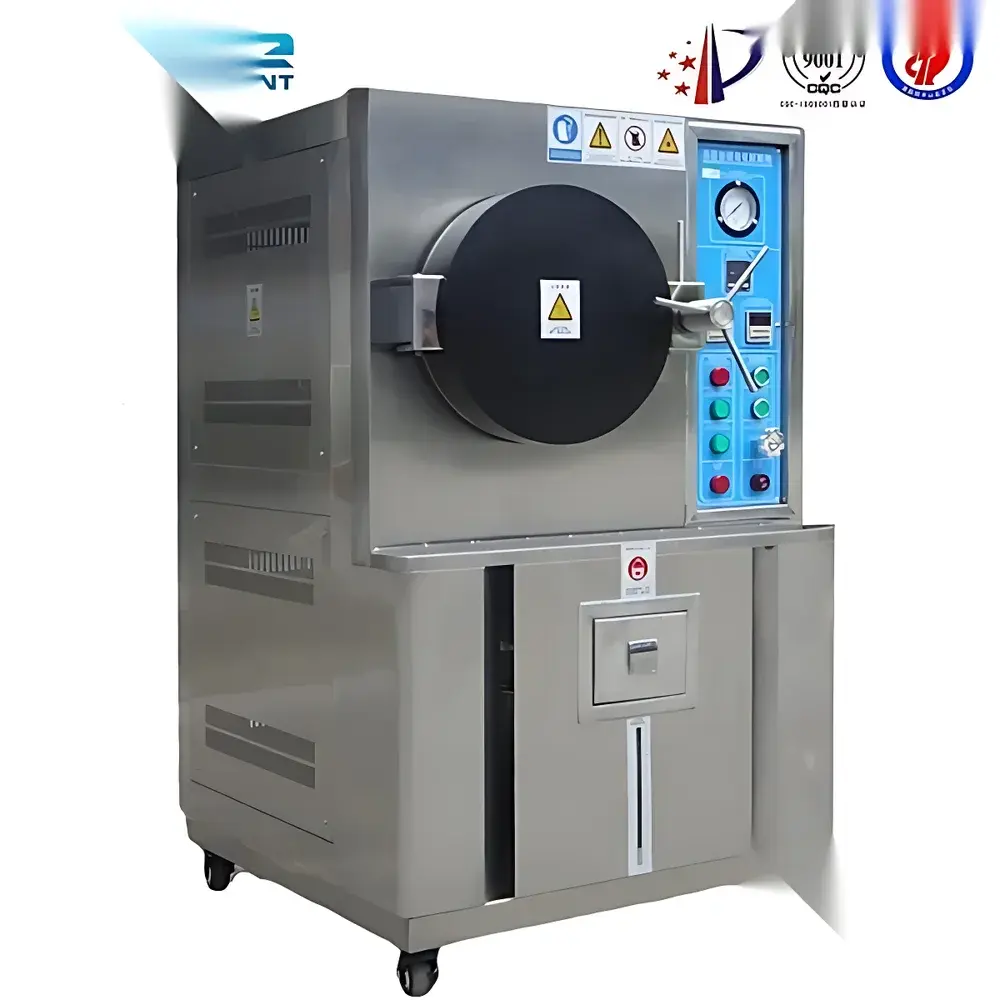
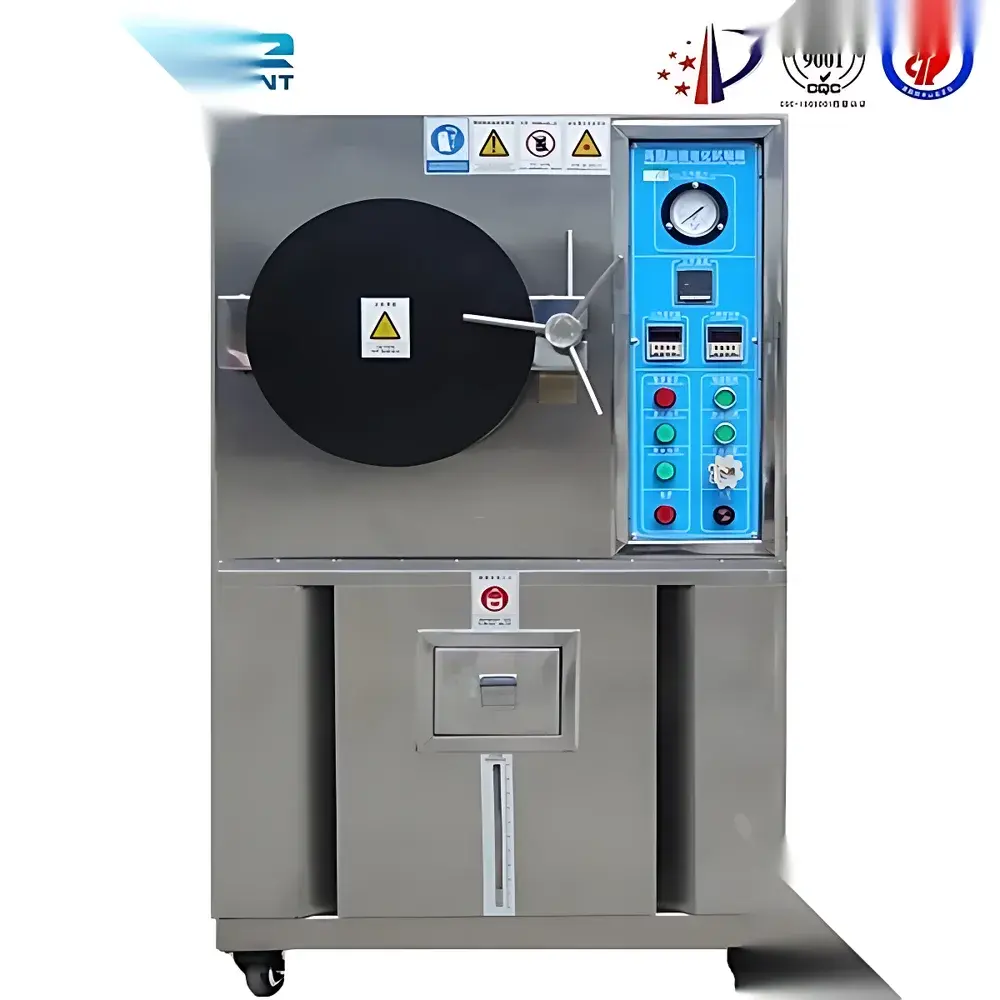
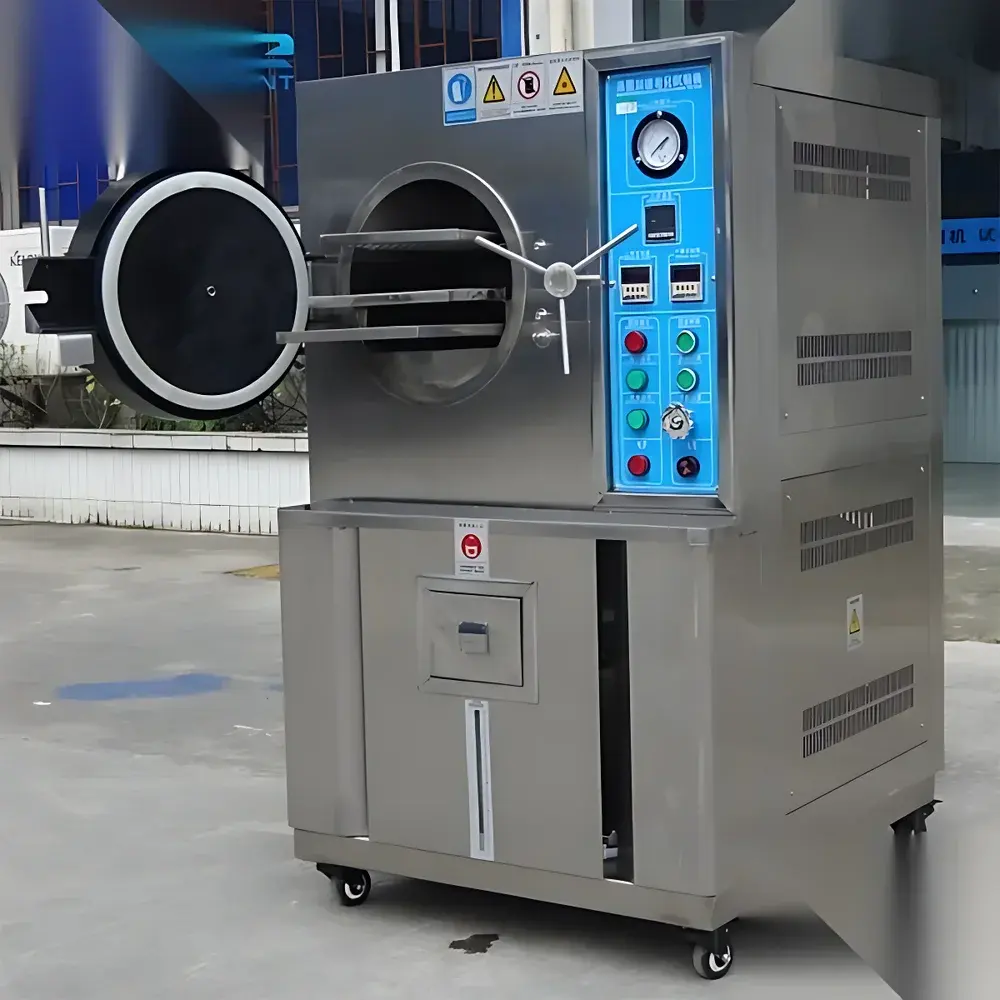
PCT High-Temperature and High-Humidity Autoclave Chamber
| Brand | Other Brands |
|---|---|
| Origin | Imported |
| Manufacturer Type | General Distributor |
| Temperature Range | 100–132 °C |
| Humidity Range | 100 % RH |
| Temperature Uniformity | ±0.5 °C (unloaded) |
| Humidity Uniformity | ±3 % RH |
| Heating/Cooling Rate | 0.7–1.0 °C/min (unloaded) |
| Temperature Cycling Range | 20–80 °C |
| Timer Range | 0–9999 h |
| Power Supply | AC 380 V |
| Insulation | High-Density Fine-Glass Wool |
| Sealing | Dual-Silicone Gasket System |
| Refrigeration | Hermetic Tecumseh or Copeland Compressor (Equivalent to “Tecumseh”-class Performance) |
| Interior Material | SUS304 Mirror-Finish Stainless Steel |
| Exterior Finish | Powder-Coated A3 Steel |
Overview
The PCT High-Temperature and High-Humidity Autoclave Chamber is a precision environmental stress test system engineered for accelerated reliability evaluation of electronic components, packaging materials, PCB assemblies, and hermetically sealed devices under pressurized saturated steam conditions. Unlike standard humidity chambers, this chamber operates at elevated temperatures (up to 132 °C) and maintains full saturation (100 % RH) — replicating the thermodynamic state of pressurized steam in an autoclave environment without requiring external pressure vessels. It functions on the principle of saturated vapor equilibrium: internal heating and precise steam generation ensure that relative humidity remains at 100 % across the entire temperature range, enabling controlled moisture ingress into microstructures — a critical requirement for evaluating moisture sensitivity level (MSL) per JEDEC J-STD-020 and failure mechanisms such as popcorning, wire bond lift, and intermetallic delamination.
Key Features
- Stable 100 % RH operation from 100 °C to 132 °C, validated via NIST-traceable hygrometric calibration
- Dual silicone door gasket system with mechanical compression latch ensures leak-tight integrity during prolonged saturation cycles
- High-efficiency refrigeration circuit using hermetically sealed compressors (Tecumseh/Copeland-class), mounted beneath the chamber for thermal isolation and service accessibility
- Uniform airflow architecture: twin centrifugal blowers integrated into rear plenum ducts drive laminar recirculation across SUS304 mirror-finish interior walls, minimizing thermal gradients (<±0.5 °C) and condensation shadowing
- Robust thermal insulation: 120 mm thick ultra-fine glass wool (thermal conductivity ≤0.032 W/m·K) minimizes energy consumption and external surface temperature rise
- Structural rigidity: powder-coated A3 steel outer frame with reinforced corner joints supports long-term dimensional stability under cyclic thermal expansion
Sample Compatibility & Compliance
The chamber accommodates standard JEDEC trays (330 × 250 mm), 8-inch wafer carriers, and stacked PCB racks up to 600 mm height. Internal dimensions (W×D×H) support simultaneous testing of ≥24 QFN-48 packages or 12 BGA-324 units per cycle. Designed to meet the physical and operational requirements of IPC-9701A (Performance Test Methods for Lead-Free Solder Attachments), JEDEC JESD22-A102F (Moisture Reflow Sensitivity Classification), and MIL-STD-883 Method 1030.8 (Moisture Resistance). Optional validation kits include Class A platinum RTD probes (IEC 60751) and chilled-mirror dew-point sensors for IQ/OQ documentation. Fully compatible with GLP/GMP audit trails when paired with compliant data loggers supporting 21 CFR Part 11 electronic signatures.
Software & Data Management
Equipped with a 7-inch capacitive touchscreen HMI running embedded Linux OS, the system provides real-time monitoring of chamber temperature, RH, ramp/soak profiles, and compressor duty cycle. All parameters are logged at user-selectable intervals (1–60 s) to internal 8 GB eMMC storage with automatic rollover. Export formats include CSV and PDF reports compliant with ISO/IEC 17025 record retention standards. Optional Ethernet/Wi-Fi connectivity enables integration with LabVantage, TrackWise, or custom MES platforms via Modbus TCP or OPC UA protocols. Audit trail functionality records operator ID, parameter changes, alarm events, and calibration actions with immutable timestamps.
Applications
- Pre-reflow moisture sensitivity screening of plastic-encapsulated microcircuits (PEMs)
- Accelerated aging of conformal coatings and underfill materials under saturated steam
- Qualification testing of automotive ECUs per AEC-Q200 Rev D high-humidity stress protocols
- Evaluation of MEMS package hermeticity degradation kinetics
- Validation of solder paste shelf-life and flux residue hygroscopic behavior
- Reliability assessment of medical device polymer housings per ISO 10993-12 extraction protocols
FAQ
What standards does this chamber support for MSL testing?
It fully satisfies JEDEC J-STD-020E’s temperature/humidity profile requirements for MSL 1–6 classification, including soak durations at 121 °C/100 % RH and 130 °C/100 % RH.
Is external pressure regulation required?
No — the chamber achieves 100 % RH at elevated temperatures through saturated vapor equilibrium at ambient pressure; no pressure vessel certification or safety interlocks are needed.
Can it perform temperature cycling with humidity control?
Yes — programmable profiles support combined temperature cycling (20–80 °C) with concurrent 85 % RH hold phases, meeting IPC-9701A thermal-hygric stress sequences.
How is calibration traceability maintained?
Factory calibration uses dual NIST-traceable reference sensors (PT100 and chilled-mirror hygrometer); users may perform field verification using ISO/IEC 17025-accredited portable standards.
What maintenance intervals are recommended?
Compressor oil inspection every 2,000 operating hours; gasket integrity check and chamber interior passivation every 6 months; full sensor recalibration annually or after 500 test cycles.



