
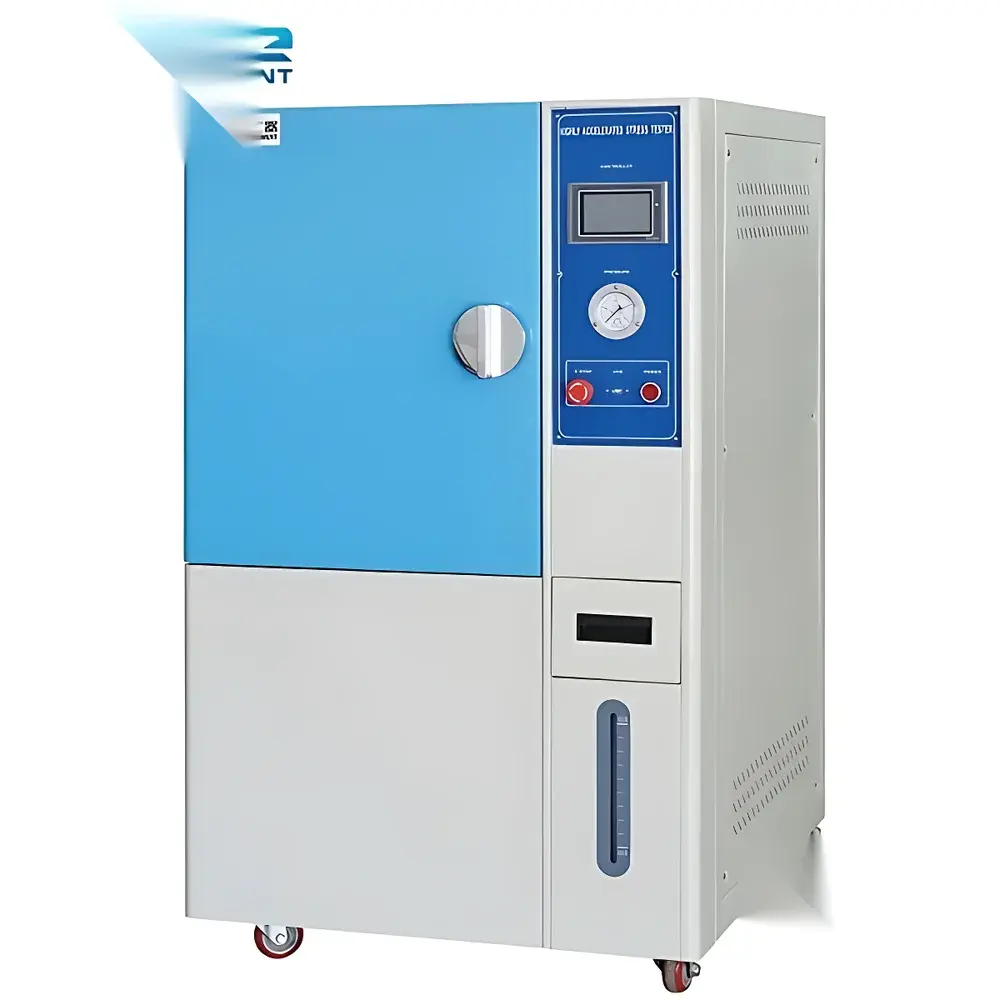
PCT High-Temperature and High-Pressure Accelerated Aging Test Chamber
| Brand | Other Brands |
|---|---|
| Origin | Imported |
| Manufacturer Type | Authorized Distributor |
| Price | USD 3,950 (FOB) |
| Internal Chamber Diameter × Depth | ∅30 cm × D (model-specific) |
| Temperature Range | 100–132 °C |
| Humidity Range | 75–100 % RH |
| Pressure Range | 0.0–2.0 kg/cm² (gauge), absolute pressure = 1.0 kg/cm² + gauge pressure |
| Max Safety Pressure Capacity | 4.0 kg/cm² |
| Temperature Uniformity | ±1.5 °C |
| Temperature Control Accuracy | ±0.5 °C |
| Temperature Resolution | 0.1 °C |
| Pressurization Time (0 → 2.0 kg/cm²) | ≈30 min |
| Internal Material | SUS316 stainless steel |
| External Material | SECC cold-rolled steel with electrostatic powder coating |
Overview
The PCT High-Temperature and High-Pressure Accelerated Aging Test Chamber is a precision-engineered environmental stress test system designed to evaluate material reliability under combined thermal, humid, and pressurized conditions—mimicking accelerated moisture ingress and hydrolytic degradation mechanisms in electronic components, polymer encapsulants, PCB laminates, and medical device packaging. Operating on the principle of saturated steam pressurization, the chamber maintains controlled equilibrium between temperature, relative humidity, and absolute pressure to replicate real-world failure modes such as delamination, wire bond corrosion, popcorning, and intermetallic growth—within standardized test durations defined by JEDEC JESD22-A102, JESD22-A110, and IPC-9708. Its robust pressure containment architecture ensures strict adherence to ASME BPVC Section VIII Division 1 safety requirements for Class I pressure vessels, while the self-reinforcing door sealing mechanism—where internal overpressure enhances gasket compression—eliminates risk of uncontrolled venting during operation.
Key Features
- Self-locking safety door system with pressure-dependent mechanical interlock: door remains physically sealed until internal gauge pressure drops below atmospheric threshold (≤0.05 kg/cm²), preventing accidental opening during active test cycles.
- Integrated automatic water replenishment: ultrasonic level sensor triggers solenoid-controlled deionized water injection when reservoir falls below operational minimum—ensuring uninterrupted steam generation and stable RH profile.
- Dual-channel digital PID controller with LED display: independently regulates chamber temperature (0.1 °C resolution) and monitors real-time pressure via calibrated Bourdon-tube transducer (±0.05 kg/cm² accuracy).
- Steam quality optimization: continuous condensate purge valve removes non-saturated vapor fractions during pressurization, maintaining >99.5 % dryness fraction per ISO 8573-1 Class 2 requirements.
- Corrosion-resistant internal chamber: electropolished SUS316 stainless steel construction withstands prolonged exposure to high-temperature saturated steam and chloride-laden condensates.
- Time-delayed test initiation: built-in digital timer activates only after chamber reaches setpoint temperature and stabilizes for ≥5 minutes—guaranteeing valid thermal equilibration before aging duration begins.
Sample Compatibility & Compliance
The chamber accommodates standard JEDEC trays (JEDEC MO-178), 8”/12” wafer carriers, and sealed medical pouches up to 30 cm diameter. It supports test protocols requiring strict traceability per ISO/IEC 17025:2017 and GLP-compliant validation documentation packages—including IQ/OQ/PQ templates, calibration certificates for pressure and temperature sensors (NIST-traceable), and pressure vessel certification records. All electrical components meet UL 61010-1 and IEC 61000-6-4 EMI immunity standards. The system complies with regulatory expectations for accelerated reliability testing referenced in FDA Guidance for Industry: “Guidance for Industry and FDA Staff – Use of Real-Time and Accelerated Stability Studies for Sterile Devices” (2021), and supports audit readiness for ISO 13485:2016 and IATF 16949:2016 manufacturing environments.
Software & Data Management
While the base configuration features standalone digital controllers, optional RS-485 Modbus RTU interface enables integration with LabVIEW™, MATLAB®, or enterprise MES platforms (e.g., Siemens Opcenter, Rockwell FactoryTalk). Logged data—including time-stamped temperature, pressure, and cycle phase status—is exportable as CSV or Excel-compatible .xlsx files. Optional 21 CFR Part 11-compliant software add-on provides electronic signatures, role-based access control, audit trail generation (with immutable timestamps), and automated report generation aligned with FDA-submission requirements.
Applications
- Qualification of plastic-encapsulated microcircuits (PEMs) per MIL-STD-883 Method 1008.5 and AEC-Q200 stress testing.
- Moisture sensitivity level (MSL) grading of surface-mount devices (SMDs) per J-STD-020.
- Accelerated aging of silicone elastomers, polyimide films, and epoxy molding compounds used in implantable electronics.
- Validation of sterilization barrier integrity for Tyvek®-laminated pouches under ISO 11607-1.
- Hydrolytic stability assessment of biodegradable polymers (e.g., PLA, PCL) in biomedical scaffolds.
FAQ
What is the maximum allowable test duration per cycle?
Standard operation supports continuous runs up to 999 hours; extended-duration testing requires periodic verification of water reservoir capacity and pressure relief valve functionality.
Does the chamber support vacuum-assisted dehumidification pre-test?
No—this model is optimized for positive-pressure saturated steam environments only; vacuum drying must be performed in separate equipment prior to PCT loading.
Can third-party calibration services be performed onsite?
Yes—NIST-traceable calibration of temperature sensors (PT100 Class A) and pressure transducers (0–3 kg/cm² range) is supported by certified metrology providers using portable dry-block calibrators and deadweight testers.
Is the internal chamber volume customizable?
Standard models are offered in ∅30 cm internal diameter; custom diameters (up to ∅60 cm) and depth extensions are available upon engineering review and ASME code compliance verification.
How is condensate managed during depressurization?
A dedicated drain line with manual isolation valve and sight glass allows safe, gravity-fed removal of condensed water post-cycle—preventing cross-contamination between test batches.



