
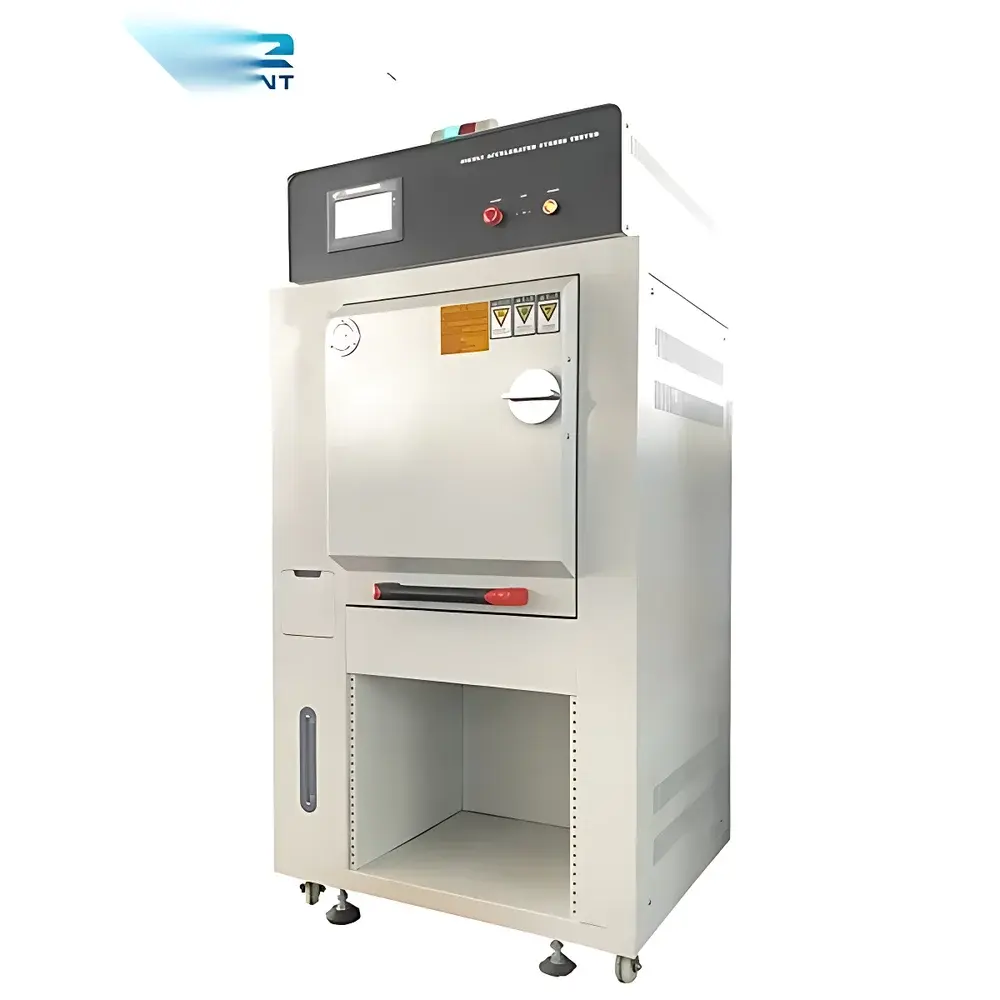
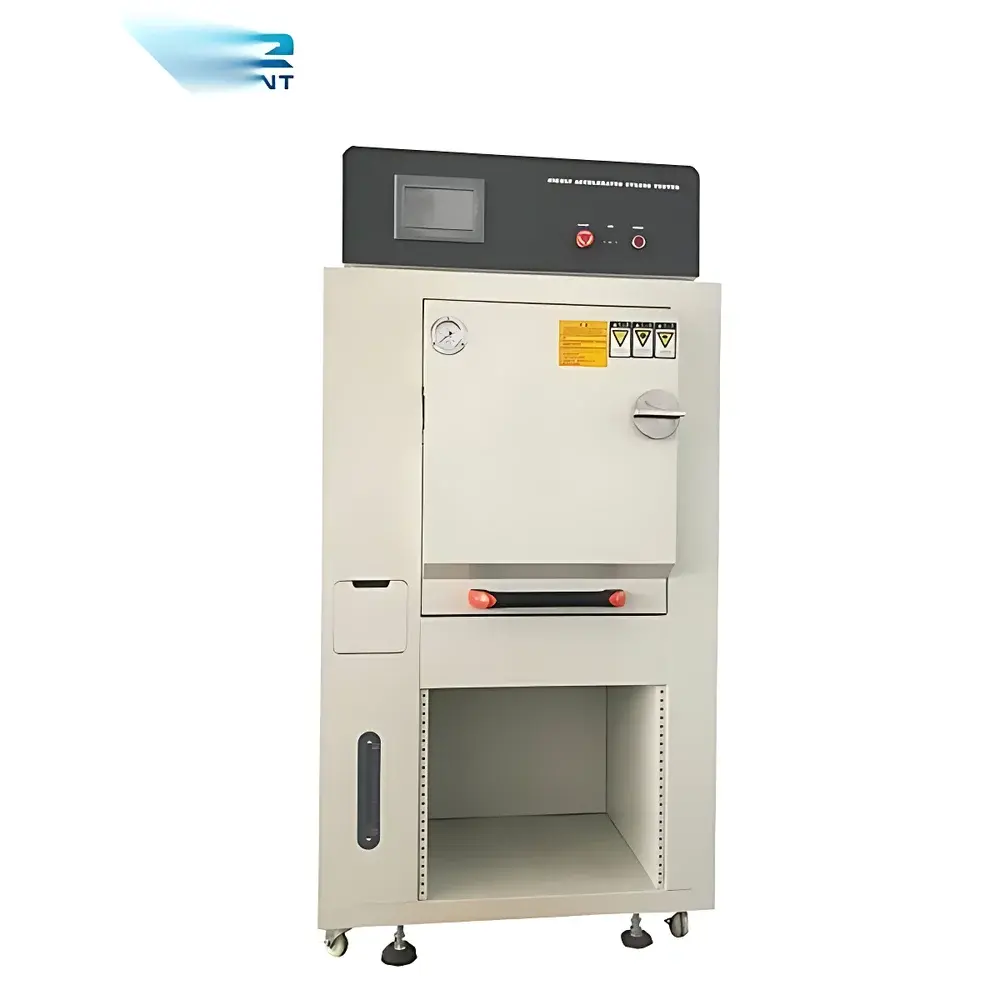
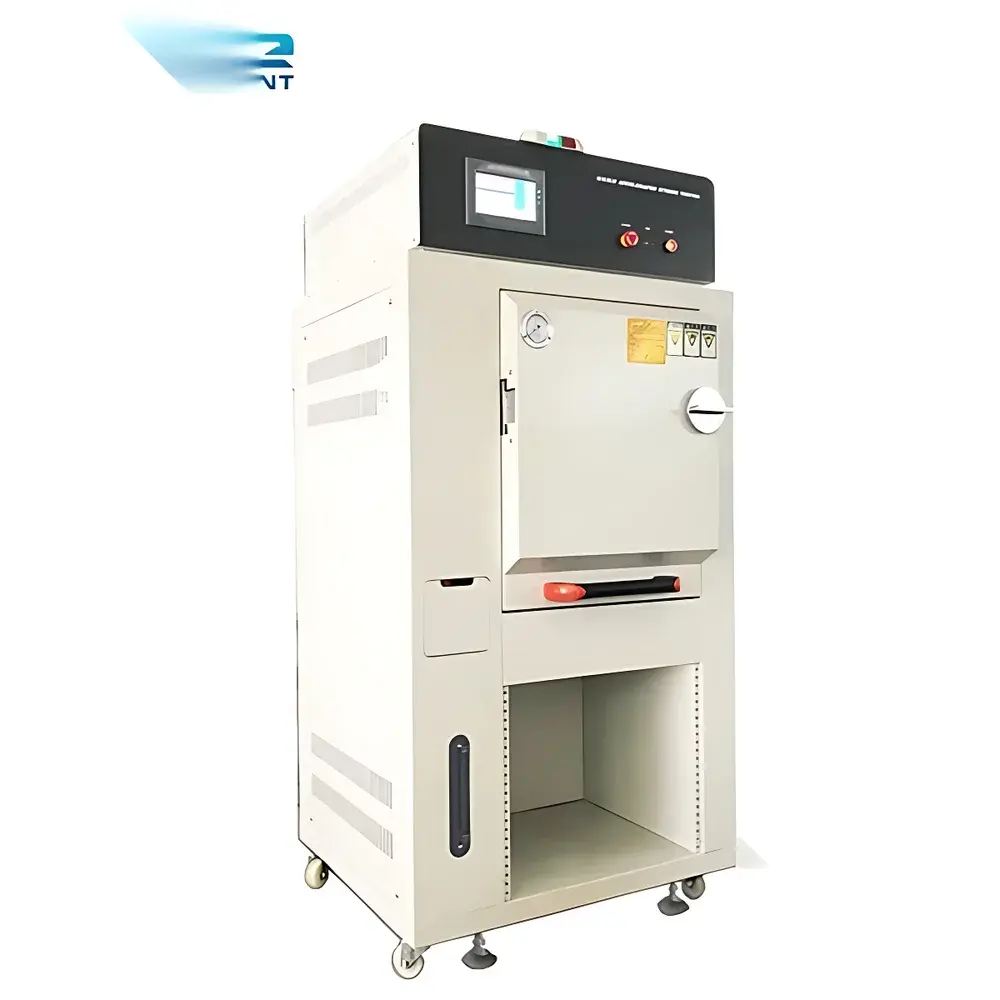
PCT High-Temperature and High-Pressure Autoclave Testing Chamber
| Key | Test Volume: 90 × 90 × 90 cm (W×D×H) |
|---|---|
| Net Weight | 320 kg |
| External Dimensions | 900 × 700 × 1600 mm (W×D×H) |
| Internal Chamber | Cylindrical, Ø400 mm × L600 mm (HAST-45 type) |
| Inner Liner Material | SUS316 stainless steel (3 mm thick) |
| Insulation | Rockwool + rigid polyurethane foam |
| Heating Element | Titanium steam generator tube |
| Temperature Range | 20°C ±15°C |
| Humidity Range | 75–100% RH |
| Dust Concentration Options | 100 mg/m³, 3000 mg/m³, 5000 mg/m³, 60000 mg/m³ |
| Dust Velocity | 5 m/s (for selected concentrations) |
| Cycle Timing | 0–999 sec / 0–99 hr (dual-range programmable) |
| Control System | Color touchscreen PLC with PT-100 sensors, P.I.D. saturation control, analog pressure gauge, manual fill valve with auto-refill capability |
| Compliance | GB/T 10586–1989, GB 2423.3–1993 (IEC 60068-2-3), MIL-STD-810D Method 502.2, GJB 150.9–1986, GB 2423.34–1986, MIL-STD-883C Method 1004.2 |
Overview
The PCT High-Temperature and High-Pressure Autoclave Testing Chamber is a purpose-built environmental stress test system engineered for evaluating the long-term dust resistance, sealing integrity, and functional reliability of electromechanical components under accelerated thermo-hygrometric and particulate exposure conditions. Unlike standard humidity chambers, this unit integrates controlled high-pressure saturated steam generation with programmable airborne dust injection—enabling true Pressure Cooker Test (PCT) simulation per industry-defined thermal-hygro-mechanical stress profiles. Its core operation relies on precise regulation of saturated vapor pressure–temperature equilibrium (via titanium-heated steam generation), combined with calibrated aerosol dispersion at defined mass concentration and flow velocity. This dual-stress methodology replicates real-world degradation mechanisms—including moisture ingress through micro-gaps, condensation-induced corrosion, and abrasive particulate accumulation in moving interfaces—commonly observed in automotive and aerospace subsystems exposed to harsh operational environments.
Key Features
- Robust cylindrical test chamber (HAST-45 configuration: Ø400 mm × L600 mm) constructed from 3 mm-thick SUS316 stainless steel for superior corrosion resistance against chlorides and acidic condensates.
- Multi-layer thermal insulation combining mineral rockwool and rigid polyurethane foam, minimizing heat loss and ensuring stable chamber wall temperature uniformity during extended high-humidity cycles.
- Titanium-sheathed steam heating elements eliminate oxidation and scaling, guaranteeing long-term stability of saturation temperature control without maintenance-induced downtime.
- Full-color touchscreen PLC interface with embedded PT-100 platinum resistance thermometers for real-time monitoring of chamber air temperature and saturated steam temperature, enabling closed-loop P.I.D. regulation.
- Dual-range programmable timer supports both short-duration pulses (0–999 seconds) and extended endurance testing (0–99 hours), accommodating qualification protocols requiring repeated thermal-hygro-dynamic cycling.
- Integrated automatic water replenishment system allows uninterrupted operation over multi-day test sequences—critical for compliance with MIL-STD-883C Method 1004.2 and GB 2423.34–1986.
Sample Compatibility & Compliance
The chamber accommodates components up to 90 cm × 90 cm × 90 cm in external envelope, with internal cylindrical volume optimized for uniform dust suspension and steam saturation. It supports standardized test categories including F1/F2/F3 (floating dust) and C1/C2 (flowing dust), as defined in MIL-STD-810D and GJB 150.9. All operational parameters—including temperature ramp rates, dwell times, humidity setpoints, and dust injection timing—are fully traceable and reproducible, meeting GLP documentation requirements for laboratory accreditation. The system complies with national and international standards for environmental testing: GB/T 10586–1989 (technical specifications for damp heat chambers), GB 2423.3–1993 (equivalent to IEC 60068-2-3), MIL-STD-810D Method 502.2 (damp heat), and MIL-STD-883C Method 1004.2 (combined temperature/humidity/pressure cycling). Calibration records and sensor traceability are maintained per ISO/IEC 17025 requirements.
Software & Data Management
Data acquisition is managed via embedded PLC firmware with non-volatile memory storage for all cycle logs, including timestamped temperature, relative humidity, chamber pressure, and elapsed runtime. The system provides USB export functionality for raw CSV-formatted datasets compatible with MATLAB, JMP, or Minitab for statistical analysis of failure modes. While no proprietary PC software is bundled, the controller supports Modbus RTU communication protocol for integration into centralized lab management systems (LIMS) or SCADA networks. Audit trails—including operator ID, parameter changes, and alarm events—are retained for ≥30 days and can be exported for FDA 21 CFR Part 11–compliant review when deployed in regulated QA/QC environments.
Applications
This chamber is routinely deployed in Tier-1 automotive suppliers and OEM validation labs for functional durability assessment of safety-critical assemblies. Typical test subjects include headlamp housings (seal integrity under cyclic condensation), seatbelt retractors (lubricant washout and particulate abrasion resistance), HVAC blend door actuators (gear train contamination tolerance), steering column lock mechanisms (corrosion-induced binding), and instrument cluster gaskets (compression set under humid aging). It also serves electronics manufacturers validating conformal coating performance on PCBAs exposed to desert-dust + monsoon-humidity combinations. The ability to replicate F-type (low-velocity suspended particles) and C-type (high-velocity impinging dust) conditions enables differentiation between passive ingress and dynamic wear mechanisms—supporting root-cause analysis in DFMEA studies.
FAQ
What distinguishes this PCT chamber from a standard humidity chamber?
Unlike conventional humidity chambers, this unit maintains saturated steam conditions at elevated pressures (up to ~2 atm absolute), accelerating moisture diffusion into enclosures and interfaces far beyond ambient-pressure capabilities.
Is the dust delivery system calibrated and traceable?
Yes—mass concentration is verified using gravimetric filter sampling per ISO 12103-1 A2 Fine Test Dust, with velocity confirmed via calibrated hot-wire anemometry at the chamber inlet plane.
Can the system operate unattended for 72+ hours?
Yes—automatic water refill, redundant temperature monitoring, and configurable alarm thresholds (e.g., low water level, overpressure, sensor fault) enable safe extended operation.
Does it support custom test profiles beyond published standards?
Absolutely—the PLC permits user-defined multi-step sequences with independent control of temperature, humidity, dust injection timing, and dwell duration.
What maintenance intervals are recommended for titanium heating elements?
No scheduled replacement is required; titanium elements exhibit >10,000 hours of continuous service life under nominal operating conditions, with periodic visual inspection recommended every 6 months.



