
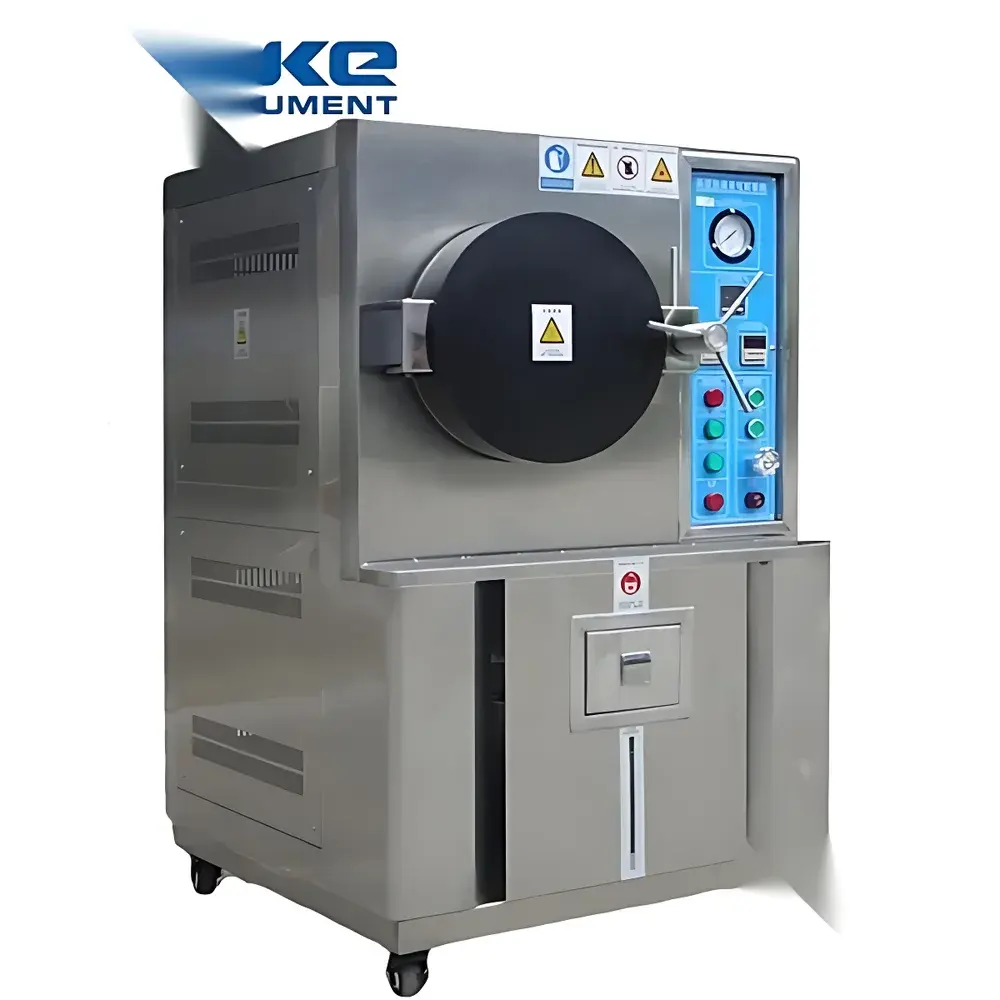
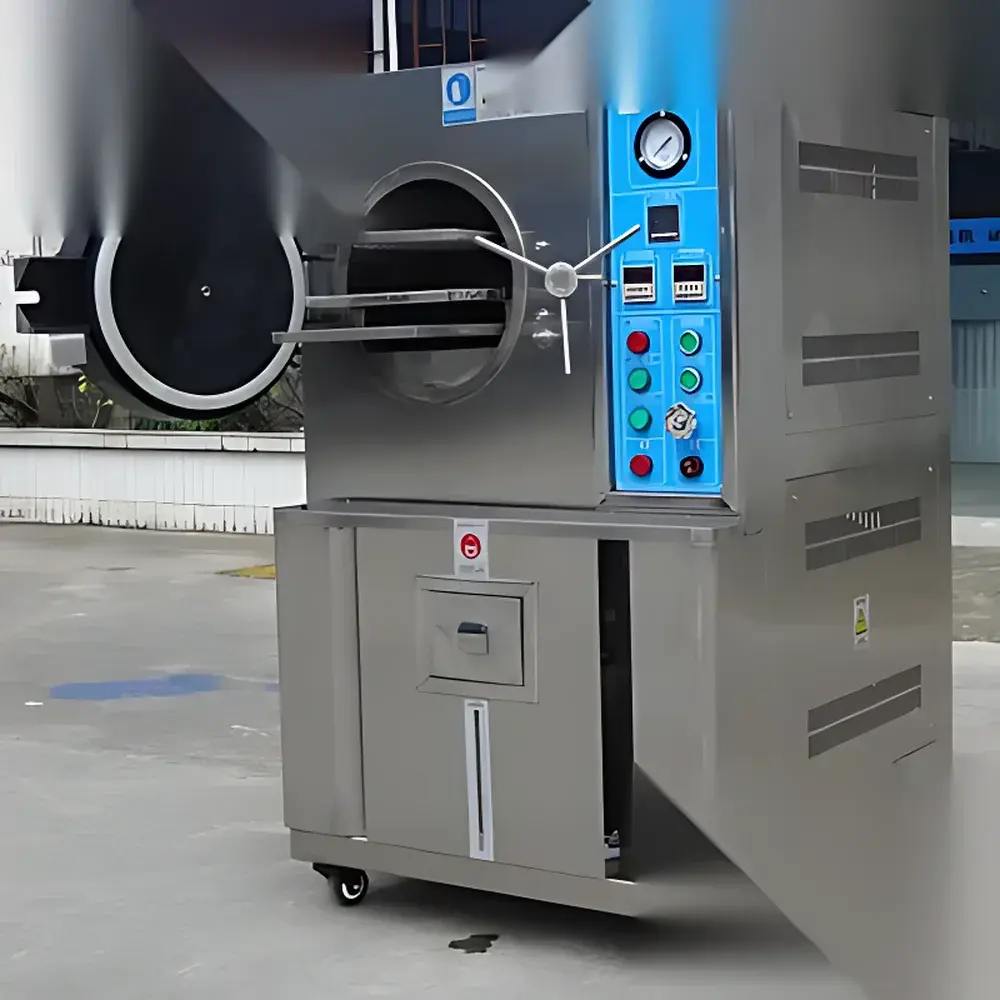
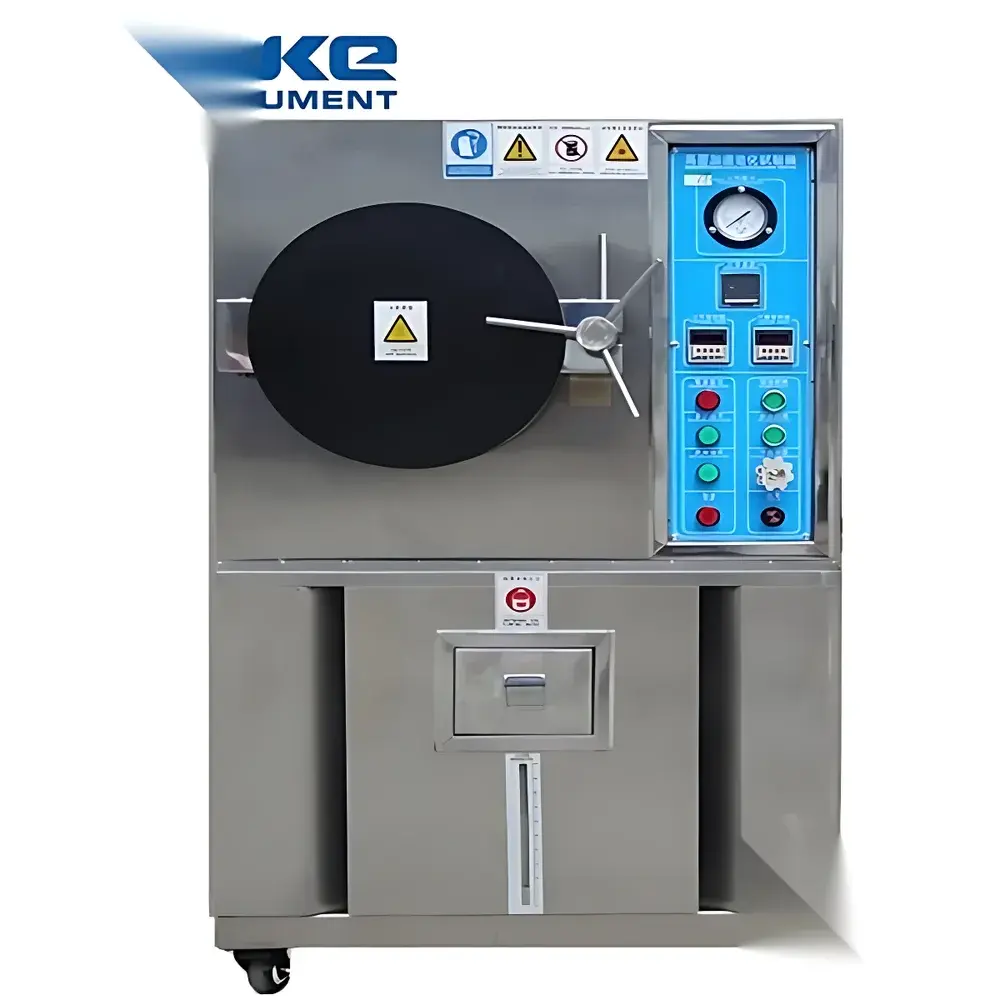
OK-PCT Series High-Pressure Saturated Steam Aging Test Chamber
| Brand | OK Instruments |
|---|---|
| Origin | Imported |
| Manufacturer Type | Authorized Distributor |
| Price | USD 4,100 (FOB) |
| Internal Dimensions (Φ×D) | 30×45 cm to 60×65 cm |
| External Dimensions (W×H×D) | 65×100×65 cm to 85×120×90 cm |
| Temperature Range | 121 °C, 132 °C, (143 °C optional) |
| Humidity | 100 % RH (saturated steam) |
| Operating Pressure (absolute) | 101.3 kPa (ambient) to 304 kPa (2.0 kgf/cm²) |
| Temperature Uniformity | ≤ ±2 °C |
| Humidity Uniformity | ≤ ±3 % RH |
| Safety Systems | Low-water cutoff, overpressure relief valve, overtemperature cutout, auto-locking pressure interlock door, real-time pressure/temperature monitoring |
| Power Supply | AC 220 V ±5 %, 50 Hz ±0.5 Hz |
Overview
The OK-PCT Series High-Pressure Saturated Steam Aging Test Chamber is an engineered environmental stress test system designed for accelerated reliability evaluation of hermetically sealed and moisture-sensitive components under controlled high-pressure saturated steam conditions. It operates on the fundamental principle of pressurized saturated vapor aging—where elevated temperature and absolute pressure synergistically accelerate moisture ingress, hydrolysis, intermetallic diffusion, and delamination mechanisms in electronic packages, multilayer PCBs, IC encapsulants, LED assemblies, and medical-grade polymer housings. Unlike conventional thermal-humidity chambers, the OK-PCT chamber maintains true thermodynamic saturation (100 % RH at defined T/P setpoints), eliminating boundary-layer drying effects and ensuring reproducible, physics-based failure acceleration per JEDEC JESD22-A102D, MIL-STD-883 Method 1008.7, and IEC 60068-2-66. Its cylindrical stainless-steel pressure vessel architecture complies with ASME BPVC Section VIII Division 1 design criteria for low-pressure steam service, enabling safe, long-duration (up to 200 h uninterrupted) testing without manual intervention.
Key Features
- 7-inch industrial touchscreen HMI with embedded PID algorithm for precise saturated steam temperature control—optimized for stability within ±0.5 °C at 132 °C setpoint.
- Integrated dual-sensor safety interlock: real-time monitoring of internal pressure and temperature triggers automatic door lock engagement when P > 101.3 kPa; mechanical reverse-pressure sealing enhances gasket compression as internal pressure rises, improving seal longevity versus traditional clamp-type designs.
- Cylindrical 316L stainless-steel inner chamber and curved liner geometry minimize condensate pooling and eliminate direct impingement of latent heat onto test specimens—critical for uniform thermal stress distribution across stacked PCBs or wafer-level packages.
- Automated water management system with ultrasonic level sensing, self-priming pump, and fail-safe refill logic ensures continuous operation for ≥200 h on a single fill; LED-display timer and analog pressure gauge provide redundant operational verification.
- ASME-certified spring-loaded safety relief valve (set at 310 kPa for standard models) provides passive overpressure protection compliant with ISO 13850 and EN 61000-6-2 requirements for industrial machinery.
Sample Compatibility & Compliance
The OK-PCT chamber accommodates a broad range of sample geometries—including stacked multilayer PCBs (up to 60 cm diameter), ceramic QFN packages, hermetic TO-cans, silicone-encapsulated sensors, and pharmaceutical blister packaging—via adjustable stainless-steel dual-tier racks. All internal wetted surfaces meet ASTM A240/A240M for corrosion resistance in chlorinated steam environments. The system supports full traceability for GLP/GMP-regulated validation: pressure/temperature logs are timestamped, non-volatile, and exportable via USB; configuration parameters are password-protected and audit-trail enabled per FDA 21 CFR Part 11 requirements. Calibration certificates for integrated PT100 sensors and pressure transducers are provided with NIST-traceable documentation.
Software & Data Management
While the base model features standalone microprocessor control, optional PC connectivity (RS-485/Modbus RTU or Ethernet/IP) enables integration into centralized lab data acquisition networks. The OEM software suite supports scheduled test profiles (e.g., ramp-hold-ramp cycles), real-time graphing of P/T/RH trends, automated pass/fail flagging against user-defined thresholds, and CSV/Excel report generation compliant with ISO/IEC 17025 clause 7.8.2. All data files include digital signatures and immutable metadata (operator ID, instrument serial, firmware version), satisfying requirements for regulatory submission under ICH M4Q(R2) and USP .
Applications
- Failure mode analysis of solder joint interfacial oxidation and Cu-Sn IMC growth in automotive ECUs under 132 °C/200 kPa steam exposure.
- Qualification of conformal coating integrity on aerospace-grade flex circuits per RTCA DO-160 Section 26.
- Accelerated lifetime modeling of moisture barrier performance in OLED display encapsulation layers.
- Validation of sterilization process compatibility for Class II medical device housings (ISO 11134).
- Reliability screening of GaN power modules prior to AEC-Q101 qualification.
FAQ
What pressure and temperature combinations are validated for JEDEC JESD22-A102D compliance?
The OK-PCT-45 and larger models are factory-verified at 132 °C / 200 kPa (2.0 kgf/cm² absolute) for 96-hour tests meeting JESD22-A102D Class II requirements.
Can the chamber be configured for 143 °C operation?
Yes—optional high-temp configuration includes upgraded gasket material (FFKM), reinforced pressure vessel lining, and recalibrated safety valve; requires formal engineering review and extended lead time.
Is remote monitoring supported out-of-the-box?
Standard units include local HMI logging only; RS-485 Modbus interface and cloud-ready firmware are available as configurable options.
How is water quality managed to prevent scaling in the steam generator?
We recommend deionized water (≤5 µS/cm conductivity); built-in scale-inhibiting heater elements and periodic acid-decalcification cycles (per maintenance manual) extend service intervals beyond 1,500 operating hours.
Does the system support automated test sequence execution across multiple setpoints?
Yes—advanced firmware (v3.2+) enables up to 16-step programmable profiles with conditional branching based on elapsed time, pressure deviation, or temperature ramp rate.



