
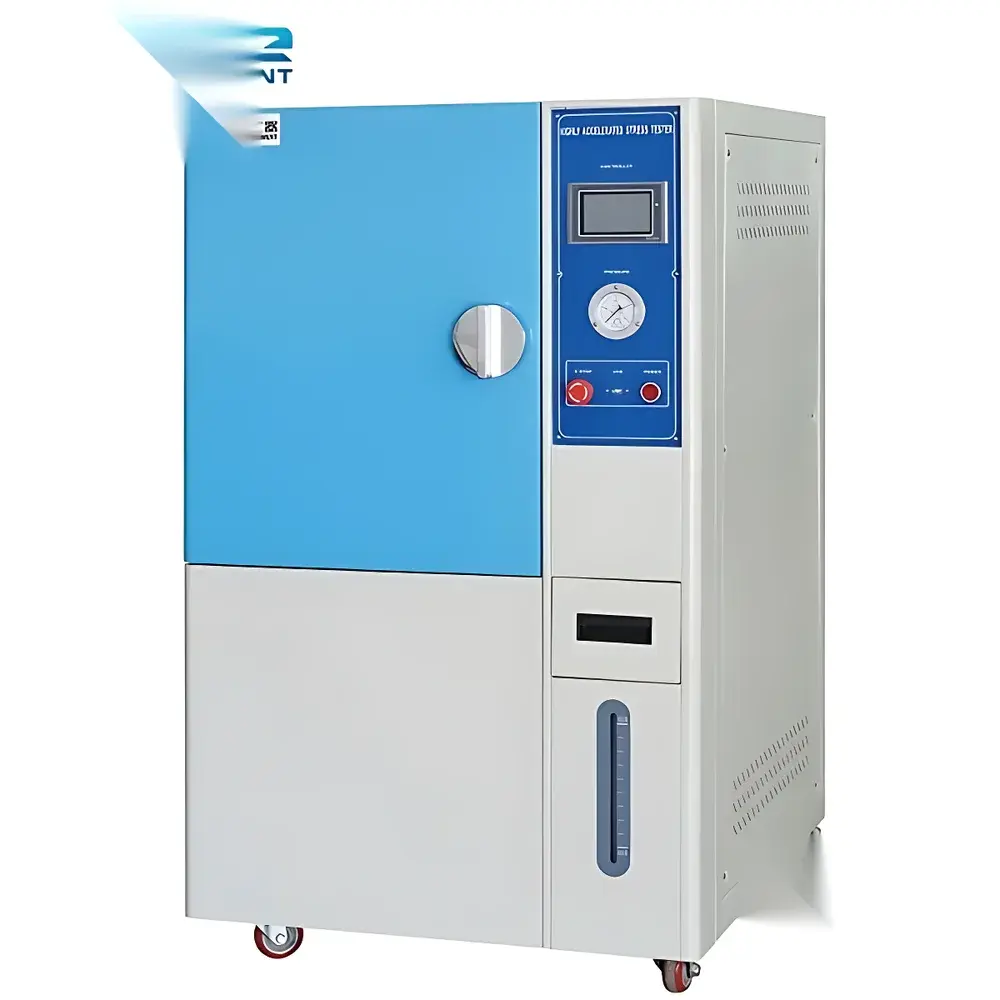
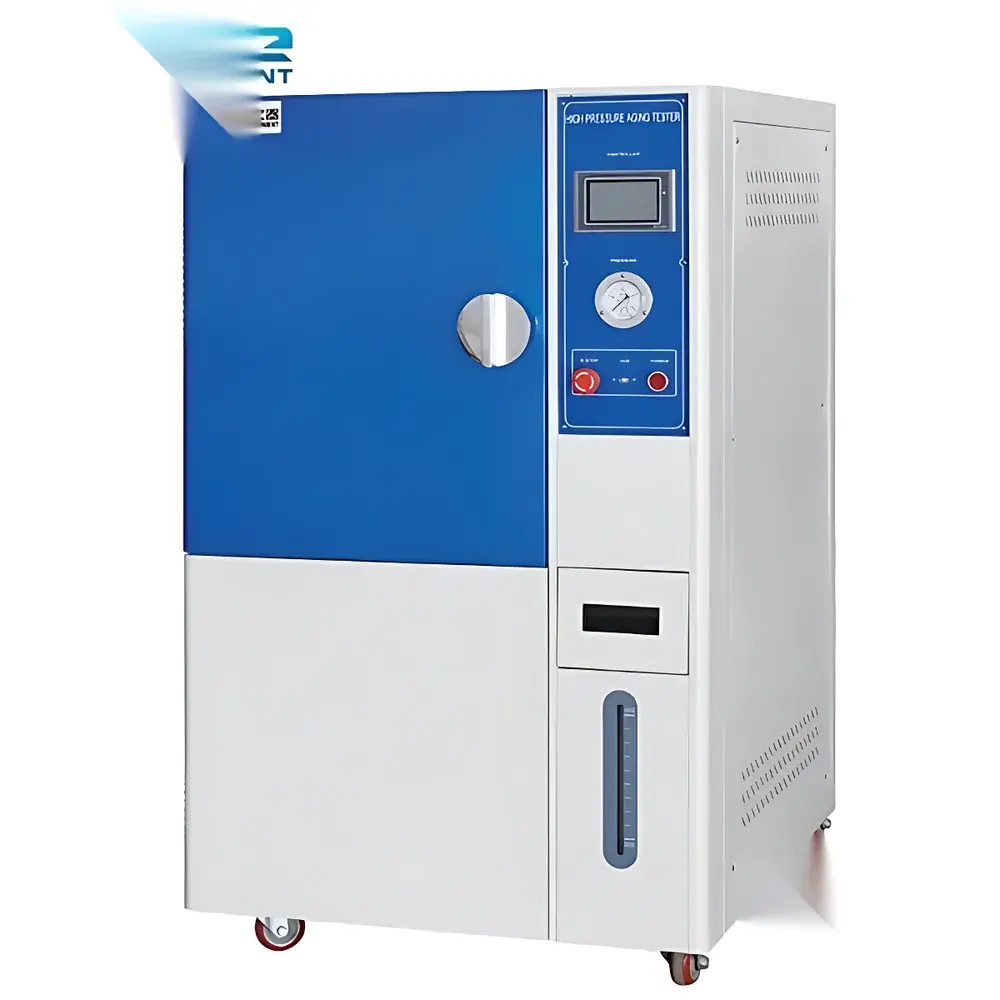
PCT Steam Aging Chamber (Pressure Cooker Test Chamber)
| Brand | Other Brands |
|---|---|
| Origin | Imported |
| Manufacturer Type | General Distributor |
| Price | USD 4,100 (FOB) |
| Inner Chamber Dimensions (cm) | Φ25×35 |
| Temperature Range | 100–132 °C (143 °C optional) |
| Humidity | 100 % RH (saturated steam) |
| Pressure Range | 0.0–4.0 kg/cm² absolute (max safety capacity: 4.0 kg/cm² abs = 1 atm + 3.0 kg/cm² gauge) |
| Temperature Resolution | 0.1 °C |
| Temperature Stability | ±0.5 °C |
| Chamber Material | SUS316 stainless steel |
| Exterior Material | Powder-coated steel |
| Heating System | Electric immersion heater with thermal cutoff |
| Safety Protections | Dual-stage overtemperature, dual-stage overpressure, emergency mechanical pressure relief, door pressure interlock, water-level alarm & auto-shutdown, heater dry-run protection, humidifier overcurrent protection, manual & automatic pressure release |
| Power Supply | AC 220 V / 50–60 Hz / single-phase OR AC 380 V / 50–60 Hz / three-phase |
Overview
The PCT Steam Aging Chamber—commonly referenced in reliability engineering as a Pressure Cooker Test (PCT) chamber—is a controlled-environment test system engineered for accelerated moisture ingress evaluation of hermetically sealed and semi-hermetic electronic components, packaging materials, and polymer-based assemblies. It operates on the principle of saturated steam exposure under elevated temperature and pressure conditions, thereby accelerating hydrolytic degradation mechanisms that occur during long-term field operation. Unlike conventional humidity chambers, this system subjects specimens to thermodynamically coupled stress: simultaneous application of high-temperature saturated vapor (100 % RH), elevated absolute pressure (up to 4.0 kg/cm² abs), and precisely regulated dwell time. This combination dramatically increases the partial pressure of water vapor, driving moisture diffusion through micro-defects, interfacial boundaries (e.g., mold compound–leadframe), and bulk dielectric layers—enabling early detection of latent failures such as wire bond corrosion, delamination, or conductive anodic filament (CAF) formation. Designed to meet fundamental requirements of JEDEC JESD22-A102F, IPC-9701A, and MIL-STD-202 Method 108, the chamber supports qualification-level stress screening during design verification and process validation phases.
Key Features
- Microprocessor-based PID controller with independent real-time display of temperature, pressure, and elapsed test time via LED interface
- SUS316 stainless steel cylindrical inner chamber—corrosion-resistant, seamless construction compliant with ASME BPVC Section VIII Div. 1 vessel safety standards for low-pressure steam service
- Integrated water level sensor with audible/visual alarm and automatic power cutoff upon low-water condition
- Multi-tiered safety architecture: 11 redundant protection circuits including dual-stage overtemperature (primary + secondary limit), dual-stage overpressure (electronic + mechanical), emergency burst disc, door-mounted pressure interlock, and manual/automatic pressure release valves
- Natural convection steam circulation—no internal fans or moving parts—to eliminate turbulence-induced condensate redistribution and ensure uniform saturation
- Calibration-ready analog pressure gauge (0.1 kg/cm² resolution) supplemented by digital transducer output for traceable data logging
- Configurable stainless steel sample racks (standard: two-tier; custom configurations available per IPC-9708 mounting requirements)
Sample Compatibility & Compliance
The chamber accommodates standard JEDEC trays (JEDEC STD-20), wafer-level packages (WLP), QFN, BGA, CSP, and multi-layer PCB assemblies up to Φ50 cm diameter. Its cylindrical geometry eliminates corner shadowing effects common in rectangular chambers, ensuring consistent steam exposure across all specimen surfaces. All internal wetted surfaces are electropolished SUS316 to prevent iron contamination and chloride-induced pitting—critical for semiconductor and medical device qualification. The system is compatible with GLP-compliant audit trails when paired with external data loggers (e.g., Omega OM-DAQPRO-5300). While not certified to IEC 61000-4-x EMC standards out-of-box, it meets CE machinery directive (2006/42/EC) and RoHS 2011/65/EU material restrictions. Optional NIST-traceable calibration certificates (temperature & pressure) are available upon request.
Software & Data Management
This model operates via embedded firmware without proprietary PC software. All operational parameters—including setpoint, ramp rate, hold time, and real-time temperature/pressure values—are displayed locally on the front-panel LED interface. Analog outputs (4–20 mA or 0–5 V) are provided for integration into centralized SCADA or MES platforms. For regulatory compliance in GMP environments (e.g., ISO 13485, FDA 21 CFR Part 11), users may connect third-party validated data acquisition systems (e.g., National Instruments LabVIEW with audit trail module) to capture timestamped, tamper-evident records. The controller retains last-run parameters and fault history (up to 50 events) with time/date stamping—supporting root cause analysis during failure review meetings.
Applications
- Accelerated moisture sensitivity level (MSL) classification per J-STD-020
- Qualification testing of plastic-encapsulated microcircuits (PEMs) under JEDEC JESD22-A110E
- Reliability assessment of automotive-grade ADAS sensors exposed to under-hood thermal-hygric cycling
- Validation of conformal coating integrity on flex-rigid PCBs per IPC-CC-830B
- Failure mode acceleration for MEMS packages with glass frit seals
- Process capability studies for transfer-molded LED modules subjected to thermal shock after PCT exposure
FAQ
What is the maximum allowable test duration per cycle?
Standard operation supports continuous runs up to 999 hours; however, JEDEC-recommended PCT durations range from 16 h (JESD22-A102F, Class H2) to 96 h (Class H3), depending on package type and MSL rating.
Can the chamber be used for unsaturated humidity testing?
No—this unit is specifically engineered for saturated steam environments only. It does not support relative humidity control below 100 % RH.
Is third-party calibration support available?
Yes—certified calibration services (temperature sensor, pressure transducer, timer) are offered with NIST-traceable documentation and uncertainty budgets per ISO/IEC 17025.
Does the system comply with FDA 21 CFR Part 11 for electronic records?
The base unit does not include Part 11–compliant software; however, full compliance is achievable using validated external data loggers with electronic signatures, audit trails, and role-based access control.
What maintenance intervals are recommended?
Monthly inspection of pressure relief valves and water reservoir cleanliness; annual recalibration of temperature and pressure sensors; biannual verification of door gasket integrity and interlock functionality.



