
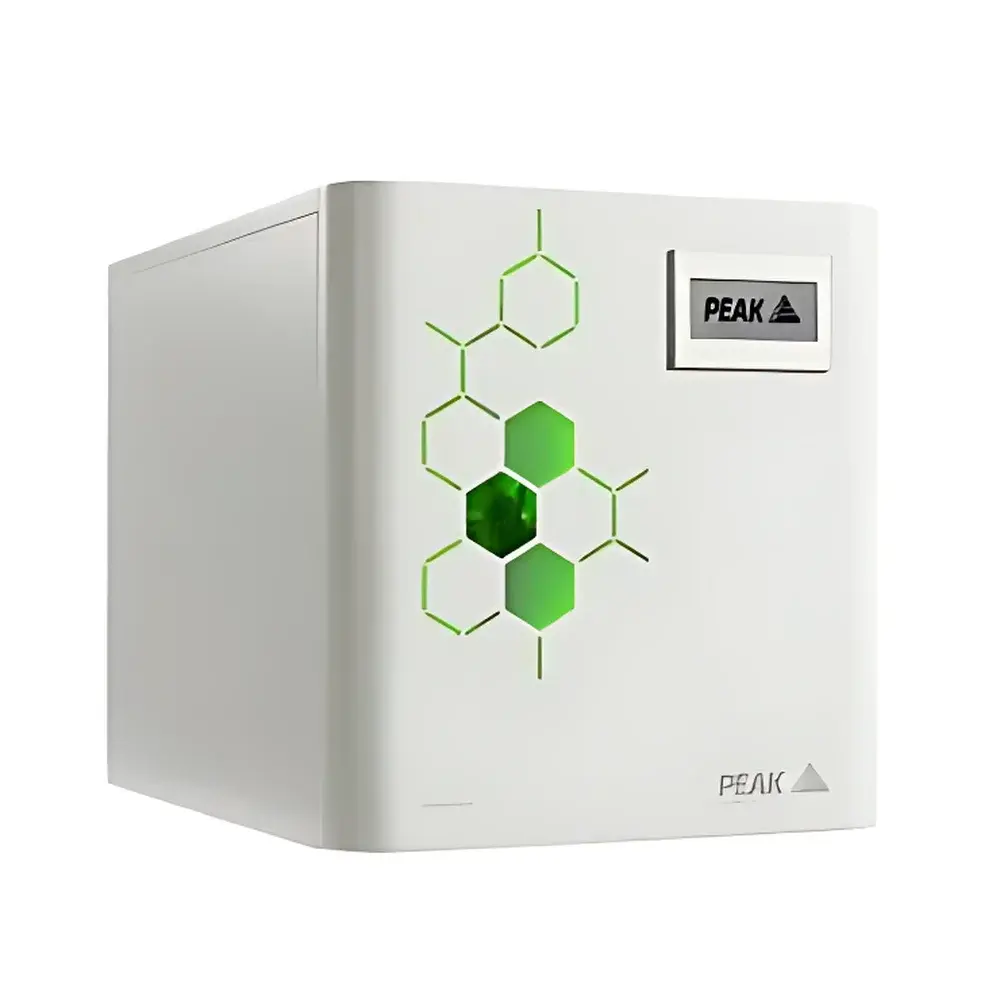
Peak Scientific Precision Hydrogen 200 Hydrogen Generator
| Brand | PEAK |
|---|---|
| Origin | United Kingdom |
| Manufacturer Type | Original Equipment Manufacturer (OEM) |
| Import Status | Imported |
| Model | Precision Hydrogen 200 |
| Hydrogen Generation Principle | Pure Water Electrolysis via Proton Exchange Membrane (PEM) |
| Output Flow Rate | 200 cm³/min |
| Output Pressure | 100 psi (6.9 bar) |
| Hydrogen Purity | 99.9995% |
| Power Consumption | 367–422 W |
| Safety Certifications | CE, UKCA, UL/CSA-compliant design |
| Dimensions (W×D×H) | 280 × 440 × 380 mm |
| Weight | 18.5 kg |
| Internal H₂ Storage Volume | < 50 cm³ |
Overview
The Peak Scientific Precision Hydrogen 200 is a laboratory-grade hydrogen generator engineered for continuous, on-demand supply of ultra-high-purity hydrogen gas (99.9995%) to fuel detectors in gas chromatography (GC) systems—primarily flame ionization detectors (FID) and flame photometric detectors (FPD). Unlike compressed gas cylinders, this generator employs proton exchange membrane (PEM) electrolysis of deionized water—a zero-carbon, catalyst-driven electrochemical process—to produce hydrogen with exceptional consistency and minimal operational overhead. The system operates at a regulated output pressure of 100 psi (6.9 bar), delivering up to 200 cm³/min of hydrogen with inherent flow stability across variable demand conditions. Its compact footprint (280 × 440 × 380 mm) and internal hydrogen inventory of less than 50 cm³ align with modern laboratory safety standards for low-hazard gas generation. Designed for integration into multi-instrument GC laboratories, the Precision Hydrogen 200 supports simultaneous supply to multiple detectors without cross-contamination risk or pressure drop, eliminating dependency on high-pressure cylinder logistics and associated regulatory documentation.
Key Features
- Proton exchange membrane (PEM) electrolysis technology ensures stable, catalyst-free hydrogen generation from deionized water—no caustic electrolytes or metal hydride beds required.
- Integrated dual-stage purification: desiccant drying followed by catalytic oxygen removal and fine particulate filtration delivers consistent 99.9995% H₂ purity (measured by residual O₂ & H₂O ≤ 0.5 ppm each).
- Intelligent pressure regulation maintains constant 100 psi output across flow rates from 0 to 200 cm³/min, compatible with standard GC detector inlet manifolds.
- Automated self-diagnostics continuously monitor PEM stack voltage, electrolyte conductivity, gas purity sensors, and thermal load—triggering safe shutdown upon anomaly detection.
- Modular consumable architecture: only two replaceable components—deionizer cartridge and desiccant column—with tool-free access and <5-minute service intervals.
- UL/CSA and CE/UKCA certified electrical design; integrated pressure relief valve, hydrogen leak sensor, and automatic purge cycle meet IEC 61000-6-4 EMC and ISO 13849-1 functional safety requirements.
Sample Compatibility & Compliance
The Precision Hydrogen 200 is validated for use with all major GC platforms requiring hydrogen as fuel gas—including Agilent, Thermo Fisher Scientific, Shimadzu, PerkinElmer, and Waters systems. It complies with ASTM D3612 Annex A3 for hydrocarbon analysis using FID, and supports method validation under USP , EP 2.2.46, and ISO/IEC 17025-accredited quality management systems. All firmware and hardware configurations adhere to FDA 21 CFR Part 11 data integrity principles when operated with optional Ethernet-enabled remote monitoring. No external ventilation or dedicated exhaust ducting is required, as per NFPA 55 and local fire code allowances for low-storage (< 200 cm³) PEM-based generators.
Software & Data Management
While the Precision Hydrogen 200 operates autonomously via embedded microcontroller logic, optional Ethernet connectivity enables integration into centralized lab infrastructure. Real-time status telemetry—including stack temperature, outlet pressure, cumulative runtime, and consumable life estimation—is accessible via secure HTTPS interface or SNMP polling. Audit trails log all critical events (e.g., power cycles, alarm triggers, maintenance actions) with timestamped records compliant with GLP/GMP electronic record retention policies. Firmware updates are delivered through digitally signed packages, ensuring traceability and cryptographic integrity per NIST SP 800-193 guidelines.
Applications
- Fuel gas supply for GC-FID and GC-FPD in environmental testing (EPA Method 8015, 8260), petrochemical analysis (ASTM D3612, D5186), and residual solvent quantification (ICH Q3C).
- Hydrogen carrier gas in specialized GC applications where helium scarcity or cost necessitates alternative carrier strategies (e.g., fast-GC, microfluidic separation).
- On-site hydrogen sourcing for portable GC systems deployed in field laboratories, mobile analytical units, or cleanroom environments where cylinder handling is prohibited.
- Backup or redundancy source in multi-generator configurations supporting 24/7 analytical operations in pharmaceutical QC labs operating under cGMP Annex 11 compliance.
FAQ
What safety certifications does the Precision Hydrogen 200 hold?
It carries CE, UKCA, and UL/CSA marks, with mechanical and electrical design conforming to ISO 13849-1 PL e and IEC 61000-6-4 emission standards.
Can it supply multiple GC detectors simultaneously?
Yes—its pressure-regulated output supports daisy-chained distribution to up to three FID/FPD units without flow compensation hardware.
How often must consumables be replaced?
Deionizer cartridges require replacement every 6–12 months depending on feed water quality; desiccant columns typically last 12–18 months under continuous operation.
Is remote monitoring supported out of the box?
Standard configuration includes local LED status display and analog alarm relay; Ethernet module is optional but factory-configurable.
Does it meet regulatory requirements for GxP environments?
Yes—its deterministic control logic, event logging capability, and firmware update audit trail support validation per FDA 21 CFR Part 11 and EU Annex 11.



