
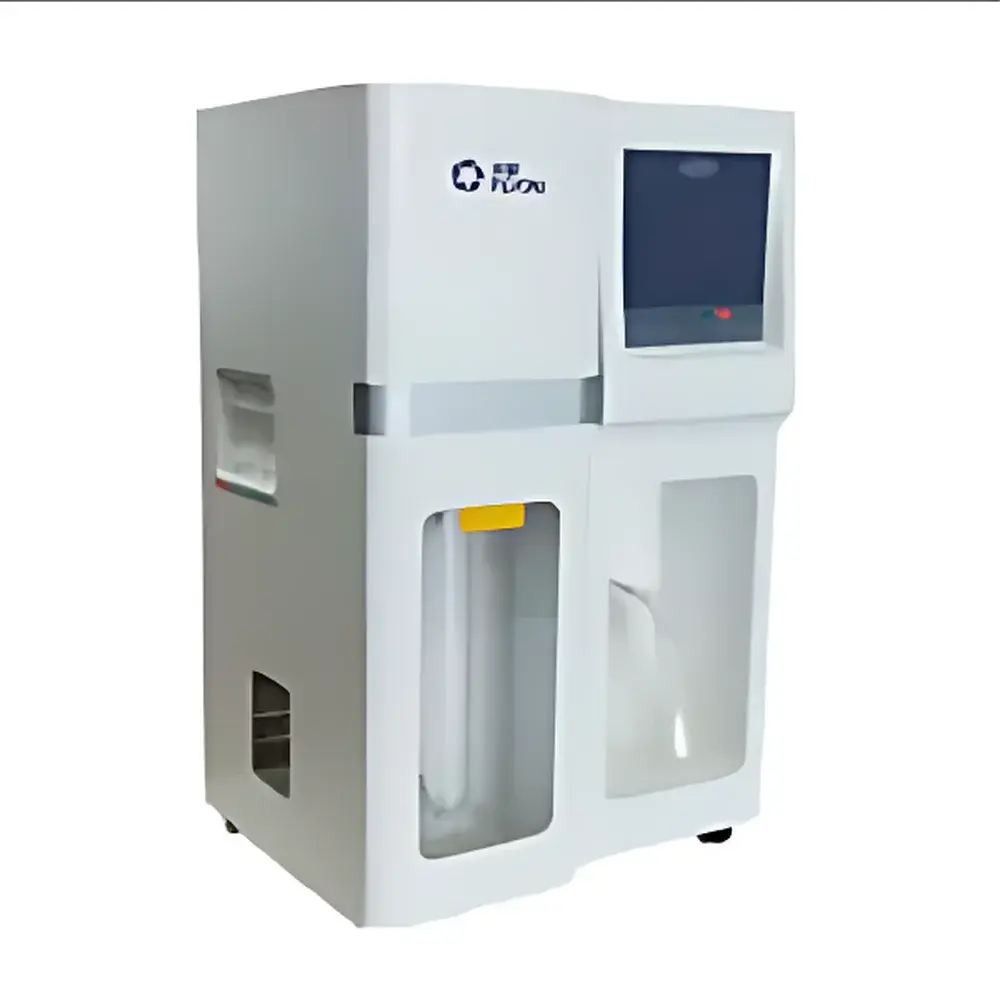
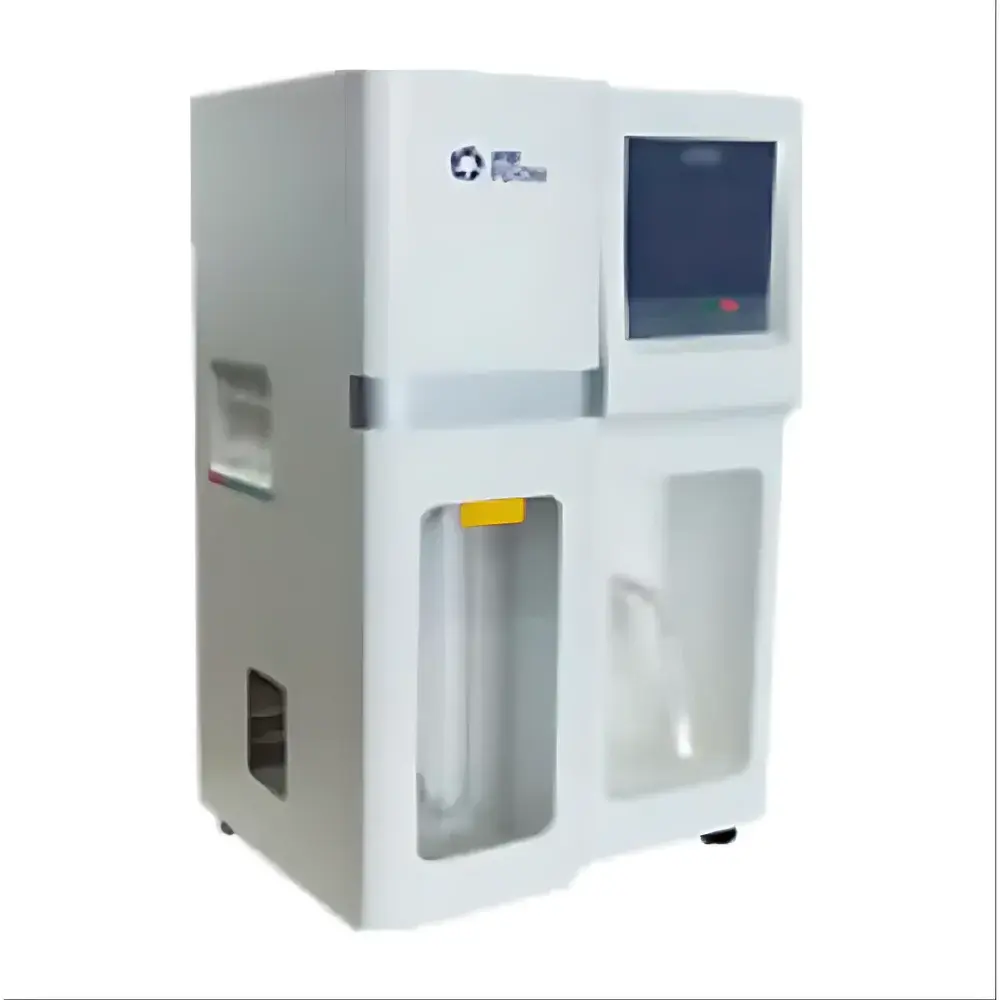
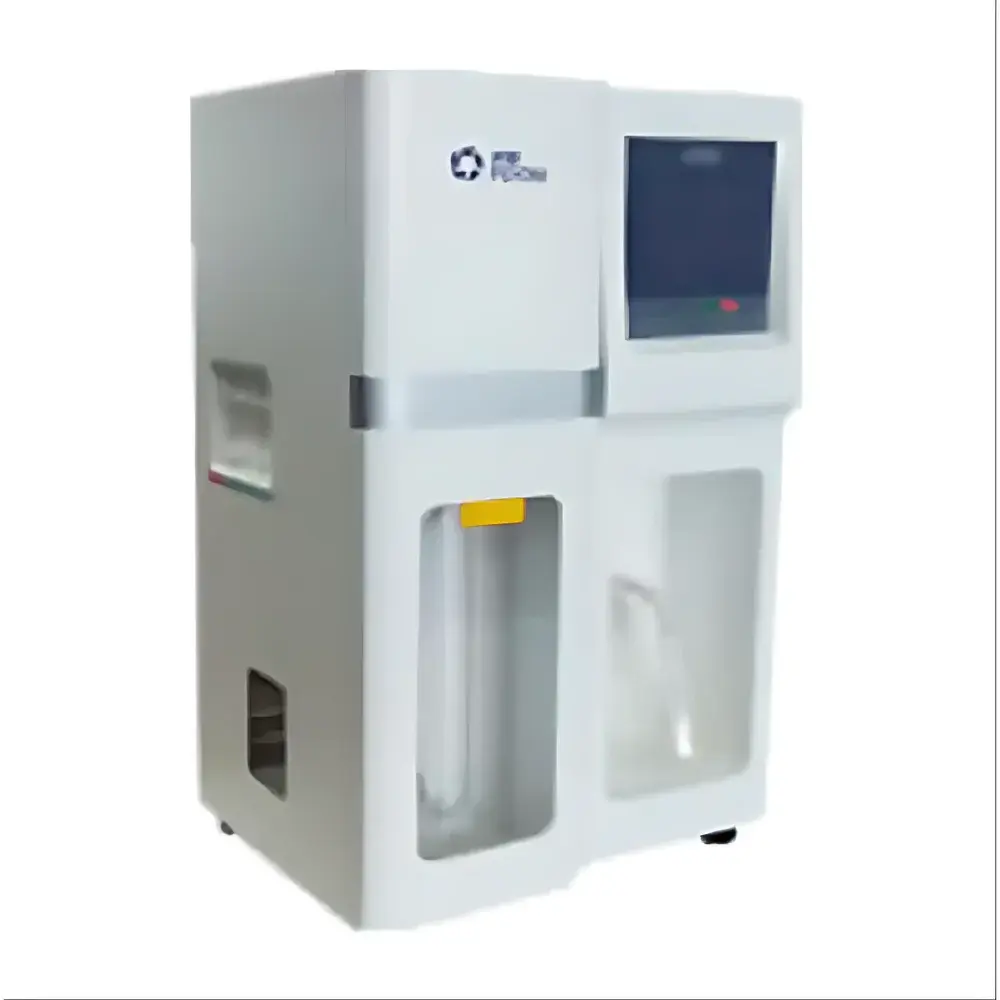
Peiou SKD-100 Automated Kjeldahl Nitrogen Analyzer
| Brand | Peiou |
|---|---|
| Origin | Shanghai, China |
| Model | SKD-100 |
| Housing Material | Monolithic ABS engineering plastic |
| Sample Capacity | ≤5 g (solid) or ≤15 mL (liquid) per run |
| Distillation Time | 3–8 min/sample |
| Nitrogen Measurement Range | 0.1–240 mg N |
| Alkali Addition Time | 0–99 s |
| Distillation Duration Setting | 0–99 min |
| Distillate Flow Rate | 14–28 mL/min |
| Heating Power Adjustment | 750–1500 W |
| Data Storage | 10 programmable distillation/alkali-addition protocols |
| Recovery Rate | >99.5% |
| Repeatability | RSD ≤0.5% |
| Safety Features | Real-time liquid-level monitoring, dry-run protection, overpressure relief, emergency stop |
| Compliance | Designed for ISO 8968, AOAC 981.10, and ASTM D1122-compliant workflows |
Overview
The Peiou SKD-100 Automated Kjeldahl Nitrogen Analyzer is a fully integrated, microprocessor-controlled system engineered for precise, reproducible total nitrogen determination in accordance with classical Kjeldahl methodology. It performs digestion-derived sample conversion—where organic nitrogen is quantitatively converted to ammonium sulfate under acidic catalytic conditions—followed by alkaline distillation, ammonia capture in boric acid, and subsequent titrimetric or colorimetric quantification. Designed for routine QC/QA laboratories in food, feed, agricultural, environmental, and pharmaceutical sectors, the SKD-100 eliminates manual intervention in critical steps: alkali dosing, steam generation, distillate collection, and system conditioning. Its architecture prioritizes operational safety, long-term stability in corrosive environments, and compliance-ready data integrity—making it suitable for GLP-regulated workflows and method validation under ISO/IEC 17025 frameworks.
Key Features
- Monolithic ABS engineering plastic chassis: Chemically inert, non-conductive, and resistant to concentrated H2SO4, NaOH, and HCl vapors—eliminating corrosion-induced leakage, electrical hazards, and structural degradation.
- Corrosion-resistant fluidic pathway: Custom-synthesized high-temperature elastomeric tubing rated for continuous exposure to ≥98% sulfuric acid and 40% sodium hydroxide; validated for ≥36 months of uninterrupted service without replacement.
- Pressure-driven alkali delivery: Eliminates peristaltic or diaphragm alkali pumps—common failure points in conventional systems—by applying regulated pneumatic pressure to the alkali reservoir, ensuring metered, pulse-free reagent dispensing with ±1.5% volumetric consistency across 10,000+ cycles.
- Intelligent steam management: Integrated pressure-balanced steam generator with real-time vapor pressure regulation prevents vacuum-induced back-suction during distillation termination, thereby safeguarding sample integrity and eliminating carryover artifacts.
- Programmable thermal control: Adjustable heating power (750–1500 W) enables optimization for diverse matrix viscosities and digest volumes, maintaining stable distillation rates between 14–28 mL/min with <±2% flow deviation.
- Dry-run and overpressure protection: Dual redundant sensors monitor distillation flask liquid level and chamber pressure; automatic power cutoff activates within 120 ms upon detection of low liquid volume or pressure exceeding 1.2 bar(g).
Sample Compatibility & Compliance
The SKD-100 accommodates solid samples up to 5 g and liquid samples up to 15 mL per digestion tube, supporting heterogeneous matrices including cereal grains, dairy powders, meat homogenates, soil extracts, and wastewater sludge digests. Its performance meets or exceeds acceptance criteria defined in AOAC Official Method 981.10 (crude protein), ISO 8968-1 (milk and milk products), and ASTM D1122 (petroleum products). The system’s deterministic timing logic, fixed reagent delivery, and closed-loop steam control collectively ensure nitrogen recovery ≥99.5% and repeatability (RSD) ≤0.5% across triplicate analyses—fully aligned with USP requirements for method robustness. While not inherently 21 CFR Part 11 compliant, its programmable protocol storage (10 user-defined methods) and timestamped operation logs provide foundational traceability for internal audit and regulatory review.
Software & Data Management
Operation is governed by an embedded single-chip microcontroller with non-volatile flash memory. Ten distinct distillation profiles—including preheating duration, alkali addition timing (0–99 s), steam generation ramp rate, condensate volume target (programmable via time or volume threshold), and post-run alkaline wash sequence—can be stored, recalled, and edited via front-panel LED interface. All parameters are retained after power cycling. Each analysis cycle logs timestamp, program ID, alkali volume estimate, distillation duration, and final condensate volume—exportable via RS-232 interface for integration into LIMS or ELN platforms. No proprietary software or cloud dependency is required; raw data export supports CSV formatting for third-party statistical analysis (e.g., JMP, Minitab).
Applications
- Food & Feed: Crude protein quantification in flour, soybean meal, fishmeal, and infant formula per Codex Alimentarius standards.
- Agriculture: Total nitrogen assessment in fertilizers, compost, and plant tissue for nutrient balance modeling.
- Environmental: Kjeldahl nitrogen (TKN) measurement in municipal wastewater, activated sludge, and sediment cores per EPA Method 351.2.
- Pharmaceuticals: Nitrogen content verification in excipients (e.g., gelatin, casein) and active pharmaceutical ingredient (API) intermediates where stoichiometric nitrogen correlates with purity.
- Research Laboratories: Method development for nitrogen-rich biomolecules (e.g., peptides, nucleic acid derivatives) requiring high-precision stoichiometric calibration.
FAQ
Does the SKD-100 require external cooling water for condensation?
No—the system employs an air-cooled condenser with optimized fin geometry and forced convection; no tap water or recirculating chiller is needed.
Can the SKD-100 be used with automated titrators?
Yes—its standardized 28 mm borosilicate collection flask fits all major autotitrator autosamplers (e.g., Metrohm 809, Hanna HI84532); distillate volume is precisely controlled to match titrant concentration ranges.
Is routine maintenance limited to consumables only?
Yes—beyond periodic cleaning of the alkaline wash line and condenser bore, no scheduled mechanical servicing is required for first 18 months under normal usage (≤20 samples/day).
How is method traceability ensured without electronic signature capability?
Each stored program carries a unique alphanumeric identifier; operators log protocol selection manually in bound lab notebooks, satisfying GLP documentation requirements for non-Part 11 environments.
What is the expected service life of the ABS housing under daily exposure to fume hood conditions?
Accelerated aging tests per ISO 4892-3 confirm no measurable surface degradation, discoloration, or dimensional change after 5,000 hours of continuous exposure to 60°C, 85% RH, and intermittent H2SO4 vapor at 10 ppmv.



