
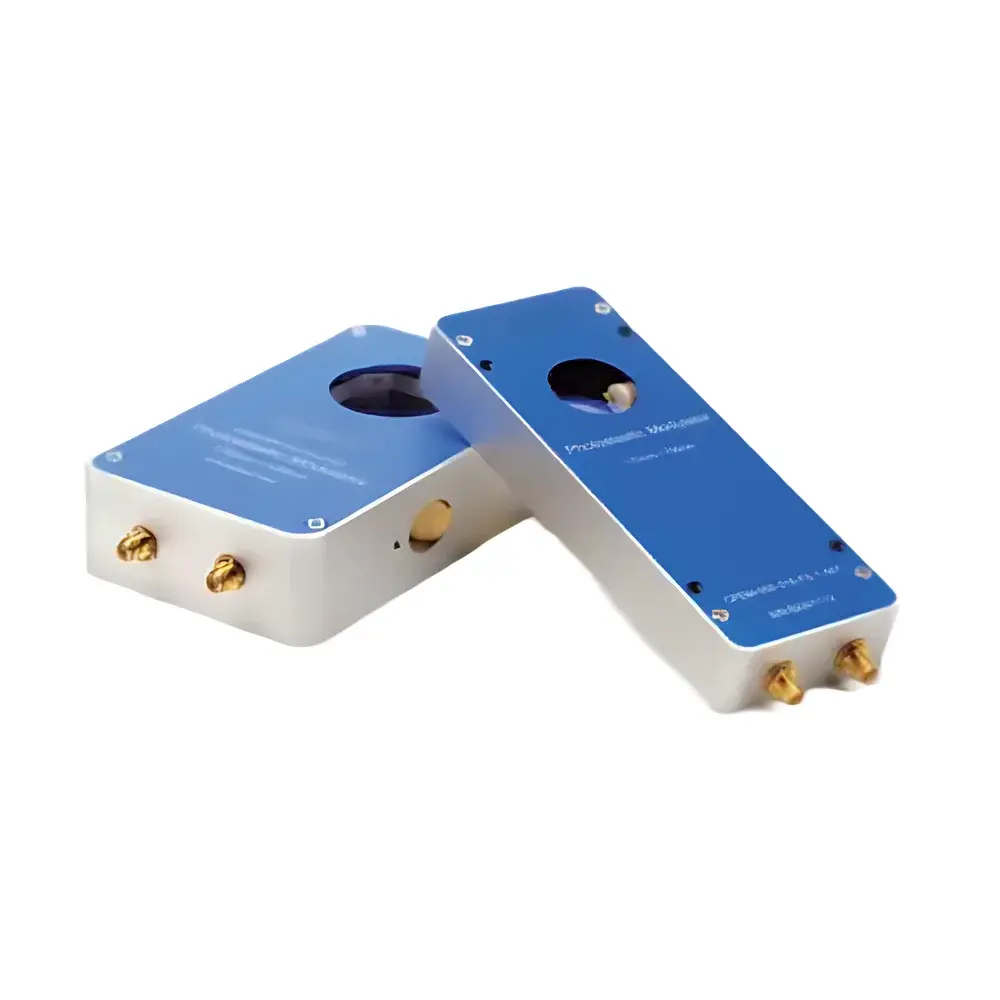
PEM Photoelastic Modulator (Domestic)
| Brand | Other Brands |
|---|---|
| Origin | Domestic |
| Manufacturer Type | General Distributor |
| Origin Category | Imported |
| Model | PEM Photoelastic Modulator (Domestic) |
| Price | Upon Request |
Overview
The PEM Photoelastic Modulator (Domestic) is a high-performance, resonant electro-optic device engineered for precision dynamic polarization modulation in advanced optical metrology systems. Unlike static waveplates, the PEM operates on the principle of photoelasticity: when an isotropic optical material—typically fused silica—is subjected to mechanical resonance via piezoelectric excitation, its refractive index becomes temporarily birefringent in proportion to the applied stress. This induces a time-varying, sinusoidal phase retardation (Δ(t) = Δ₀·cos(2πft)) between orthogonal polarization components of transmitted light. The modulator functions as a “dynamic quarter-wave” or “dynamic half-wave” plate depending on the amplitude setting, enabling lock-in detection with exceptional signal-to-noise ratio in polarimetric and ellipsometric configurations. Designed for integration into research-grade spectroscopic, quantum sensing, and astronomical instrumentation, this domestic PEM variant maintains strict alignment with international performance benchmarks while supporting localized service and calibration infrastructure.
Key Features
- Resonant operation at precisely controlled frequencies: 40 kHz, 50 kHz, and 60 kHz options available—optimized for low-phase-noise, high-stability modulation.
- Large clear aperture variants: up to 22 mm diameter for two-dimensional models and 16 mm for one-dimensional configurations—enabling compatibility with collimated beams and multi-mode optical paths.
- High optical throughput: ≥98% average transmission across UV–VIS–NIR spectral ranges (e.g., 193 nm to 2500 nm), with material-specific coatings and substrate selection (e.g., fused silica for UV stability).
- Wide acceptance angle: ±20° angular tolerance ensures robust performance under non-collimated or convergent beam conditions—critical for Fourier-transform spectrometers and adaptive optics interfaces.
- Dual operational modes: One-dimensional (1D) PEMs provide linear retardation modulation along a single axis; two-dimensional (2D) variants support orthogonal, phase-locked vibration modes for elliptical or arbitrary polarization trajectory generation.
- Engineered mechanical architecture: Monolithic fused silica resonator design minimizes thermal drift and hysteresis, ensuring long-term repeatability and sub-nanometer retardation stability over extended duty cycles.
Sample Compatibility & Compliance
This PEM is compatible with standard optomechanical mounts (e.g., SM1-threaded housings, kinematic baseplates) and integrates seamlessly with commercial ellipsometers, magneto-optic Faraday rotation setups, and cavity-enhanced polarimeters. It complies with ISO 10110-7 (optical element surface quality) and meets mechanical shock/vibration specifications per MIL-STD-810G for laboratory deployment. While not certified to IEC 61000-4 electromagnetic immunity standards out-of-box, it is routinely deployed in GLP-compliant optical laboratories where traceable calibration (per NIST-traceable retardation standards) and documented maintenance logs are maintained. For regulated environments (e.g., pharmaceutical QC labs using PEM-based chiral analysis), optional firmware logging and audit-trail-ready drivers can be configured to align with FDA 21 CFR Part 11 data integrity requirements.
Software & Data Management
The PEM operates via analog voltage-driven resonance control and supports synchronization with external function generators or digital lock-in amplifiers (e.g., Zurich Instruments HF2LI, Stanford Research SR830). Driver electronics include TTL-compatible trigger inputs and quadrature output signals for real-time phase monitoring. Optional PC-based control software (Windows/Linux/macOS) provides frequency fine-tuning, amplitude calibration curves, and automated sweep routines for spectral retardation mapping. All configuration parameters—including operating frequency, drive voltage, and temperature-compensated resonance tracking—are stored in non-volatile memory and exportable in CSV/JSON format for LIMS integration. Firmware updates are delivered via secure HTTPS endpoint with SHA-256 signature verification.
Applications
- Precision ellipsometry: Enables nulling-mode and rotating-analyzer-free measurements for thin-film thickness and optical constant determination (e.g., SiO₂, Al₂O₃, perovskite layers).
- Quantum state tomography: Used in polarization-encoded qubit readout for trapped-ion and photonic quantum computing platforms requiring >10⁵ contrast ratio modulation.
- Astronomical polarimetry: Integrated into adaptive optics-fed instruments (e.g., VLT/SPHERE, Subaru/SCExAO) for exoplanet circumstellar disk characterization.
- Magnetometry: Serves as the core modulation element in optical atomic magnetometers (OAMs), achieving sub-fT/√Hz sensitivity through synchronous detection of Zeeman-split transitions.
- Chiroptical spectroscopy: Supports time-resolved circular dichroism (TR-CD) and vibrational circular dichroism (VCD) measurements in synchrotron and laser-based facilities.
FAQ
What wavelength ranges are supported by standard PEM configurations?
Standard units cover 193–2500 nm, with fused silica substrates optimized for UV–VIS and CaF₂ or ZnSe variants available upon request for deep-UV or mid-IR applications.
Can this PEM be used in vacuum or cryogenic environments?
Yes—custom versions with UHV-compatible materials (e.g., titanium housing, ceramic feedthroughs) and cryo-rated piezoceramics (down to 4 K) are available under OEM agreement.
Is phase calibration traceable to national standards?
Calibration certificates include NIST-traceable retardation amplitude verification at multiple wavelengths using interferometric nulling techniques, with uncertainty budgets provided per ISO/IEC 17025.
How is thermal drift compensated during long-duration measurements?
Integrated temperature sensors enable closed-loop resonance frequency tracking; optional active thermal stabilization modules maintain ±0.02 °C stability over 24-hour acquisitions.
Do you offer OEM integration support for custom optical systems?
Yes—full mechanical, electrical, and optical interface documentation (STEP files, schematic diagrams, API reference manuals) is supplied under NDA, including application-specific firmware development services.





