
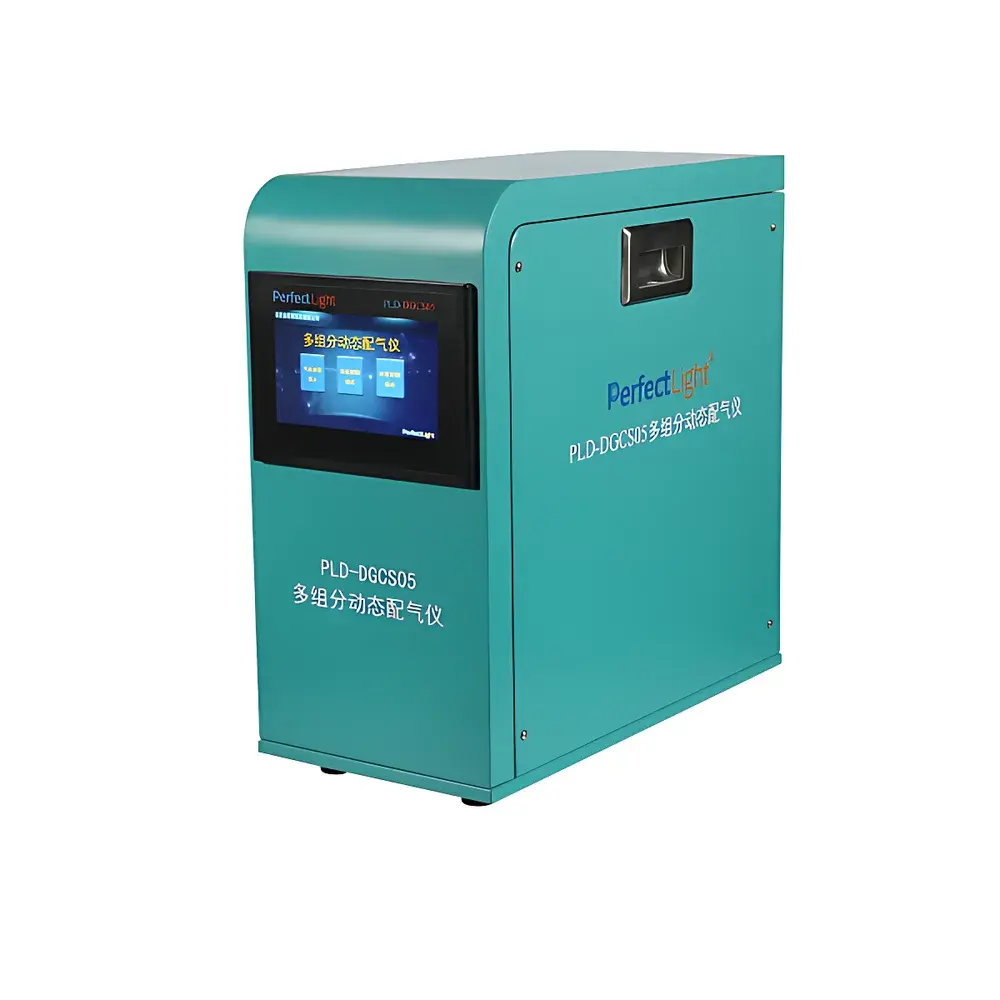
PerfecLight PLD-DGCS Multi-Component Dynamic Gas Mixing System
| Brand | PerfecLight |
|---|---|
| Origin | Beijing, China |
| Model | PLD-DGCS |
| Gas Channels | Up to 8 independent mass flow-controlled inlets |
| Output Ports | Dual configurable outlets (selectable single or simultaneous output) |
| Max Outlet Pressure | 0.4 MPa (gauge) |
| Temperature & Pressure Monitoring | Integrated sensors per outlet |
| Control Modes | Manual (fixed-ratio) and Time-Programmed (dynamic ratio/flow ramping) |
| Display | 7-inch capacitive touchscreen interface |
| Standard Conditions Reference | 0 °C, 101.325 kPa (for all stated flow values) |
| Compliance | Designed for GLP-compliant gas standard generation and traceable calibration workflows |
Overview
The PerfecLight PLD-DGCS Multi-Component Dynamic Gas Mixing System is an engineered solution for precision gas standard generation in research and analytical laboratories. Based on thermal mass flow control technology, it dynamically blends up to eight independently regulated gas streams—comprising reactive precursors, diluents (e.g., N₂, Ar, He), and carrier gases—to produce stable, traceable, and time-resolved gas mixtures. Unlike static dilution methods, the PLD-DGCS enables continuous, high-flow (>100 mL/min per channel, typical range), low-concentration (<1 ppmv to 100% v/v) gas standards with real-time compositional control. Its architecture supports both steady-state delivery and programmable temporal gradients—critical for kinetic studies, catalyst evaluation under transient conditions, and method validation in environmental and catalytic science.
Key Features
- Eight-channel mass flow controller (MFC) array with ±1% full-scale accuracy and <0.5% repeatability, calibrated per ISO 6145-7 for binary and multi-component gas mixtures
- Dual independently monitored outlet ports: software-selectable single-output mode or concurrent dual-output mode, each equipped with integrated temperature (±0.3 °C) and absolute pressure (±0.25% FS) transducers
- Maximum regulated outlet pressure of 0.4 MPa (gauge), compatible with pressurized reactor manifolds and inline humidification modules
- Two operational modes: (1) Manual Mode—intuitive fixed-ratio blending via touch interface; (2) Time-Programmed Mode—user-defined flow and routing schedules with up to 100 time steps, supporting linear ramps, step changes, and dwell periods
- 7-inch industrial-grade capacitive touchscreen HMI with localized English UI, onboard data logging (timestamped flow/pressure/temperature), and USB export capability
- Gas path wetted materials: electropolished 316L stainless steel, VCR® fittings, and metal-sealed solenoid valves—compatible with CO, CO₂, H₂, CH₄, NH₃, NOₓ, VOCs, and inert gases (corrosive gas variants require optional Hastelloy C-276 components and pre-approved inlet configuration)
Sample Compatibility & Compliance
The PLD-DGCS is validated for use with certified reference gases traceable to NIST SRMs and CRM-certified cylinders. It supports preparation of calibration standards compliant with EPA Method TO-15, ISO 16000-6, and EN 14662 for ambient air and stack emission monitoring. All MFCs are factory-calibrated against primary standards under ISO/IEC 17025-accredited procedures. The system meets mechanical safety requirements per PED 2014/68/EU (Category I) and electrical safety per IEC 61010-1. For regulated environments, audit trails—including parameter change logs, user authentication timestamps, and firmware version history—are retained for ≥90 days and exportable for FDA 21 CFR Part 11–aligned review.
Software & Data Management
The embedded control firmware provides deterministic real-time scheduling with sub-second actuation resolution. Logged data (flow setpoints, actual readings, T/P at each outlet, and mode transitions) are stored in CSV format with UTC timestamps and instrument serial metadata. Optional Ethernet/Wi-Fi connectivity enables remote monitoring via HTTP API (RESTful endpoints for status polling and script-triggered sequences). Integration with LabVIEW™, Python (PySerial/requests), or MATLAB® is supported through documented ASCII command protocol. Data integrity safeguards include cyclic redundancy checks (CRC-16) on all communication frames and write-protection for calibration coefficients.
Applications
The PLD-DGCS serves as a core gas delivery subsystem in advanced heterogeneous catalysis research, including but not limited to: CO₂ hydrogenation (to CH₄, CH₃OH, or C₂+ hydrocarbons), CO hydrogenation (Fischer–Tropsch synthesis), methane dry reforming (CH₄ + CO₂ → 2CO + 2H₂), reverse water-gas shift (RWGS), photocatalytic VOC abatement (e.g., formaldehyde, toluene), selective partial oxidation of methane, oxidative coupling of methane (OCM), Sabatier reaction (CO₂ + 4H₂ → CH₄ + 2H₂O), and photocatalytic nitrogen fixation (N₂ → NH₃). It is routinely deployed alongside PerfecLight’s PLR-GSPR atmospheric gas–solid photoreactors, PLR-MFPR-I multifunctional photochemical workstations, and PLR-PTSR-II integrated photo-thermal catalytic platforms—enabling precise co-feeding of reactant gases, controlled humidity introduction, and dynamic stoichiometric modulation during operando spectroscopic interrogation.
FAQ
What is the standard condition reference for all flow specifications?
All volumetric flow rates are referenced to 0 °C and 101.325 kPa (STP), unless otherwise specified in custom calibration certificates.
Can the PLD-DGCS be used with corrosive gases such as Cl₂ or H₂S?
Yes—subject to prior consultation and installation of corrosion-resistant wetted parts (e.g., Hastelloy C-276 MFCs, PTFE-coated solenoids) and assignment to designated inlet ports per gas compatibility matrix.
Is external software required to configure time-programmed sequences?
No—full sequence programming, validation, and execution are performed natively on the 7-inch touchscreen interface; no PC dependency is required for routine operation.
How is gas pathway integrity verified before operation?
A built-in leak-check function performs automated pressure hold tests on selected channels at user-defined setpoints (up to 0.4 MPa), reporting decay rate and pass/fail status per ISO 15848-1.
What maintenance intervals are recommended for long-term accuracy?
Biannual verification against traceable reference gases is recommended; annual recalibration of MFCs is advised for GLP/GMP environments, with full certificate documentation available upon request.



