
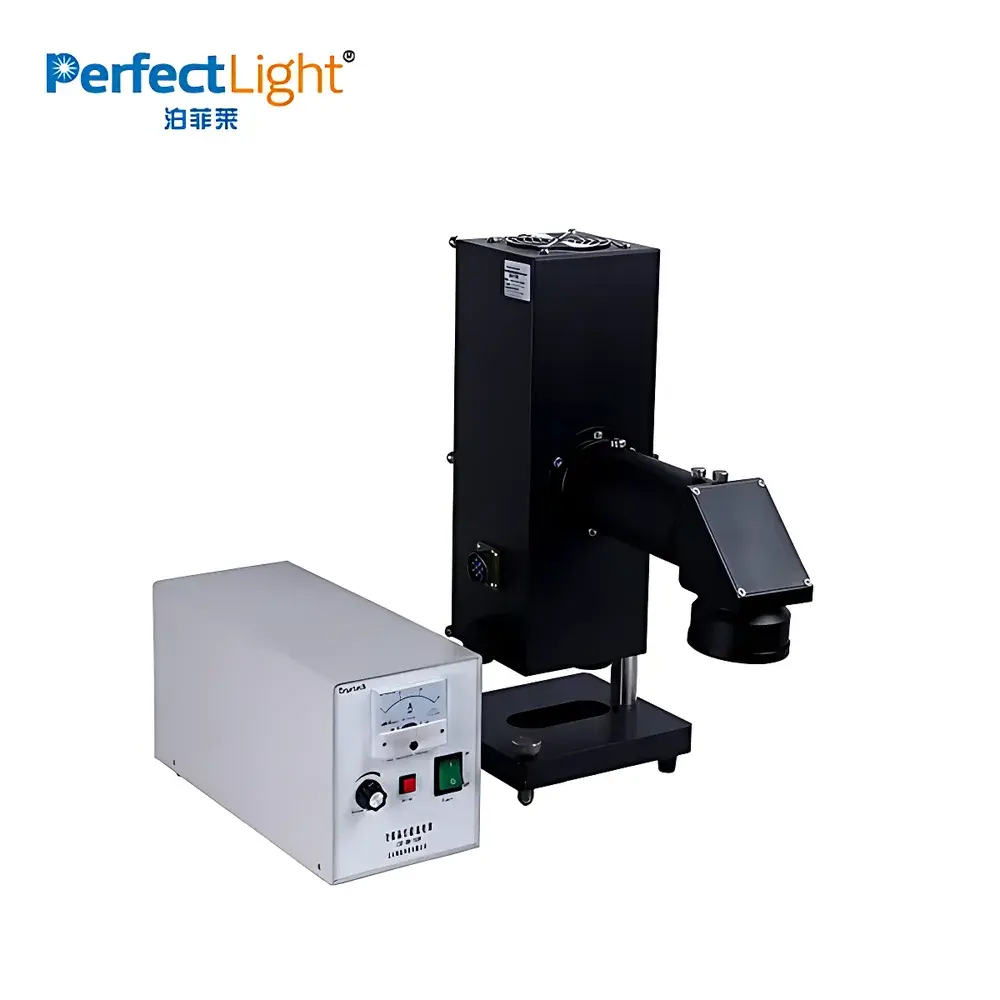
PerfectLight CHF-XM Series Xenon Light Source
| Brand | PerfectLight |
|---|---|
| Origin | Beijing, China |
| Manufacturer Type | Authorized Distributor |
| Product Category | Domestic |
| Model | CHF-XM Series |
| Light Source Type | Xenon Arc Lamp |
| Illumination Mode | External Irradiation |
| Spectral Range | 300–1100 nm |
| Output Modes | Point Source, Collimated Beam, Fiber-Coupled Output |
| Point Source Diameter | 4–6 mm |
| Collimated Beam Diameter | 50 mm (adjustable up to Φ60 mm) |
| Beam Divergence | ≤0.85° (at working distance < 250 mm) |
| Spatial Uniformity | ≤±11% (over Φ60 mm spot), ≤±5% (over 2 cm × 2 cm area) |
| Spectral Continuity | Continuous UV-Vis-NIR output from 300 nm to 1100 nm with strong irradiance in 800–1200 nm region |
| Lamp Power Options | 35 W, 75 W, 150 W, 200 W, 350 W, 450 W, 500 W |
| Optional Accessories | Fiber coupling kits (two fiber types), bandpass/notch/longpass/shortpass filters, calibrated optical power meter, UV/IR safety goggles, lens cleaning cloth, zoom collimation adapter |
Overview
The PerfectLight CHF-XM Series Xenon Light Source is a high-stability, broadband external illumination system engineered for precision photonic and photochemical research. Based on a stabilized DC-powered xenon short-arc lamp, it delivers continuous spectral irradiance across the ultraviolet, visible, and near-infrared regions (300–1100 nm), with pronounced intensity in the 800–1200 nm range—critical for evaluating silicon-based photovoltaic devices and NIR-sensitive photocatalysts. Unlike pulsed or LED-based sources, the CHF-XM provides true steady-state illumination, enabling quantitative quantum yield measurements, time-resolved photocurrent analysis, and reproducible light-driven reaction kinetics. Its design prioritizes spatial uniformity and spectral fidelity, directly addressing a key experimental constraint in standardized photoelectrochemical (PEC) testing, solar cell I-V characterization, and heterogeneous photocatalysis—where non-uniform irradiance introduces systematic error in apparent activity and efficiency metrics.
Key Features
- Triple-output flexibility: switch seamlessly between point-source (4–6 mm diameter), collimated beam (50 mm standard, expandable to Φ60 mm), and fiber-coupled configurations—enabling integration with spectrometers, monochromators, surface photovoltage systems, and fiber-optic sensors.
- High spatial uniformity: ≤±11% irradiance variation over a Φ60 mm collimated spot; ≤±5% over a 2 cm × 2 cm test area—meeting ASTM E927-22 requirements for reference solar simulator classification (Class AAA equivalent for localized testing).
- Optically tunable collimation: adjustable focus mechanism allows real-time optimization of beam diameter and power density without mechanical repositioning—essential for matching active areas of diverse optoelectronic devices.
- Broadband spectral continuity: no discrete peaks or gaps; smooth energy distribution from 300 nm (deep UV) through 1100 nm (NIR edge), facilitating multi-wavelength action spectrum studies and avoiding artifacts induced by narrowband excitation.
- Modular lamp platform: supports interchangeable xenon lamps ranging from 35 W to 500 W, permitting scalability from low-flux kinetic screening to high-intensity accelerated aging or photopolymerization experiments.
Sample Compatibility & Compliance
The CHF-XM is compatible with solid, liquid, and gas-phase samples housed in quartz cuvettes, electrochemical cells, flow reactors, and custom-built photochemical chambers. Its external irradiation geometry enables non-contact illumination of temperature-sensitive, vacuum-compatible, or electrically biased substrates—making it suitable for in situ PEC measurements under controlled atmospheres (e.g., N2, Ar, CO2). The system complies with ISO 9001-certified manufacturing protocols and incorporates safety interlocks aligned with IEC 61000-4 electromagnetic compatibility standards. For GLP/GMP-regulated environments, optional accessories—including NIST-traceable optical power meters and FDA 21 CFR Part 11-compliant data logging software—support audit-ready irradiance calibration and traceable exposure dosimetry.
Software & Data Management
While the base CHF-XM operates via analog/manual controls, it integrates with third-party DAQ systems (e.g., National Instruments, Keysight) for synchronized irradiance monitoring, lamp current/voltage logging, and closed-loop intensity stabilization. Optional PerfectLight Control Suite (v3.2+) enables automated spectral filtering sequencing, time-stamped power density mapping, and export of irradiance profiles in HDF5 and CSV formats—facilitating cross-platform comparison with reference AM1.5G spectra per ASTM G173-22. All calibration certificates include uncertainty budgets compliant with ISO/IEC 17025:2017.
Applications
- Photoelectrochemical (PEC) characterization: steady-state and transient photocurrent response, Mott-Schottky analysis, incident photon-to-current efficiency (IPCE) mapping.
- Solar cell performance validation: I-V curve tracing under simulated sunlight (AM1.5G), series/shunt resistance extraction, degradation rate quantification.
- Heterogeneous photocatalysis: VOC and aqueous dye degradation kinetics, water splitting half-reactions (H2/O2 evolution), CO2 reduction product selectivity studies.
- Photopolymerization & photolithography: spatially resolved curing depth profiling, initiator quantum yield determination.
- Biophotonics & photosensitizer screening: action spectrum acquisition for photodynamic therapy agents, ROS generation quantification.
- Materials photostability testing: accelerated UV-NIR exposure per ISO 4892-2 for polymers, coatings, and OLED encapsulation layers.
FAQ
What spectral calibration options are available for the CHF-XM?
Factory-installed NIST-traceable spectroradiometric calibration is offered for 300–1100 nm at three irradiance levels (low/medium/high lamp power), with full uncertainty reporting per ISO/IEC 17025.
Can the CHF-XM be used for UV-C applications below 254 nm?
No—the fused silica optics and lamp envelope limit effective output to ≥300 nm; for deep-UV work, a deuterium lamp or excimer-based source is recommended.
Is the collimated beam intensity stable over extended operation?
Yes—thermal management and regulated DC power supply ensure ≤±1.5% RMS intensity drift over 4-hour continuous operation at rated lamp power.
How is beam uniformity verified during installation?
A calibrated CCD-based beam profiler (optional accessory) generates ISO 13695-compliant flatness maps; uniformity reports are included with each system shipment.
Are there regulatory documents supporting use in pharmaceutical photostability testing?
The CHF-XM meets ICH Q1B Option 2 (broadband UV-Vis) requirements when configured with appropriate filters and calibrated irradiance; full compliance documentation available upon request.





