
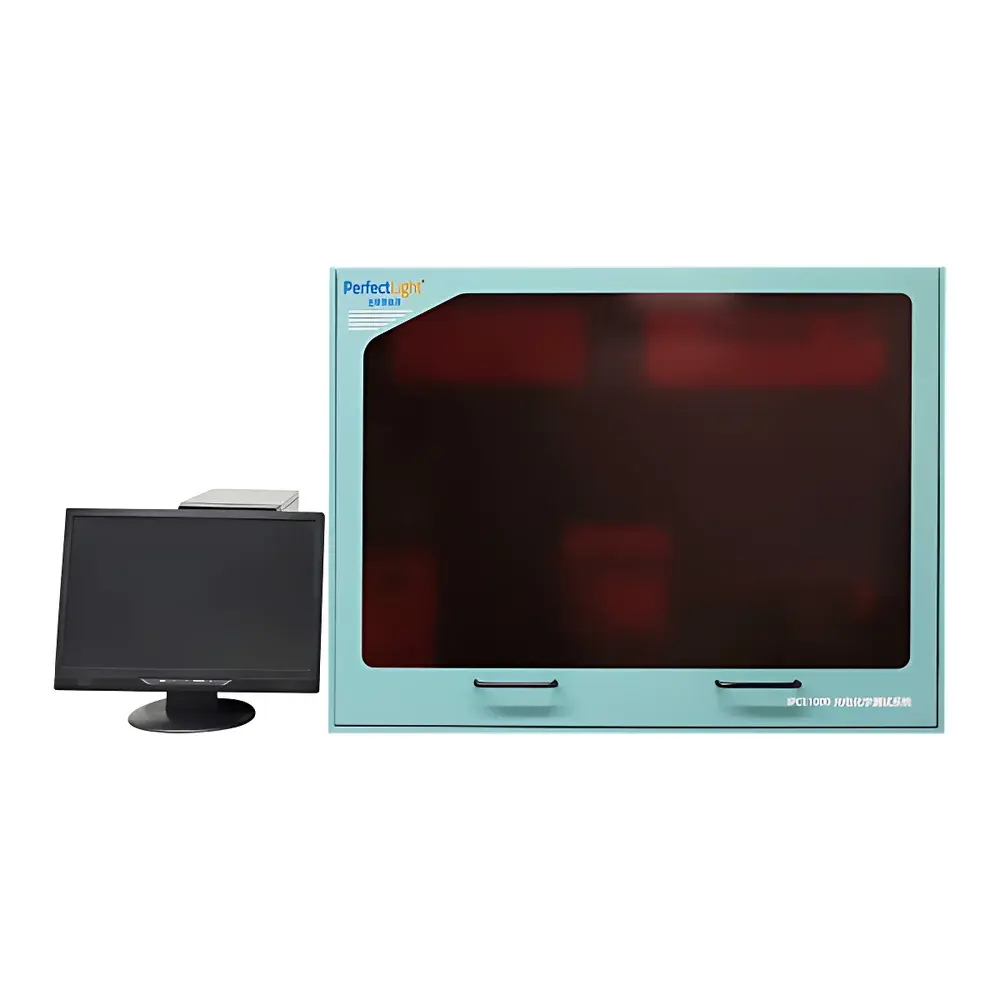
PerfectLight IPCE 1000 Photoelectrochemical Quantum Efficiency Measurement System
| Brand | PerfectLight |
|---|---|
| Origin | Beijing, China |
| Manufacturer Type | Authorized Distributor |
| Product Origin | Domestic (China) |
| Model | IPCE 1000 |
| Pricing | Upon Request |
Overview
The PerfectLight IPCE 1000 Photoelectrochemical Quantum Efficiency Measurement System is a precision-engineered platform designed for wavelength-resolved incident photon-to-current efficiency (IPCE) characterization of photoactive materials under controlled electrochemical conditions. Built upon the principles of monochromatic photocurrent spectroscopy and lock-in detection, the system enables quantitative determination of external quantum efficiency (EQE) across the full UV–Vis–NIR spectrum (200–1000 nm). It integrates a high-stability xenon light source with UV-enhanced output, a dual-grating monochromator for spectral purity and accuracy, a Stanford Research Systems SR830 lock-in amplifier for sub-picoampere current resolution, and an SR540 optical chopper operating from 4 Hz to 3.7 kHz. The system operates in conjunction with a standard potentiostat/galvanostat to perform synchronized photoelectrochemical measurements—including I–V, I–t, V–t, and LSV—under programmable bias, enabling rigorous evaluation of photoanode/cathode kinetics, charge separation efficiency, and spectral response boundaries.
Key Features
- High-sensitivity photocurrent detection: Measures currents from 1 pA to 1 mA using the SR830 lock-in amplifier, achieving signal-to-noise ratios >80 dB in noisy laboratory environments.
- Dual-grating monochromator architecture: Equipped with two interchangeable gratings (1200 L/mm and 600 L/mm), delivering ±0.2 nm wavelength accuracy and ≤10 nm spectral bandwidth (FWHM) across 200–1000 nm.
- UV-optimized optical path: Xenon lamp output enhanced for UV irradiance (up to 20× increase at 254 nm); photodetector responsivity upgraded by two orders of magnitude in the 200–350 nm range to ensure fidelity in UV-responsive catalyst testing (e.g., TiO₂, g-C₃N₄, BiVO₄).
- Continuous wavelength scanning: 1 nm step resolution enables high-fidelity IPCE spectra generation without spectral gaps or interpolation artifacts common in filter-based systems.
- Modular electrochemical interface: Fully compatible with third-party potentiostats supporting three-electrode configuration (working, counter, reference electrodes) and compliant with standard electrochemical cell geometries (e.g., quartz cuvettes, custom dual-compartment reactors).
Sample Compatibility & Compliance
The IPCE 1000 supports solid-state photoelectrodes (e.g., FTO/TiO₂, ITO/WO₃, NiOₓ/Cu₂O), suspended nanoparticle films, and thin-film heterostructures deposited on conductive substrates. Standard testing employs Ag/AgCl (sat. KCl) or SCE reference electrodes, Pt wire counter electrodes, and aqueous electrolytes (e.g., 0.1 M Na₂SO₄, 0.5 M Na₂S/Na₂SO₃). All optical and electronic subsystems adhere to IEC 61000-4 electromagnetic compatibility standards. Data acquisition workflows support GLP-compliant documentation when paired with validated electrochemical software; optional audit trail and user access control modules align with FDA 21 CFR Part 11 requirements for regulated R&D environments.
Software & Data Management
System operation is coordinated via a dedicated Windows-based control suite that synchronizes monochromator positioning, chopper frequency, potentiostat biasing, and lock-in acquisition parameters. Raw photocurrent data are time-stamped, calibrated against NIST-traceable photodiode standards, and automatically converted into IPCE (%) using the formula: IPCE(λ) = (1240 × Iph(λ)) / (λ × Pin(λ)), where Iph is photocurrent (A), λ is wavelength (nm), and Pin is incident monochromatic irradiance (W/m²). Export formats include CSV, MATLAB (.mat), and HDF5 for downstream analysis in Python (NumPy, SciPy), OriginPro, or MATLAB. Batch processing scripts enable automated multi-sample IPCE mapping and statistical reproducibility assessment (n ≥ 3 per condition).
Applications
- Quantitative IPCE profiling of semiconductor photoanodes and photocathodes for solar fuel generation (e.g., water splitting, CO₂ reduction).
- In situ investigation of bias-dependent charge transfer kinetics at semiconductor/electrolyte interfaces.
- Correlation of spectral response with bandgap, defect states, and interfacial recombination losses via combined IPCE + EIS analysis.
- Multi-field coupling studies: Integration with Labsolar-6A gas chromatography modules for simultaneous IPCE and H₂/O₂ quantification; compatibility with external magnetic fields (up to 1 T) or heating stages (RT–200 °C) for operando field-effect photocatalysis.
- Hybrid characterization: Direct coupling with in situ FTIR or differential electrochemical mass spectrometry (DEMS) for real-time identification of surface intermediates during photoelectrolysis.
FAQ
What is the minimum detectable photocurrent under typical experimental conditions?
The system achieves stable 1 pA resolution with 1 s time constant and 12 dB/octave low-pass filtering, assuming optimal electrode geometry and electrolyte conductivity. Signal averaging over 10–30 s further reduces noise floor to ~0.3 pA RMS.
Can the IPCE 1000 be used with non-aqueous electrolytes or ionic liquids?
Yes—provided the electrochemical cell is sealed and optically transparent in the target wavelength range, and the potentiostat supports the required voltage window and current compliance. Quartz or CaF₂ windows are recommended for UV transmission below 220 nm.
Is calibration traceable to national standards?
All optical power calibrations are performed using a NIST-calibrated silicon photodiode (Hamamatsu S1337-1010BQ) with uncertainty <±2.5% (k=2) across 250–900 nm. Electrical calibration follows ISO/IEC 17025-accredited procedures.
Does the system support automated long-term stability testing (e.g., 24 h IPCE monitoring)?
Yes—the control software includes scheduled wavelength/bias sequences with auto-recovery after interruptions, and supports external temperature/humidity logging via RS-485 or USB-DAQ interfaces for environmental correlation.
Are OEM integration options available for custom reactor designs?
PerfectLight provides mechanical drawings, API documentation, and TTL-level trigger I/O specifications for seamless integration with custom flow cells, microfluidic platforms, or vacuum-compatible reaction chambers. Engineering support is available for co-development under NDA.




