
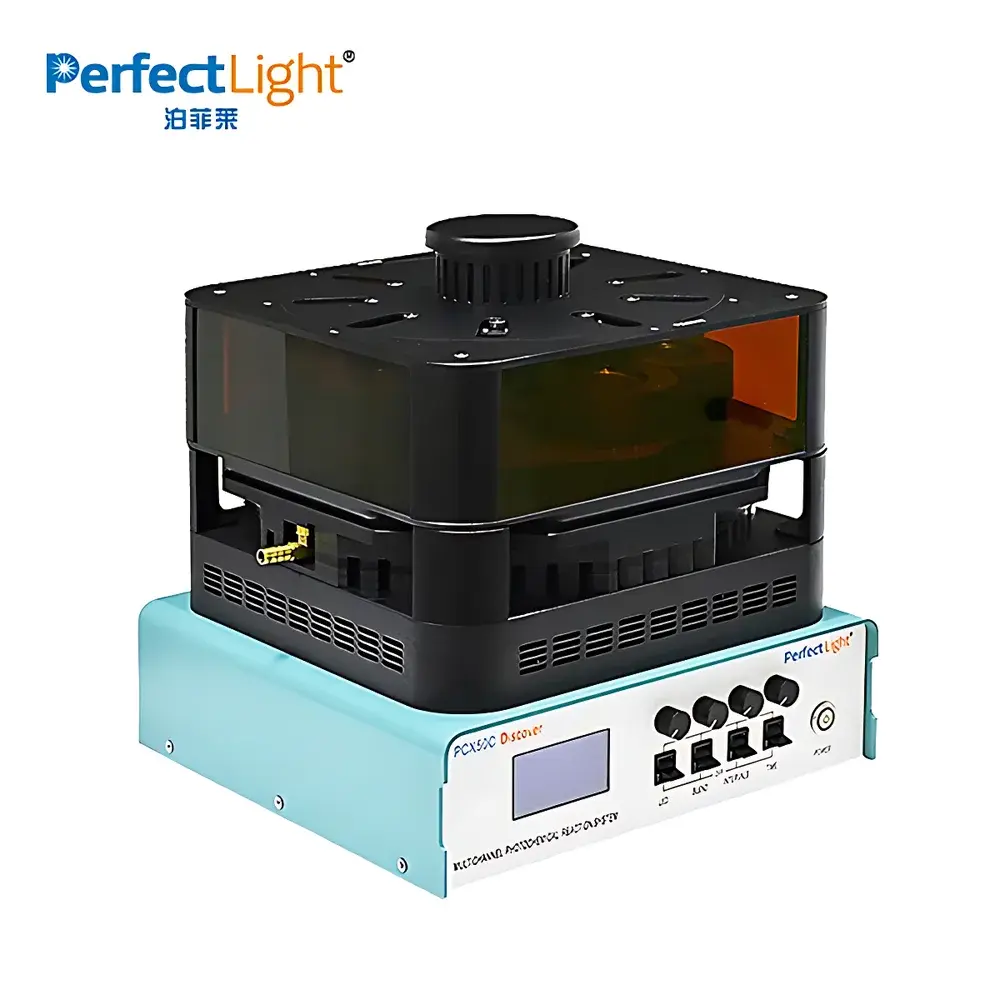
PerfectLight PCX-50C Discover Multi-Channel Photocatalytic Reaction System
| Brand | PerfectLight |
|---|---|
| Origin | Beijing, China |
| Manufacturer Type | Authorized Distributor |
| Product Origin | Domestic (China) |
| Model | PCX-50C |
| Number of Reaction Stations | 9 |
| Illumination Geometry | Bottom-up vertical irradiation |
| Reactor Material | Optical-grade fused quartz base |
| Temperature Control | Integrated recirculating water chiller |
| Temp. Range | 10–80 °C (custom low-temp options available) |
| Temp. Stability | ±0.1 °C |
| Stirring Method | Synchronized magnetic suspension stirring |
| Speed Range | 0–500 rpm |
| Power Supply | 220 VAC / 50 Hz |
| Max. Current | 1 A |
| Timer Range | 1–999 min |
| Pressure Rating | 0.05 MPa |
| Standard Vial Capacity | 50 mL × 9 |
| Optional Vial Sizes | 1.5 mL, 5 mL, 10 mL |
| Vial Base Enhancement | Reflective cup for sub-50 mL vials |
| Vial Cap Options | C1 (degradation), C2 (gas-tight 3-port with auto-sampling interface) |
| Compatibility | AC1000 atmosphere controller, PLA-MAC1005 multi-gas controller, PLA-GPA1000 automated sampler |
Overview
The PerfectLight PCX-50C Discover Multi-Channel Photocatalytic Reaction System is an engineered platform for high-throughput, quantitative photocatalytic experimentation under rigorously controlled optical, thermal, and mechanical conditions. Designed around the principle of uniform bottom-up irradiation through optical-grade fused quartz reactor bases, the system enables precise spatial and temporal control over photon delivery—critical for reproducible quantum yield determination, comparative catalyst screening, and kinetic modeling in heterogeneous photocatalysis. Its nine parallel reaction stations operate under synchronized illumination, temperature regulation, and magnetic suspension stirring, eliminating inter-channel variability caused by lamp non-uniformity, thermal gradients, or rotational inconsistency. The system adheres to fundamental requirements for photoreactor validation per ISO 10676:2022 (photocatalytic activity measurement) and supports experimental traceability aligned with GLP-compliant workflows when integrated with audit-ready data acquisition modules.
Key Features
- Parallel architecture with nine fixed-position reaction stations—enabling statistically robust comparative studies without cross-contamination or positional bias.
- Optical-grade fused quartz reactor bases ensure >92% transmittance across UV–Vis range (200–800 nm); sub-50 mL vials incorporate integrated reflective cups to maximize effective photon flux at the catalyst–substrate interface.
- Modular lamp disk design allows rapid interchange of light sources—including LED arrays, Xe lamps, or filtered Hg lamps—with customizable wavelength combinations (e.g., 365 nm, 405 nm, 450 nm, white light) for action spectrum analysis.
- Synchronized magnetic suspension stirring across all channels, driven by microcontroller–mechanical coupling, guarantees identical shear profiles (0–500 rpm) and eliminates vortex-induced light-path distortion.
- Integrated recirculating water cooling system maintains thermal stability within ±0.1 °C across the full 10–80 °C operating range; includes condensate collection reservoir and quick-connect fittings to prevent moisture ingress into electronics.
- Horizontal leveling calibration function ensures consistent incident angle and optical path length across all reactors—essential for Beer–Lambert compliance in absorbance-based product quantification.
Sample Compatibility & Compliance
The PCX-50C accommodates diverse sample formats via interchangeable vial configurations: standard 50 mL quartz vials (included), plus optional 1.5 mL, 5 mL, and 10 mL variants—all featuring optically flat, pressure-rated (0.05 MPa) bases. Vial caps support multiple operational modes: C1 for open-atmosphere liquid-phase degradation; C2 for sealed, gas-tight environments with three ports—enabling simultaneous inert gas purging, online gas sampling, and integration with automated syringe-based sampling systems. The platform complies with mechanical safety standards per GB/T 20937–2018 (laboratory photoreactors) and supports method validation under ASTM E2657–21 (quantum efficiency measurement) and ISO 22197-1:2016 (NO removal testing). When coupled with optional atmosphere controllers (AC1000 or PLA-MAC1005), it meets gas-handling requirements for VOC oxidation, CO₂ reduction, and PEC cell evaluation under defined partial pressures.
Software & Data Management
While the base PCX-50C operates via front-panel digital interface with programmable timer (1–999 min) and real-time parameter display, it is fully compatible with PerfectLight’s optional PLA-DataLink software suite for time-stamped logging of temperature setpoints, stirring speed, and runtime. When interfaced with third-party GC/MS, HPLC, or gas chromatography systems via RS-485 or Ethernet, the platform supports semi-automated assay sequences—including trigger-based sampling initiation upon timer expiration or external sensor input. Audit trails, user access logs, and electronic signatures are enabled when deployed with validated software packages compliant with FDA 21 CFR Part 11 requirements—facilitating regulatory submissions in pharmaceutical photocatalysis or environmental remediation R&D.
Applications
- Quantitative photocatalytic water splitting (H₂/O₂ evolution) with independent temperature control per batch—supporting Arrhenius analysis and thermodynamic profiling.
- CO₂ photoreduction to CH₄, CO, or C₂H₄ under tunable gas atmospheres; compatible with isotopic labeling (¹³CO₂) studies via C2-cap integration.
- Photodegradation kinetics of aqueous pollutants (methylene blue, phenol, bisphenol A) and gaseous contaminants (formaldehyde, NOₓ, SO₂) under standardized irradiance conditions.
- Action spectrum mapping and apparent quantum yield (AQY) calculation per ISO 25855:2020 using monochromatic LED arrays and calibrated radiometers.
- Photoelectrochemical (PEC) half-cell characterization using conductive substrates mounted in custom electrode-compatible vials.
- Light-triggered polymerization, photoisomerization, and photocatalytic C–N bond formation under inert or reducing atmospheres.
FAQ
Can the PCX-50C be used for gas-phase reactions requiring strict oxygen exclusion?
Yes—the C2 cap configuration provides a gas-tight seal with three standardized ports, enabling continuous N₂/Ar purging, vacuum evacuation, and integration with mass flow controllers for reactive gas mixtures.
Is the system suitable for long-term stability testing (e.g., >100 h)?
Yes—its solid-state magnetic suspension stirrers, corrosion-resistant stainless-steel chassis, and thermally stabilized lamp housing support unattended operation up to 999 minutes per cycle; extended runs require manual or automated cycle stacking.
How is irradiance uniformity verified across all nine stations?
Irradiance mapping is performed using a NIST-traceable UV–Vis radiometer; typical deviation is ≤±3% across the active reactor area when operated with calibrated lamp disks and leveled alignment.
Does the system support custom reactor geometries or non-quartz materials?
Standard configurations use fused quartz only; custom borosilicate or sapphire bases may be fabricated under OEM agreement—subject to optical transmission and thermal expansion compatibility assessment.
What documentation is provided for IQ/OQ/PQ validation?
Factory test reports include dimensional verification, temperature stability curves, stirring synchronization logs, and quartz transmittance spectra; full qualification protocols are available upon request for GMP-aligned installations.



