
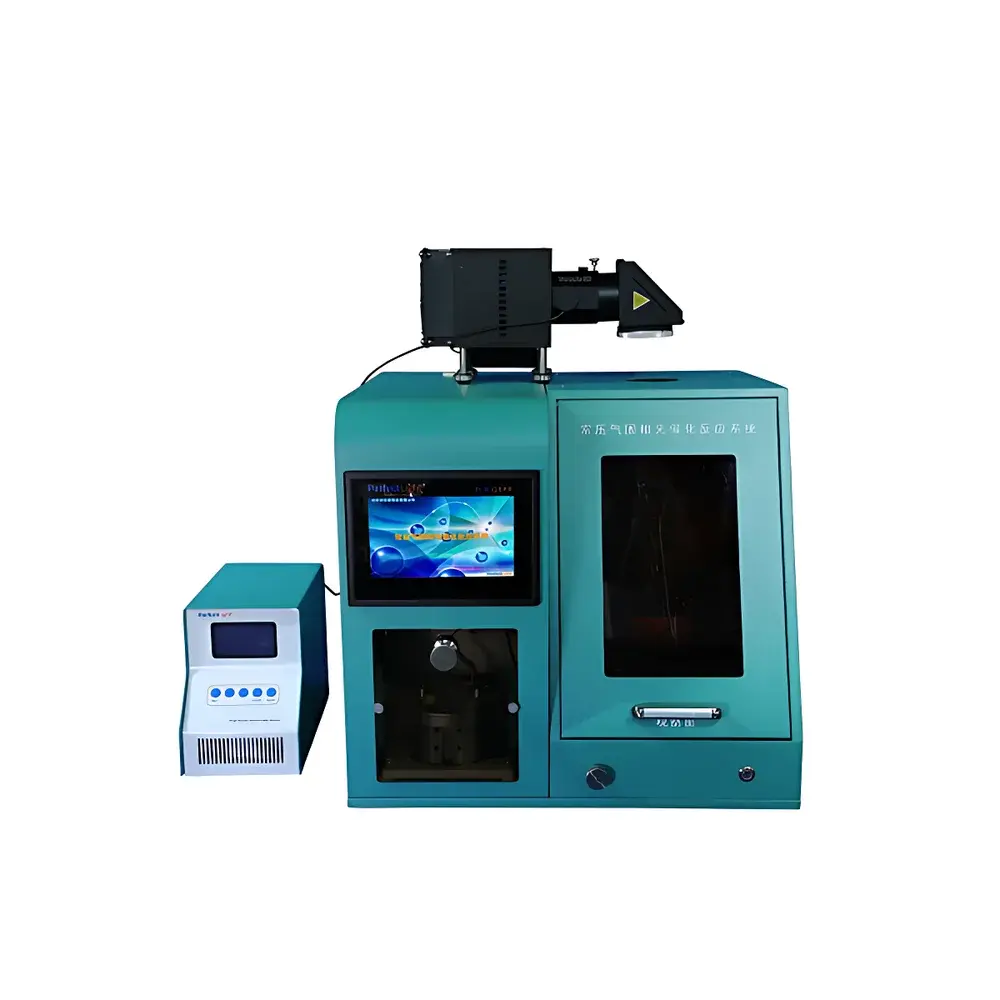
PerfectLight PLR-GSPR Ambient-Temperature and Atmospheric-Pressure Gas-Solid Phase Photocatalytic Reaction System
| Brand | PerfectLight |
|---|---|
| Origin | Beijing, China |
| Manufacturer Type | Authorized Distributor |
| Country of Origin | China |
| Model | PLR-GSPR |
| Pricing | Upon Request |
Overview
The PerfectLight PLR-GSPR is an engineered ambient-temperature and atmospheric-pressure gas-solid phase photocatalytic reaction system designed for standardized evaluation and fundamental research of heterogeneous photocatalytic materials under realistic air-purification conditions. It operates on the principle of controlled continuous-flow photoreactor kinetics, where gaseous reactants (e.g., NOx, VOCs, SOx, formaldehyde) interact with solid-phase photocatalysts—such as TiO2-based films, monolithic blocks, or powder-loaded membranes—under precisely regulated irradiation, humidity, temperature, and residence time. The system was instrumental in the development and validation of GB/T 39716–2020, China’s national standard for testing nitrogen oxide removal efficiency of photocatalytic air purification products. Its modular architecture supports reproducible, traceable, and auditable experimentation aligned with GLP-compliant laboratory practices.
Key Features
- Four independently controllable mass flow channels (expandable to eight), each equipped with thermal mass flow meters (accuracy ±1% FS, repeatability ±0.5% FS, control range 4–100% FS)
- Integrated intelligent humidity feedback system with dual-path humidification: dedicated saturator vessels per gas line and real-time RH monitoring (range 5–95% RH, accuracy ±1% RH, resolution 0.1% RH)
- Dual-point gas-state monitoring: simultaneous inlet/outlet measurement of temperature (±0.01 °C resolution), relative humidity (0.04% RH resolution), and static pressure (range 1–200 kPa, accuracy ±0.2 kPa, resolution 0.1 kPa)
- Plate-type reactor chamber (250 × 120 × 40 mm³) constructed from corrosion-resistant alloy (standard); optional PTFE-lined configuration available for aggressive chemical environments
- Optically optimized reaction zone: quartz-glass window (50 × 100 mm² active area) enabling uniform UV–vis irradiation; bottom-mounted water-cooling interface for thermal stabilization of catalyst bed
- 8.5-inch high-brightness LED touchscreen interface providing real-time visualization of all process variables, alarm states, and historical trend overlays
- ROM-based embedded control firmware supporting multiple operational modes: pure gas flow control, total gas flow regulation, integrated reaction flow management, and virtual flow synthesis
Sample Compatibility & Compliance
The PLR-GSPR accommodates diverse photocatalyst morphologies—including thin-film coatings (100 × 50 × 5 mm³ on glass substrates), bulk monoliths (100 × 50 × 1–10 mm³), and powder-compacted membranes (100 × 50 mm² on porous support)—within its standardized plate reactor (50 × 100 × 5 mm³ working volume) or porous media configuration (50 × 100 × 10 mm³). All wetted components comply with ISO 8502-3 for non-reactive surface finish and are compatible with ASTM D6612 (standard practice for evaluating photocatalytic oxidation of gaseous pollutants). The system meets electromagnetic compatibility requirements per IEC 61326-1 and operates within safety limits defined by IEC 61010-1 for laboratory electrical equipment. Data acquisition and control logs are timestamped and structured to support 21 CFR Part 11-compliant audit trails when paired with validated third-party LIMS integration.
Software & Data Management
Control logic resides in a deterministic ROM-based firmware layer that executes closed-loop sensor feedback at 100 Hz. Sensor inputs—including MFC outputs, capacitive RH sensors, Pt100 temperature probes, and piezoresistive pressure transducers—are digitized with 16-bit resolution and subjected to linearization and temperature compensation prior to actuation. Raw and processed data streams are exported via USB or Ethernet in CSV/JSON format, retaining native timestamps and metadata tags (e.g., “inlet_NOx_ppb”, “catalyst_T_°C”, “RH_feedback_setpoint_%”). Optional OPC UA server add-on enables seamless interoperability with SCADA platforms and enterprise-level analytics tools. All calibration coefficients and user-defined protocols are stored in write-protected memory partitions to ensure integrity across power cycles.
Applications
- Air purification performance testing per GB/T 39716–2020 (NOx removal), ISO 22197-1 (CO oxidation), and ISO 22197-3 (toluene degradation)
- Kinetic modeling of surface-limited photocatalytic reactions under laminar flow conditions (Re < 2000)
- Humidity-dependent quantum yield determination for TiO2, g-C3N4, and MOF-based catalysts
- In situ product analysis coupling: direct interfacing with GC-FID (for C1–C4 hydrocarbons), IC (for NO3−, NH4+), PAS (for sub-ppb VOCs), and chemiluminescence NOx analyzers
- Long-term stability assessment under cyclic illumination/dark and variable RH protocols (e.g., 24-hr aging tests at 60% RH, 25 °C)
FAQ
What standards does the PLR-GSPR directly support?
It was co-developed with national metrology institutes to fulfill the experimental requirements of GB/T 39716–2020 and is routinely used in accredited labs performing ISO 22197 series testing.
Can the system operate without external gas analyzers?
Yes—the base configuration provides full environmental control and reaction monitoring; analyzers are field-selectable add-ons based on target analytes.
Is remote operation supported?
Local touchscreen control is primary; optional Ethernet-enabled firmware allows secure read-only monitoring and scheduled start/stop via browser-based dashboard.
What is the maximum allowable pressure drop across the reactor at 1 L/min?
≤3.5 kPa, verified per ISO 4003–2 for low-backpressure catalytic test rigs.
How is catalyst temperature stabilized during prolonged UV irradiation?
Via thermally coupled water-jacketed baseplate with PID-regulated chiller interface (external chiller required; recommended setpoint: 20–25 °C).



