
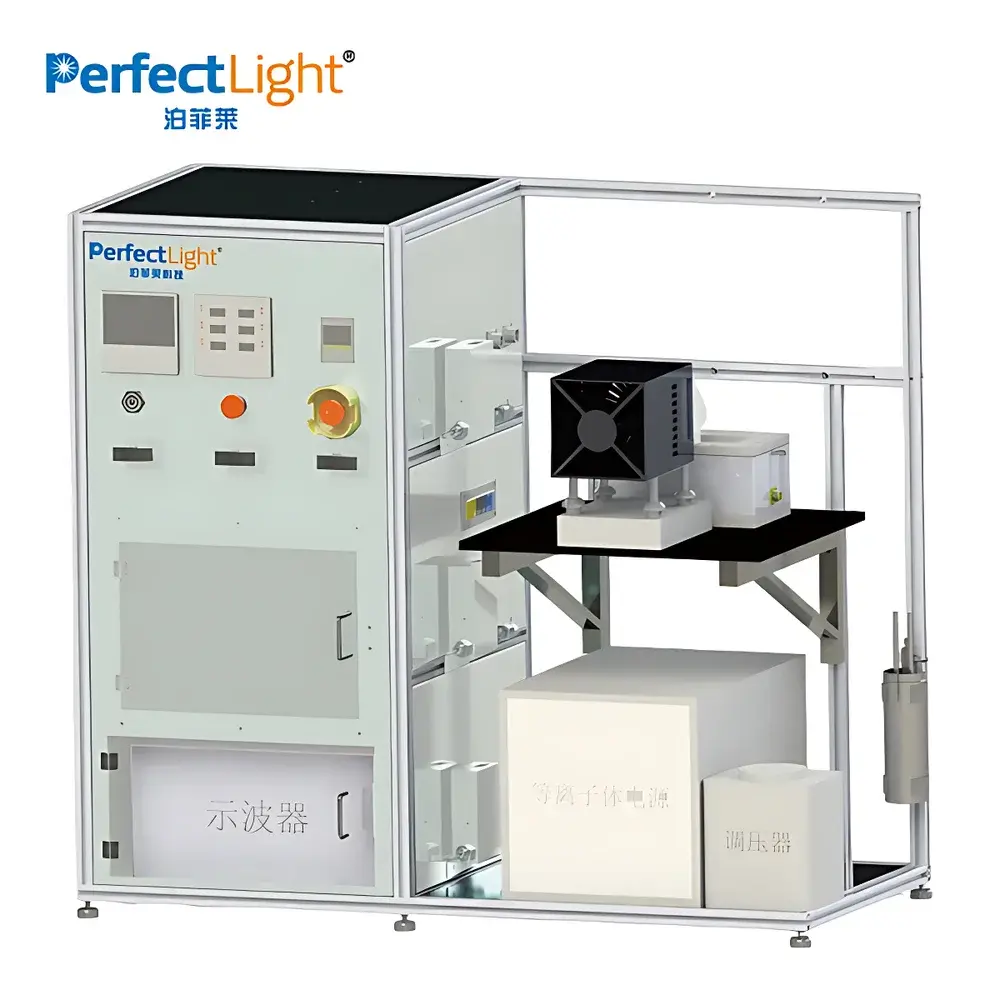
PerfectLight PLR-MPPT-X Plasma-Enhanced Photocatalytic Reactivity Testing Platform
| Brand | PerfectLight |
|---|---|
| Origin | Beijing, China |
| Model | PLR-MPPT-X |
| Gas Flow Control | 3-channel MFC (2–100% F.S., ±1% F.S. accuracy) |
| Liquid Delivery | 1-channel bubbling system (0–120 °C, ±1 °C control) |
| Light Source Compatibility | Xenon lamp (50 mm diameter irradiation area, 19.625 cm²) |
| Plasma Power Supply | 0–500 W, 0–30 kV output, 5–20 kHz frequency, integrated power measurement circuit |
| Heating Capability | Resistive heating plate (RT–300 °C), optional tubular furnace (RT–800 °C, ±1 °C precision) |
| Reactor Types | Integrated flat-plate multi-field coupling reactor (7.5 mL max. catalyst volume, 3 mm discharge gap) + optional tubular reactor (1.8 mL, 2 mm gap) |
| Temperature Monitoring | Up to 600 °C at reactor outlet, −100 to +100 kPa gauge pressure sensing |
| Data Acquisition | RS485-enabled multi-channel temperature/pressure/flow/power monitoring with real-time logging |
| Software | Local HMI + cloud-enabled IoT control interface (remote parameter setting, alarm management, historical trend analysis) |
Overview
The PerfectLight PLR-MPPT-X is an engineered platform for quantitative investigation of multi-field synergistic catalysis under controlled photonic, thermal, and non-thermal plasma environments. It operates on the principle of simultaneous photon absorption (via broadband or monochromatic illumination), localized resistive heating, and non-equilibrium plasma generation—enabling precise decoupling and combinatorial activation of catalytic pathways. Unlike conventional photocatalytic reactors limited to single-energy input, the PLR-MPPT-X integrates spatially resolved plasma discharge (dielectric barrier or corona configuration, configurable via internal electrode architecture), uniform irradiation geometry, and programmable thermal gradients to replicate industrially relevant reaction conditions. Its design adheres to fundamental requirements for mechanistic studies in heterogeneous catalysis: reproducible energy dosing, traceable gas-phase residence time distribution, and thermally stable reaction zones compliant with ISO 18473-3 (plasma process characterization) and ASTM E2912 (photocatalytic activity testing). The system supports both steady-state kinetic evaluation and transient response analysis across a wide operational envelope—from ambient pressure methane dry reforming to high-temperature CO₂ hydrogenation.
Key Features
- Modular multi-field reactor architecture: Integrates flat-plate and optional tubular configurations with independent control of light flux, plasma power, and resistive heating—enabling orthogonal variation of individual energy inputs.
- Uniform plasma discharge geometry: Flat-plate reactor features embedded electrodes with insulated conductive layers and precisely defined 3 mm discharge gap, ensuring repeatable electron energy distribution and minimizing hot-spot formation during extended operation.
- Dual-mode catalytic operation: Supports both sequential pre-activation + catalytic conversion (e.g., plasma-induced surface defect engineering followed by photo-driven reaction) and true concurrent multi-field synergy (simultaneous photon absorption, ion bombardment, and lattice heating).
- Comprehensive process instrumentation: Real-time monitoring of gas flow (3-channel MFCs, N₂-calibrated), reactor outlet temperature (0–600 °C range), inlet pressure (−100 to +100 kPa gauge), and plasma electrical parameters (voltage, current, instantaneous and integrated power) via calibrated internal circuits.
- IoT-enabled control ecosystem: Web-accessible interface for remote parameter adjustment, alarm-triggered shutdown (e.g., overtemperature at heater, bubbler, or tubing), and secure data export compliant with GLP audit trails (timestamped, user-logged, immutable history files).
- Thermally robust mechanical construction: Anodized aluminum frame with silk-screened functional labeling; all wetted parts fabricated from 316L stainless steel (BA finish); gas pathways rated for 0.8 MPa maximum working pressure.
Sample Compatibility & Compliance
The PLR-MPPT-X accommodates powdered, pelletized, and supported catalysts (e.g., TiO₂, g-C₃N₄, Ni/Al₂O₃, CoFe-LDH) in both flat-plate (max. 7.5 mL bed volume) and tubular (1.8 mL, optional) configurations. Its standardized 3 mm discharge gap and 50 mm optical aperture ensure consistent photon delivery and plasma-catalyst interaction depth across experiments. The system meets key regulatory expectations for laboratory-scale catalytic testing: pressure and temperature sensors are NIST-traceable; flow controllers conform to ISO 6358 for pneumatic component calibration; software logging satisfies FDA 21 CFR Part 11 requirements for electronic records (user authentication, audit trail, data integrity). Reaction protocols—including CH₄/CO₂ dry reforming, NH₃ synthesis, VOC abatement, and photocatalytic water splitting—are documented per ASTM D7295 and ISO 22197-1 for inter-laboratory comparability.
Software & Data Management
Control is executed via dual-path architecture: local HMI using RS485-linked multi-channel temperature/flow controllers and remote IoT interface accessible via encrypted HTTPS. The software provides synchronized visualization of up to 16 process variables (e.g., plasma voltage waveform, reactor temperature ramp, gas composition via optional GC integration), with configurable alarm thresholds and automatic CSV export. Historical datasets include metadata (operator ID, timestamp, hardware firmware version) and support post-hoc correlation analysis (e.g., linking plasma power transients to CO yield spikes). All configuration changes generate immutable audit logs meeting GLP/GMP documentation standards. Optional MATLAB® and Python SDKs enable custom kinetic modeling integration.
Applications
The platform is validated for mechanistic studies in: (1) plasma-assisted photocatalysis (e.g., enhancing charge separation in ZnO under UV + DBD); (2) thermally coupled plasma catalysis (e.g., lowering activation barrier for CO₂ methanation via vibrational excitation); (3) comparative benchmarking of catalyst stability under photonic vs. plasma vs. thermal stress; (4) catalyst synthesis workflows (in situ plasma pretreatment followed by photochemical reduction); and (5) reaction network analysis for complex feeds (e.g., toluene steam reforming with simultaneous coke suppression). Published use cases include kinetic isotope effect measurements in N₂ fixation and Arrhenius parameter extraction for plasma-modified Ru/TiO₂ systems.
FAQ
What plasma modes are supported?
The system delivers non-thermal dielectric barrier discharge (DBD) with adjustable frequency (5–20 kHz) and peak voltage (up to 30 kV), optimized for surface-dominated reactions without bulk gas heating.
Can the platform interface with external analytical instruments?
Yes—standard analog/digital I/O ports and Modbus TCP support synchronization with GC, MS, or FTIR systems for real-time product speciation.
Is catalyst loading standardized?
Flat-plate reactors use precision-machined quartz windows and calibrated depth gauges to ensure ≤±0.2 mm bed height repeatability across runs.
How is plasma power measured and calibrated?
Integrated capacitive voltage divider (1000:1 ratio) and Rogowski coil-based current sensing feed into a dedicated power calculation algorithm, traceable to NIST SRM 2801.
What safety certifications apply?
CE-marked per EN 61000-6-4 (EMC) and EN 61000-6-2 (immunity); high-voltage sections comply with IEC 61010-1 for laboratory equipment.



