
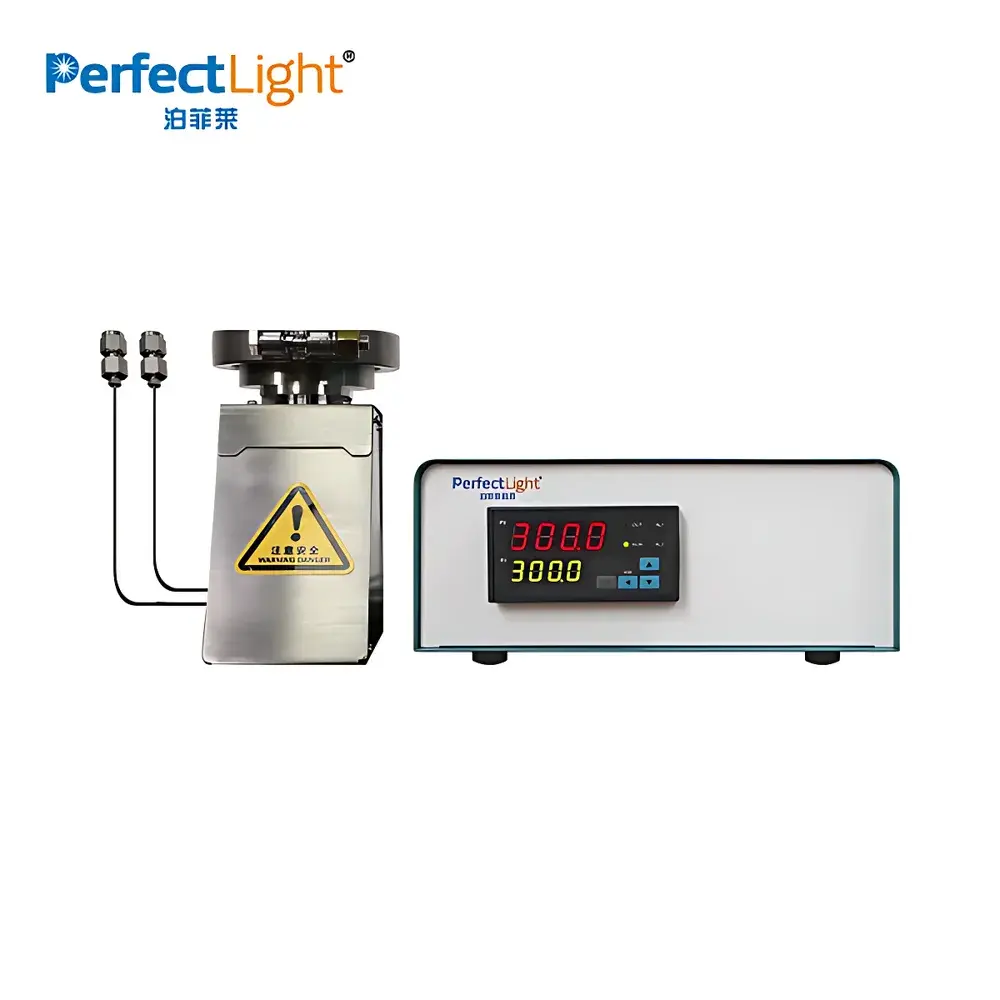
PerfectLight PLR-SYTC Photothermal Synergistic Solar Simulator Reactor System
| Brand | PerfectLight |
|---|---|
| Origin | Beijing, China |
| Model | PLR-SYTC |
| Reaction Pressure Range | 0–0.15 MPa (gauge) |
| Reaction Temperature Range | Ambient to 400 °C |
| Catalyst Bed Volume | 50 mL (customizable: 25/100/200 mL) |
| Reactor Body Material | 304 Stainless Steel |
| Optical Window | Ø47.5 mm JGS1 Fused Silica (Transmittance >97% from 190–2500 nm) |
| Heating Method | Integrated Resistive Heating Element with PID Feedback Control |
| Temperature Sensing | Type K Thermocouple, ±0.1 °C Accuracy |
| Temperature Stability | ±0.5 °C |
| Gas Interface | High-Pressure Metal Push-to-Connect Fittings (Inlet/Outlet/Vacuum/Manual Sampling) |
| Power Monitoring | Real-time Electrical Energy Consumption Logging |
Overview
The PerfectLight PLR-SYTC Photothermal Synergistic Solar Simulator Reactor System is an engineered platform for quantitative investigation of gas–solid phase photocatalytic and photothermal catalytic reactions under controlled, reproducible solar-spectrum illumination and thermal conditions. It operates on the principle of simultaneous, decoupled, and co-regulated photon flux delivery (via broadband xenon-based solar simulation) and precise thermal management (via resistive heating and closed-loop PID temperature control), enabling mechanistic studies of synergistic effects between photoexcitation and lattice heating in heterogeneous catalysts. Designed for laboratory-scale catalyst evaluation, the system integrates optical, thermal, pressure, and electrical monitoring subsystems within a single robust architecture compliant with standard chemical reactor safety protocols for low-pressure (<0.15 MPa gauge) operation.
Key Features
- Solar Spectrum Simulation: Compatible with high-stability xenon light sources (e.g., PLS-SME400E H1), equipped with beam homogenizers and calibrated neutral density filters to deliver uniform irradiance across 190–2500 nm. Supports time-resolved irradiance profiles mimicking natural diurnal solar intensity variation over up to 7 hours — critical for evaluating thermal lag, photon–phonon coupling, and transient reaction kinetics.
- Precision Thermal Management: Integrated resistive heating element embedded within the 304 stainless steel reactor body, coupled with a Type K thermocouple positioned at the catalyst bed center. Achieves temperature control from ambient to 400 °C with ±0.1 °C sensing accuracy and ±0.5 °C steady-state stability via adaptive PID algorithm.
- Dual-Mode Control Architecture: Supports both electrically driven (‘E-mode’) and illumination-driven (‘L-mode’) operational paradigms. In E-mode, temperature is set independently; in L-mode, irradiance level modulates thermal setpoint dynamically — facilitating studies of intrinsic photothermal conversion efficiency and non-radiative relaxation pathways.
- Modular Gas Handling System: Features industry-standard high-pressure metal push-to-connect fittings rated for 0.15 MPa, supporting rapid reconfiguration between flow-through and batch modes. Includes dedicated vacuum line, manual sampling valve, and calibrated mechanical pressure gauge with ISO 10100-compliant mounting interface.
- Optically Optimized Reactor Core: Equipped with a Ø47.5 mm JGS1 fused silica viewport offering >97% transmittance across UV–NIR range. Quartz selection complies with ASTM F798 for optical-grade fused silica, ensuring minimal spectral distortion and thermal shock resistance during rapid temperature cycling.
- Software-Integrated Data Acquisition: Hosted PC software provides synchronized logging of irradiance (via external sensor input), temperature, pressure, power consumption, and user-defined process variables. Supports up to 10-segment programmable temperature ramps with dwell time and rate specification per segment.
Sample Compatibility & Compliance
The PLR-SYTC accommodates powdered, pelletized, or monolithic solid catalysts loaded into a removable quartz or stainless-steel sample holder. Its 50 mL standard reactor volume (expandable to 25/100/200 mL upon request) supports catalyst loadings typical for kinetic screening (e.g., 0.1–2.0 g) while maintaining representative mass transfer characteristics. The system meets ASME B31.3 process piping design criteria for low-pressure gas service and conforms to IEC 61000-6-3 electromagnetic compatibility standards. All electrical components are CE-marked; pressure containment design follows GB/T 150.1–2011 (equivalent to EN 13445) for unfired pressure vessels. Optional integration with FTIR, GC, or MS analyzers is supported via standardized 6 mm Swagelok ports.
Software & Data Management
The proprietary Windows-based control software implements audit-trail functionality compliant with FDA 21 CFR Part 11 requirements when operated in validated mode (user-configurable electronic signatures, change logs, and data immutability settings). Raw data streams are saved in HDF5 format for long-term archival and interoperability with MATLAB, Python (h5py), or OriginLab. Real-time power consumption tracking enables calculation of specific energy input (kWh/mol converted), supporting techno-economic analysis and Life Cycle Assessment (LCA) workflows. Export options include CSV, PDF reports, and timestamped PNG plots with SI-unit annotations.
Applications
- Quantitative determination of apparent quantum yield (AQY) and solar-to-fuel efficiency (STF) under spectrally resolved illumination
- Decoupling of photonic vs. thermal contributions in CO₂ hydrogenation, NH₃ synthesis, and VOC oxidation
- Accelerated aging studies of photocatalyst thermal stability under combined UV–vis–NIR irradiation
- In situ/operando correlation of surface temperature (via IR thermography integration) and reaction intermediates (via DRIFTS)
- Development and validation of microkinetic models incorporating photon absorption cross-sections and lattice heat capacity terms
FAQ
What light sources are compatible with the PLR-SYTC system?
The system is designed for use with collimated, water-cooled xenon arc lamps (e.g., PLS-SME400E H1) delivering ≥300 W output and AM1.5G spectral match within ±15% tolerance per ASTM G173-03. LED-based solar simulators may be integrated subject to irradiance uniformity verification.
Can the reactor operate under vacuum or inert atmosphere?
Yes — the gas manifold supports evacuation to ≤10⁻² mbar and purging with N₂, Ar, or synthetic air. All seals utilize FKM elastomers rated for continuous service up to 400 °C.
Is third-party instrument integration supported?
Standard analog (0–10 V, 4–20 mA) and digital (RS-485, Modbus RTU) interfaces enable synchronization with external GC, mass spectrometers, or pyrometers. Custom API development is available under NDA.
What safety certifications does the PLR-SYTC hold?
The system carries CE marking for EMC and Low Voltage Directive compliance. Pressure vessel components meet GB/T 150.1–2011; full system installation requires local regulatory review per jurisdictional pressure equipment regulations (e.g., PED 2014/68/EU, ASME Section VIII Div. 1).
How is temperature uniformity across the catalyst bed ensured?
A machined aluminum sample stage with integrated thermal paste channels ensures axial heat conduction from the heater to the catalyst bed. Validation data (available upon request) confirms radial ΔT < 2 °C and axial ΔT < 5 °C across the 50 mL bed at 300 °C steady state.



