
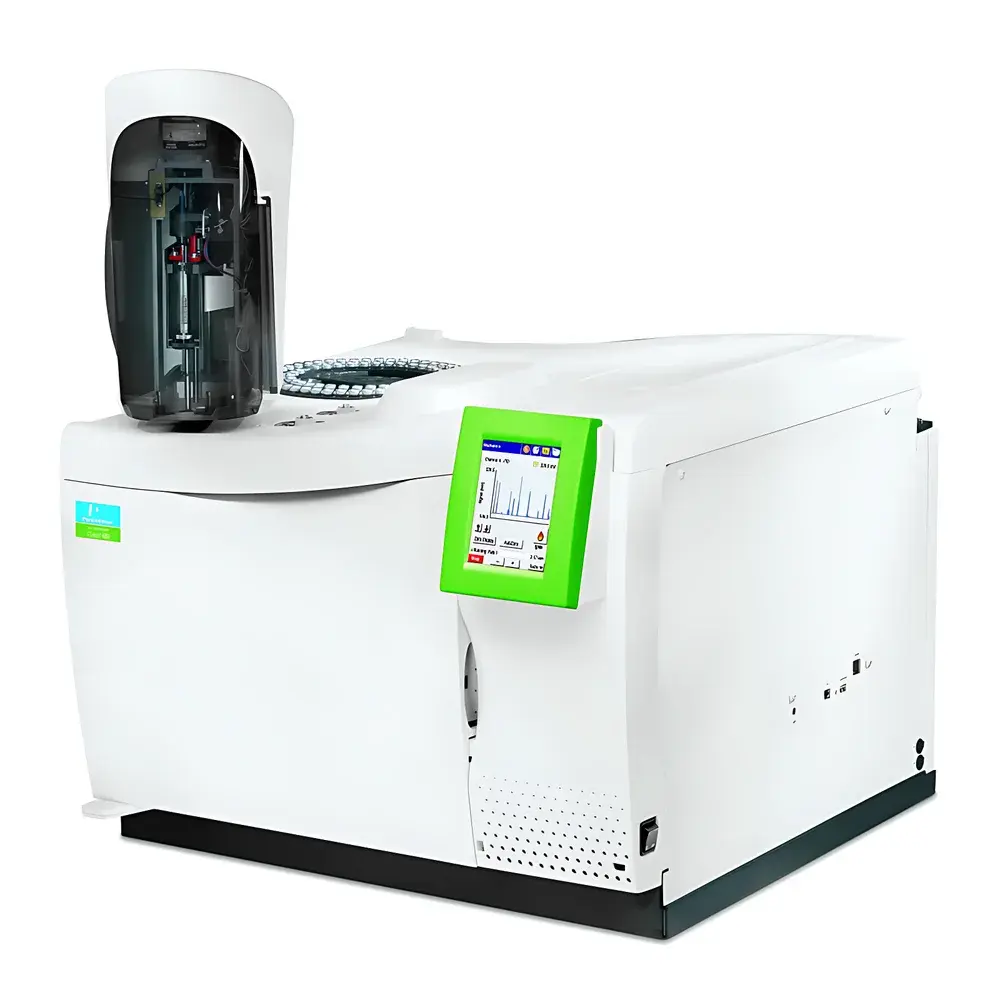
PerkinElmer Clarus 680 Gas Chromatograph
| Brand | PerkinElmer |
|---|---|
| Origin | USA |
| Manufacturer Type | Original Equipment Manufacturer (OEM) |
| Origin Category | Imported Instrument |
| Model | Clarus 680 GC |
| Pricing | Available Upon Request |
Overview
The PerkinElmer Clarus 680 Gas Chromatograph is a high-performance, benchtop analytical instrument engineered for precision, reproducibility, and operational efficiency in routine and demanding laboratory environments. Based on the fundamental principle of gas-liquid partition chromatography, the Clarus 680 separates volatile and semi-volatile compounds by differential migration through a thermally stable capillary column under controlled carrier gas flow. Its design integrates decades of GC system architecture refinement—leveraging PerkinElmer’s 50+ years of chromatographic instrumentation expertise—to deliver robust separation performance, rapid thermal cycling, and seamless integration into regulated and research-grade workflows. The system is optimized for laboratories requiring high sample throughput without compromising resolution or quantitative accuracy—particularly where short analysis cycles, method transferability, and long-term system stability are critical success factors.
Key Features
- Ultra-fast oven cooling: Achieves column oven temperature reduction from 450 °C to 50 °C in ≤120 seconds, significantly reducing cycle time between injections.
- Advanced programmable temperature vaporization (PTV) inlet: Supports large-volume injection, cold-on-column, solvent venting, and split/splitless modes—enabling broad compound polarity coverage and improved sensitivity for trace analytes.
- Integrated autosampler compatibility: Designed for seamless coupling with PerkinElmer’s HS-40/HS-60 headspace samplers, TurboMatrix™ thermal desorption units, and liquid autosamplers—ensuring consistent injection volume and minimizing carryover.
- Programmable pressure control (PPC): Delivers precise, real-time regulation of carrier gas pressure and flow across temperature ramps, enhancing retention time stability and method robustness.
- SwafER™ microchannel technology: Embedded in select detector modules (e.g., FID, ECD), this proprietary flow-path architecture improves signal-to-noise ratio and reduces baseline drift during extended runs.
- Touchscreen human-machine interface (HMI): 7-inch capacitive display with intuitive navigation, pre-configured method templates, and context-sensitive help—reducing operator training time and minimizing input errors.
- Modular detector options: Factory-integrated support for flame ionization (FID), electron capture (ECD), nitrogen-phosphorus (NPD), and thermal conductivity (TCD) detectors—each calibrated and validated per ASTM D3606, ISO 10301, and USP .
Sample Compatibility & Compliance
The Clarus 680 GC accommodates a wide range of sample matrices—including aqueous extracts, organic solvents, headspace vials, thermal desorption tubes, and solid-phase microextraction (SPME) fibers—when paired with appropriate inlet and sampling accessories. It meets key regulatory requirements for GLP and GMP environments: full audit trail capability via TotalChrom CDS, electronic signature support compliant with FDA 21 CFR Part 11, and validation documentation packages aligned with IQ/OQ/PQ protocols. System suitability testing (SST) parameters—including resolution (Rs ≥ 1.5), tailing factor (Tf ≤ 2.0), and %RSD of peak area (<5% for replicate injections)—are fully configurable and reportable within standard operating procedures.
Software & Data Management
TotalChrom Chromatography Data System (CDS) serves as the native platform for instrument control, acquisition, processing, and reporting. Version 6.4.1 and later support multi-instrument networks, customizable report templates (PDF, CSV, XML), and automated calibration curve generation with forced zero-point and weighting options. The system provides bidirectional communication with LIMS via ASTM E1384-compliant interfaces and supports third-party software integration—including Waters Empower™ 2 and Agilent EZChrom Elite™—through certified driver libraries. All raw data files (.chd) are stored in vendor-neutral formats, preserving metadata integrity for retrospective reprocessing and regulatory review.
Applications
The Clarus 680 GC is routinely deployed in environmental laboratories for EPA Method 8260D (VOCs in water/soil), food safety labs for pesticide residue screening per AOAC 2012.01, forensic toxicology units for blood alcohol and drug metabolite quantification (SWGDAM guidelines), petrochemical QA/QC for hydrocarbon group-type analysis (ASTM D5186), and academic teaching labs for fundamental chromatographic theory instruction. Its thermal stability and inlet flexibility also support emerging applications in flavor & fragrance profiling, polymer additive migration studies, and residual solvent testing in pharmaceutical excipients (ICH Q3C).
FAQ
Is the Clarus 680 GC compatible with mass spectrometry detection?
Yes—via dedicated GC-MS interface kits supporting single-quadrupole and triple-quadrupole MS systems; full synchronization of scan events, SIM transitions, and source temperature ramping is managed through TotalChrom.
Does the system support unattended overnight operation?
Yes—equipped with hardware-level watchdog timers, automatic leak detection, and power-fail recovery protocols that resume sequences from last valid injection point.
Can I upgrade my existing Clarus 580 GC to Clarus 680 specifications?
No—Clarus 680 features a redesigned electronics architecture, oven thermal management system, and firmware stack; upgrades require full system replacement.
What validation documentation is provided with shipment?
Each unit ships with Factory Acceptance Test (FAT) report, Certificate of Conformance (CoC), and NIST-traceable temperature and flow calibration certificates.
Is remote monitoring supported?
Yes—via secure HTTPS-enabled web interface (optional license); real-time status, alarm logs, and live chromatogram streaming accessible from authorized IP ranges.
Related Products





