
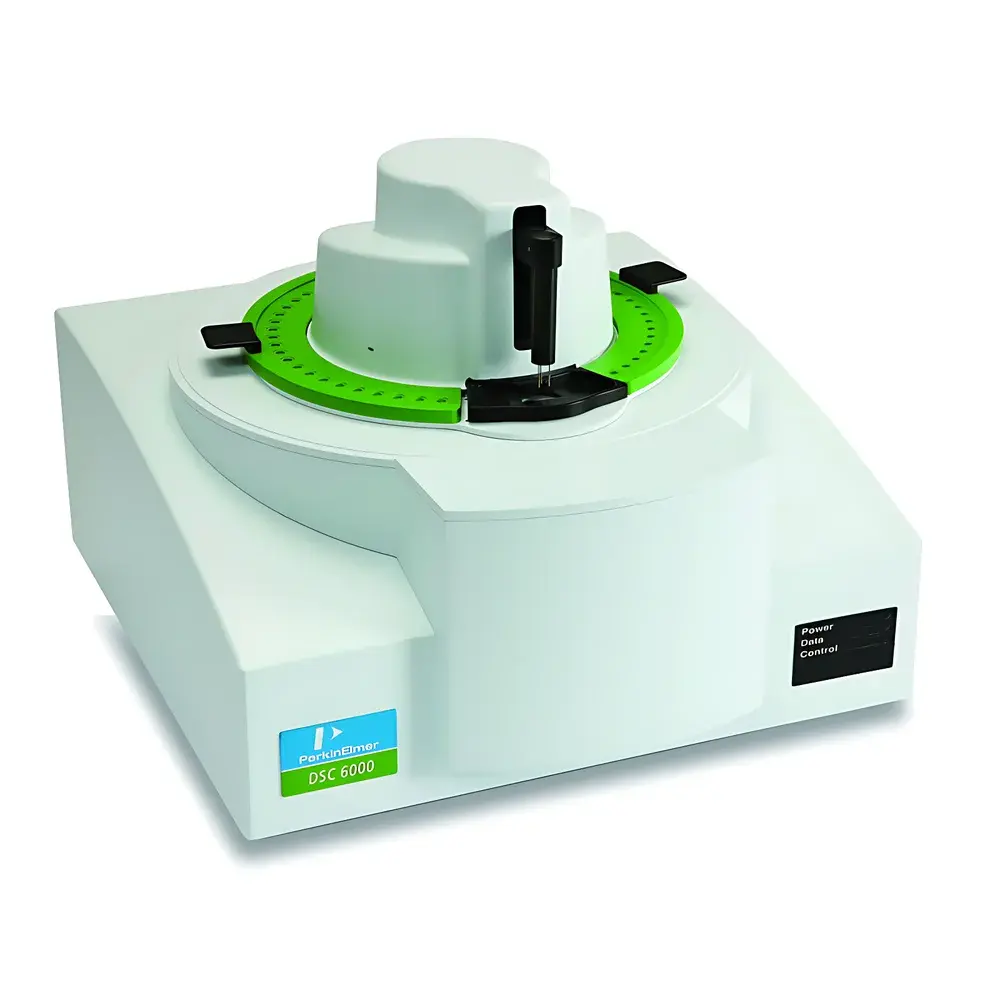
PerkinElmer DSC 4000 / DSC 6000 Differential Scanning Calorimeter
| Brand | PerkinElmer |
|---|---|
| Origin | USA |
| Manufacturer Type | Original Equipment Manufacturer (OEM) |
| Product Category | Imported Instrument |
| Model | DSC 4000 / DSC 6000 |
| Instrument Type | Differential Scanning Calorimeter (DSC) |
| Temperature Range | –100 °C to 600 °C (with optional cryogenic and high-temp accessories) |
| Temperature Accuracy | ±0.1 °C (traceable to NIST standards) |
| Heating/Cooling Rate | 0.1–100 K/min (programmable in 0.1 K/min increments) |
Overview
The PerkinElmer DSC 4000 and DSC 6000 are high-precision, single-furnace differential scanning calorimeters engineered for reproducible thermal characterization across academic, pharmaceutical, polymer, and materials science laboratories. Based on heat-flux DSC principle, these instruments measure the difference in heat flow between a sample and an inert reference as both are subjected to identical, controlled temperature programs. This enables quantitative determination of thermodynamic transitions—including glass transition (Tg), melting (Tm), crystallization (Tc), cure kinetics, oxidative induction time (OIT), and specific heat capacity (Cp). The DSC 4000 serves as a robust platform for routine quality control and teaching applications, while the DSC 6000 extends functionality with Modulated Temperature DSC (MT-DSC®), allowing separation of reversing and non-reversing thermal events—critical for resolving complex overlapping transitions in amorphous polymers, semi-crystalline systems, and multi-component formulations.
Key Features
- Single-furnace architecture ensuring superior baseline stability, low thermal mass, and rapid response to temperature changes
- Integrated mass flow controller (MFC) for automated, precise switching between purge gases (N2, O2, Ar, air) with real-time flow monitoring and logging
- Optional 45-position autosampler enabling unattended, high-throughput analysis—fully compatible with GLP-compliant workflow protocols
- Plug-and-play portable cooling device (PCD) delivering rapid, stable sub-ambient operation down to –100 °C without liquid nitrogen dependency
- Nickel-chromium alloy sample stage offering mechanical durability, chemical resistance, and easy surface decontamination between runs
- Modular upgrade path: DSC 4000 systems can be field-upgraded to DSC 6000 configuration—including MT-DSC electronics, advanced furnace calibration, and enhanced software modules
Sample Compatibility & Compliance
The DSC 4000/6000 accommodates standard hermetic and vented aluminum pans (40 µL), high-pressure stainless-steel cells (up to 100 bar), and specialized crucibles for volatile or reactive samples. All hardware and firmware comply with international regulatory frameworks including ISO 11357 (Plastics — Differential Scanning Calorimetry), ASTM E794 (Melting and Crystallization Temperatures), and USP (Thermal Analysis). Data acquisition and instrument control support 21 CFR Part 11 compliance when deployed with PerkinElmer’s certified TA Instruments software suite—including electronic signatures, audit trails, user access levels, and secure data archiving.
Software & Data Management
Controlled via Pyris™ software, the DSC 4000/6000 provides intuitive method setup, real-time visualization, and comprehensive post-run analysis. Key capabilities include baseline correction, peak integration, Cp calibration using sapphire standard, kinetic modeling (e.g., Ozawa-Flynn-Wall), and MT-DSC deconvolution algorithms. Raw data is stored in vendor-neutral .q5 format; export options include ASCII, CSV, and XML for LIMS integration. Software validation packages (IQ/OQ/PQ documentation) and GxP-ready configuration templates are available upon request for regulated environments.
Applications
- Pharmaceutical solid-state characterization: polymorph screening, hydrate/anhydrate stability, excipient compatibility, and amorphous content quantification
- Polymer processing optimization: degree of crystallinity, crosslink density, thermal degradation onset, and aging behavior under accelerated conditions
- Food science: fat crystallization profiles, starch gelatinization enthalpy, and shelf-life prediction via oxidation kinetics
- Materials R&D: nanocomposite thermal interface analysis, phase-change material (PCM) cycling stability, and battery electrode thermal runaway profiling
- Academic instruction: hands-on demonstration of first- and second-order thermal transitions, thermodynamic parameter derivation, and instrument calibration principles
FAQ
What is the difference between DSC 4000 and DSC 6000?
The DSC 4000 is a high-performance, entry-tier heat-flux DSC optimized for routine analysis. The DSC 6000 adds MT-DSC capability, advanced furnace calibration, extended temperature range options, and dedicated software modules for advanced thermal event deconvolution.
Can the DSC 4000 be upgraded to DSC 6000 in the field?
Yes—hardware and software upgrades are supported through PerkinElmer Field Service Engineers, including installation of MT-DSC electronics, updated furnace assembly, and licensed software activation.
Is nitrogen purging mandatory during operation?
While not mandatory, inert gas purging (typically N2) is strongly recommended to prevent oxidative degradation of organic samples and ensure baseline integrity—especially above 200 °C.
Does the system support cGMP or GLP compliance?
When configured with Pyris™ GxP Edition and validated hardware, the DSC 4000/6000 meets core requirements for audit-ready operation, including electronic records, role-based access control, and full traceability of all analytical parameters and results.
What sample mass range is recommended for optimal signal-to-noise ratio?
Typical sample masses range from 1–10 mg, depending on thermal capacity and transition enthalpy; smaller masses (<2 mg) are advised for high-sensitivity Cp measurements or low-enthalpy transitions.



