
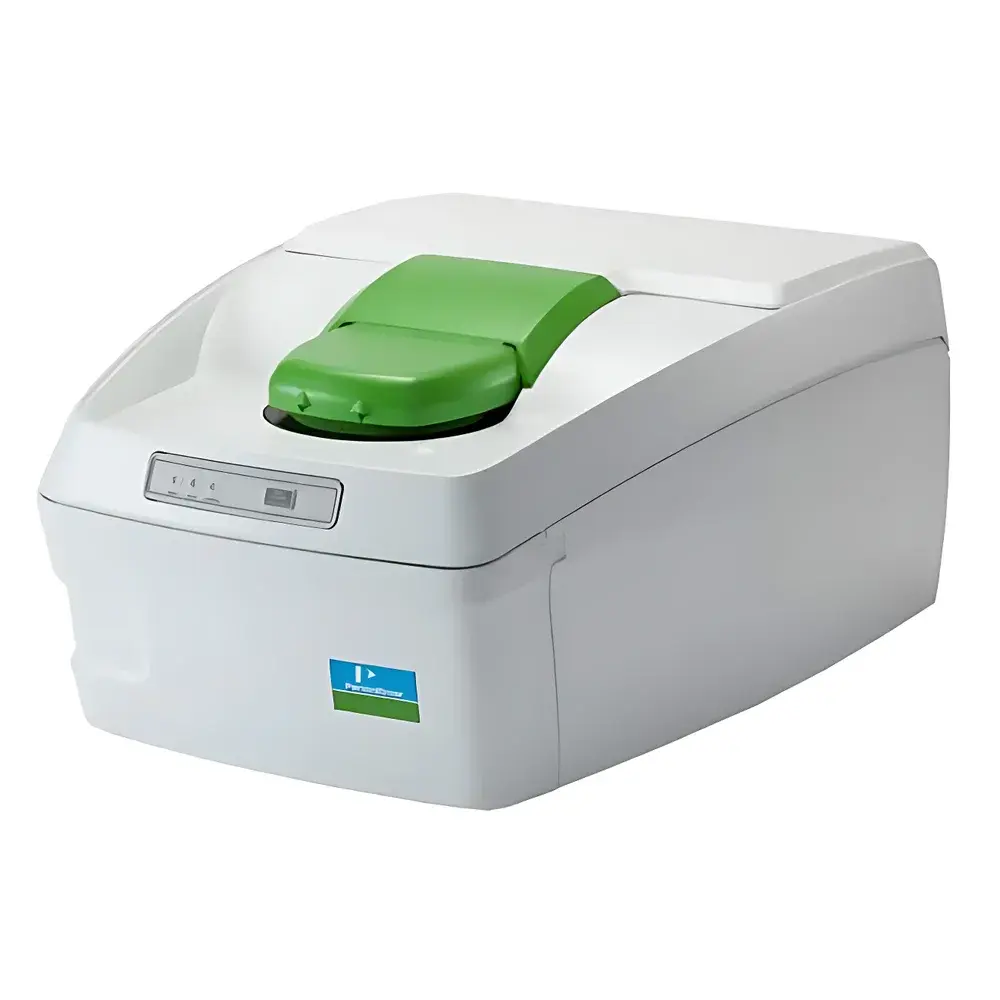
PerkinElmer DSC 8000 Dual-Furnace Differential Scanning Calorimeter
| Brand | PerkinElmer |
|---|---|
| Origin | USA |
| Manufacturer Type | Original Equipment Manufacturer (OEM) |
| Product Origin | Imported |
| Model | DSC 8000 |
| Simultaneous Sample Capacity | Multiple |
| Instrument Type | Power-Compensated DSC |
| Temperature Range | –180 °C to 750 °C |
| Heating/Cooling Rate | 0.01 °C/min to 300 °C/min |
| Dynamic Heat Flow Range | ±800 mW |
| Furnace Material | Platinum-Iridium Alloy |
| Modulated DSC (MDSC®) | Standard |
| Cooling Options | Two-stage mechanical cooler, three-stage mechanical cooler, automated liquid nitrogen cooling |
| Dual Digital Mass Flow Controllers | Standard |
| Optional Accessories | 96-position autosampler, high-pressure cell (up to 600 psi), UV photo-DSC module, isolated sample chamber for hazardous materials |
Overview
The PerkinElmer DSC 8000 is a high-performance, power-compensated differential scanning calorimeter engineered for precision thermal characterization across demanding research and quality control environments. Unlike heat-flux DSC systems, the DSC 8000 employs a true dual-furnace architecture—two thermally isolated, identical platinum-iridium alloy furnaces operating in parallel—to directly measure the differential power required to maintain equal temperatures between sample and reference positions. This design eliminates reliance on thermal resistance modeling or signal conversion, delivering inherently linear, high-fidelity heat flow data with minimal baseline drift. The instrument achieves exceptional thermal stability and reproducibility over its full operational range of –180 °C to 750 °C, supported by ultra-fast heating and cooling rates (0.01–300 °C/min) and sub-milliwatt sensitivity. Its symmetrical furnace geometry ensures matched thermal response for both sample and reference pans, minimizing time-lag artifacts and enhancing resolution of overlapping transitions—critical for polymer crystallinity analysis, pharmaceutical polymorph screening, and advanced material development.
Key Features
- Dual-furnace power-compensation architecture for direct, absolute heat flow measurement without calibration transfer or mathematical deconvolution
- Platinum-iridium alloy furnace construction offering superior oxidation resistance, long-term dimensional stability, and compatibility with aggressive chemical environments
- Standard integrated modulated DSC (MDSC®) capability for simultaneous separation of reversing and non-reversing thermal events—including glass transitions, enthalpic relaxation, and cold crystallization
- Automated dual digital mass flow controllers for precise, repeatable purge gas delivery (N₂, He, air) with real-time monitoring and programmable ramping
- Modular cooling system architecture supporting seamless switching between two-stage and three-stage mechanical coolers or fully automated liquid nitrogen cooling—enabling unattended low-temperature operation down to –180 °C
- Optional high-pressure cell (rated to 600 psi) for studying phase behavior under elevated pressure conditions, such as hydrate formation or supercritical fluid interactions
- UV photo-DSC accessory for in situ photopolymerization kinetics and light-induced degradation studies under controlled irradiation
- Isolated sample chamber option compliant with IEC 61010-1 safety requirements for handling pyrophoric, toxic, or explosive samples
Sample Compatibility & Compliance
The DSC 8000 accommodates standard hermetic and vented aluminum, gold-plated, or stainless-steel crucibles (including high-pressure cells), supporting solids, powders, gels, films, and small-volume liquids. Its robust thermal design meets ASTM E794 (melting point), ASTM E1356 (glass transition), ISO 11357 series (polymer thermal analysis), and USP (thermal analysis of pharmaceuticals). Data acquisition and reporting comply with FDA 21 CFR Part 11 requirements when used with PerkinElmer’s certified software suite, including electronic signatures, audit trails, and role-based access control. All hardware configurations support GLP/GMP-aligned validation protocols, including IQ/OQ/PQ documentation templates and traceable calibration against NIST-traceable standards.
Software & Data Management
Controlled via Pyris™ software, the DSC 8000 provides intuitive method setup, real-time visualization, and advanced post-processing—including baseline correction, peak integration, kinetic modeling (e.g., Ozawa-Flynn-Wall), and multi-curve comparison. Raw data are stored in vendor-neutral .csv and .tdf formats; metadata (instrument parameters, operator ID, timestamp, environmental logs) are embedded per ASTM E1461. The software supports automated report generation compliant with internal SOPs and external regulatory submissions. When paired with the optional 96-position autosampler, Pyris enables unattended batch processing with customizable pause/resume logic, error logging, and integration into LIMS via OPC UA or RESTful API.
Applications
- Quantitative determination of melting enthalpy, crystallinity, and polymorphic transitions in pharmaceutical APIs and excipients
- Thermal stability assessment of battery electrolytes, cathode/anode materials, and solid-state electrolytes under inert or reactive atmospheres
- Characterization of curing kinetics, crosslink density, and residual reactivity in thermosetting resins and composites
- Analysis of oxidative induction time (OIT) and onset of thermal degradation per ASTM D3895 and ISO 11357-6
- Study of phase separation, miscibility, and blend homogeneity in multicomponent polymer systems
- Investigation of hydration/dehydration mechanisms in clays, MOFs, and porous carbons
FAQ
What distinguishes power-compensated DSC from heat-flux DSC?
Power-compensated DSC (like the DSC 8000) measures the electrical power required to maintain identical temperatures in sample and reference furnaces—yielding direct, absolute heat flow values. Heat-flux DSC infers heat flow from temperature differentials across a sensor, requiring empirical calibration and exhibiting reduced accuracy at extreme heating rates or low thermal mass.
Can the DSC 8000 perform quantitative kinetic analysis?
Yes—the instrument delivers high signal-to-noise ratio heat flow data with excellent baseline flatness, enabling reliable application of model-free (e.g., Friedman, Kissinger-Akahira-Sunose) and model-fitting kinetic methods using Pyris Kinetics software.
Is the 96-position autosampler compatible with all cooling options?
The autosampler operates seamlessly with two-stage and three-stage mechanical coolers. For liquid nitrogen cooling, an optional cryo-compatible autosampler module with vacuum-jacketed transport path is required to maintain low-temperature integrity during sample loading.
How is calibration verified across the full temperature range?
Calibration is performed using high-purity reference materials (e.g., indium, zinc, tin, bismuth, and synthetic sapphire) per ASTM E967 and E968. Temperature accuracy is ±0.1 °C at key transition points; enthalpy accuracy is ±1% relative to certified reference values.
Does the DSC 8000 support custom atmosphere control beyond standard purge gases?
Yes—via optional mass flow controller expansion modules and sealed glovebox integration, users can introduce reactive gases (e.g., H₂, O₂, CO₂) or controlled humidity environments using saturated salt solutions or permeation dryers, subject to material compatibility verification.



