
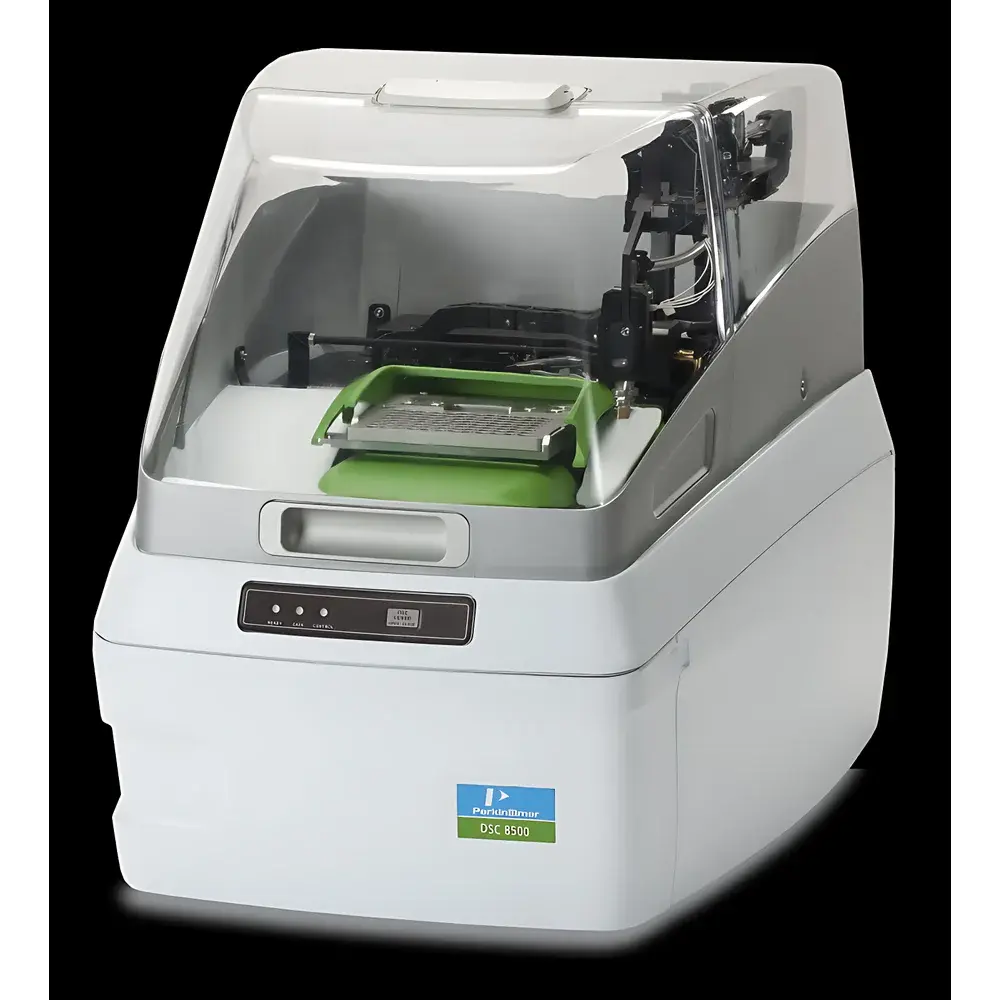
PerkinElmer DSC 8500 Differential Scanning Calorimeter
| Brand | PerkinElmer |
|---|---|
| Origin | USA |
| Manufacturer | PerkinElmer, Inc. |
| Model | DSC 8500 |
| Temperature Range | –180 °C to 750 °C |
| Heating/Cooling Rate | up to 750 K/min (controlled), >1000 K/min (free cooling) |
| Heat Flow Dynamic Range | ±800 mW |
| Calorimetric Accuracy | < ±0.2% |
| Sensitivity | 0.18 µW |
| Data Acquisition Rate | up to 100 Hz |
| Standard Features | Dual-channel digital mass flow controllers, automated lid, integrated cooling accessory |
| Optional Accessories | 96-position autosampler, high-pressure DSC cell, isolated DSC module, photo-DSC unit, DSC–Raman hyphenated system |
Overview
The PerkinElmer DSC 8500 is a high-performance differential scanning calorimeter engineered for precision thermal analysis of advanced materials across pharmaceutical, polymer, and academic research domains. It operates on the fundamental principle of heat flux DSC—measuring the difference in heat flow required to maintain identical temperature profiles between a sample and an inert reference as both undergo controlled thermal programs. Leveraging second-generation Hyper-DSC™ technology, the DSC 8500 delivers unprecedented thermal response dynamics, enabling true process-relevant simulation of industrial manufacturing conditions such as rapid quenching, melt crystallization, and thermal cycling. Its dual-furnace architecture ensures symmetrical thermal environments, minimizing baseline drift and enhancing signal-to-noise ratio. Designed and manufactured in Shelton, Connecticut, USA, the instrument complies with core design principles aligned with ISO 11357-1 (Plastics — Differential Scanning Calorimetry) and ASTM E794 (Standard Test Method for Melting and Crystallization Temperatures by Thermal Analysis).
Key Features
- Hyper-DSC™ rapid thermal control: programmable heating and cooling rates up to 750 K/min under active control; uncontrolled (free) cooling rates exceeding 1000 K/min for realistic process mimicry.
- Dual independent digital mass flow controllers for precise, reproducible purge gas delivery (N2, He, or synthetic air) to both sample and reference sides—critical for baseline stability and oxidation-sensitive measurements.
- Dynamic heat flow range of ±800 mW supports quantitative analysis of high-energy transitions (e.g., polymer melting, metal solidification, or exothermic curing reactions) without signal saturation.
- Calorimetric accuracy better than ±0.2% (verified against certified indium and zinc standards per ISO 11357-2) and baseline noise <0.18 µW enable detection of subtle thermal events—including sub-milligram polymorphic transitions and low-enthalpy relaxation processes.
- Fully automated lid actuation and optional 96-position autosampler ensure unattended operation, improving throughput consistency and reducing operator-induced variability in regulated environments.
- Modular accessory architecture: field-upgradable integration of high-pressure cells (up to 100 bar), photo-DSC modules (for UV-initiated cure kinetics), isolated DSC units (for volatile or reactive samples), and Raman-coupled configurations for simultaneous structural–thermal correlation.
Sample Compatibility & Compliance
The DSC 8500 accommodates standard hermetic and vented aluminum crucibles (20–50 µL), platinum-rhodium pans for high-temperature applications (>500 °C), and custom geometries for encapsulated or volatile samples. Its thermal design meets GLP/GMP documentation requirements when paired with PerkinElmer’s certified software suite, supporting full audit trails, electronic signatures, and 21 CFR Part 11 compliance for pharmaceutical development workflows. All calibration procedures follow traceable NIST-traceable reference materials and are documented per ISO/IEC 17025 guidelines. The system is routinely validated for USP and ICH Q5E thermal stability assessments.
Software & Data Management
Controlled via Pyris™ software v13.x, the DSC 8500 provides fully integrated method development, real-time data visualization, and post-acquisition analysis including peak deconvolution, kinetic modeling (e.g., Ozawa–Flynn–Wall, Kissinger), and multi-step transition mapping. Raw data files are stored in vendor-neutral .qtx format with embedded metadata (instrument ID, operator, calibration status, environmental logs). Secure user-role management, password-protected method templates, and automated report generation (PDF/Excel) support quality-controlled reporting in regulated laboratories. Data export interfaces include ASTM E1319-compliant XML and CSV formats for LIMS integration.
Applications
- Pharmaceutical solid-state characterization: identification and quantification of polymorphs, amorphous content, hydrate/dehydrate behavior, and excipient compatibility screening.
- Thermal stability profiling of biologics and mRNA lipid nanoparticles under accelerated storage conditions.
- Polymer processing simulation: evaluation of crystallization kinetics during injection molding or extrusion cooling profiles; assessment of thermal history effects on mechanical performance.
- Advanced materials R&D: glass transition analysis of metallic glasses, phase transformation studies in shape-memory alloys, and decomposition thermodynamics of battery cathode materials.
- Cure kinetics of thermosets and composites using isothermal and dynamic DSC protocols compliant with ASTM D3418 and ISO 21319-1.
FAQ
What temperature range does the DSC 8500 support?
The instrument operates from –180 °C to 750 °C using liquid nitrogen cooling and high-temperature furnace options.
Is the DSC 8500 compliant with regulatory requirements for pharmaceutical testing?
Yes—it supports 21 CFR Part 11 compliance through Pyris software with audit trail, electronic signature, and secure user access controls.
Can the DSC 8500 be coupled with other analytical techniques?
Yes—optional hyphenated configurations include DSC–Raman, DSC–FTIR, and photo-DSC for correlative structural–thermal analysis.
What is the minimum detectable enthalpy change?
With sensitivity of 0.18 µW and noise-limited resolution, the system reliably detects transitions with enthalpies as low as ~0.1 J/g in optimized configurations.
Does the system require external chiller or LN2 dewar for sub-ambient operation?
A dedicated LN2 delivery system or mechanical cryocooler is required for operation below –50 °C; both are supported via standardized interface ports.



