
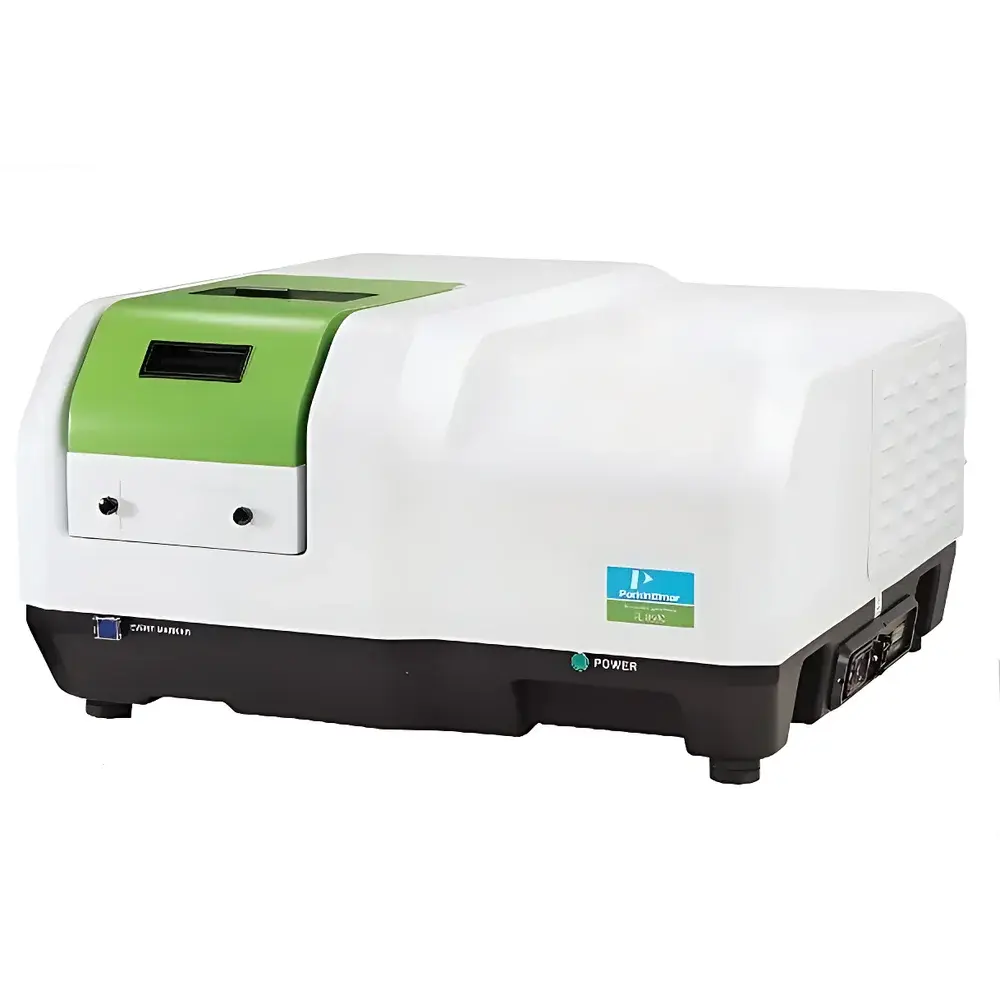
PerkinElmer FL 8500 Continuous-Xenon Fluorescence Spectrophotometer
| Brand | PerkinElmer |
|---|---|
| Origin | South Korea |
| Manufacturer Type | Original Equipment Manufacturer (OEM) |
| Import Status | Imported |
| Model | FL 8500 |
| Wavelength Accuracy | ±0.5 nm |
| Spectral Bandwidth (Slit Width) | 1, 2.5, 5, 10, 20 nm |
| Resolution | 1.0, 2.5, 5, 10, 20 nm |
| Sensitivity | 4000:1 (RMS), 1000:1 (Peak-to-Peak) |
| Dispersion Element | Holographic Grating |
| Excitation Source | Continuous Xenon Arc Lamp |
| Maximum Scan Speed | 60,000 nm/min |
| Footprint | 66 cm (26 in) width |
Overview
The PerkinElmer FL 8500 is a high-performance, continuous-xenon fluorescence spectrophotometer engineered for quantitative and qualitative molecular fluorescence analysis across research, quality control, and regulatory environments. It operates on the principle of photoluminescence spectroscopy—measuring the intensity and spectral distribution of emitted photons following excitation by a stable, broadband continuous xenon arc lamp. Unlike pulsed-source instruments, the FL 8500 delivers consistent photon flux over time, enabling reproducible kinetic measurements, low-concentration quantification, and extended photostability for light-sensitive samples such as conjugated polymers, quantum dots, and biological fluorophores. Its optical architecture integrates a dual-monochromator design with holographic gratings, minimizing stray light and ensuring high signal-to-noise ratio across the 200–900 nm excitation/emission range. The system is designed for routine compliance with analytical method validation requirements in GLP, GMP, and ISO/IEC 17025-accredited laboratories.
Key Features
- Continuous xenon arc lamp providing stable, high-intensity excitation without pulse-induced thermal transients or photobleaching artifacts
- Dual-grating monochromators with selectable slit widths (1–20 nm) for precise control of spectral bandwidth and resolution
- Scanning speed up to 60,000 nm/min—enabling rapid full-spectrum acquisition for time-resolved studies and high-throughput screening
- Compact footprint (66 cm wide) optimized for space-constrained analytical labs and modular instrumentation setups
- Interchangeable, plug-and-play accessories—including temperature-controlled cuvette holders, solid-sample stages, and integrating spheres—for seamless workflow integration
- Automated wavelength calibration and intensity normalization routines supporting instrument qualification per ASTM E275 and ISO 17025 Annex A.3
Sample Compatibility & Compliance
The FL 8500 accommodates standard 10-mm pathlength quartz cuvettes, microvolume cells (down to 50 µL), solid samples (films, powders, filters), and reflective or transmissive substrates via optional sample holders. It supports aqueous, organic, and mixed-solvent systems without optical interference from solvent Raman bands when properly configured. For regulated environments, the system complies with key international standards including USP Analytical Instrument Qualification, ASTM E1655 for spectroscopic data reporting, and ICH Q2(R2) guidelines for analytical procedure validation. When operated with PerkinElmer’s Enhanced Security (ES) software, it fulfills audit-trail, electronic signature, and data integrity requirements under FDA 21 CFR Part 11 and EU Annex 11.
Software & Data Management
The FL 8500 is controlled via PerkinElmer’s Spectrum Fluorescence software—a validated, role-based platform supporting multi-level user permissions, electronic lab notebook (ELN) integration, and automated report generation. The software includes dedicated modules for kinetic acquisition (with customizable time-point intervals and stop conditions), quantum yield calculation (using certified reference standards), and multivariate analysis (PCA, spectral deconvolution). All raw data are stored in vendor-neutral, metadata-embedded formats compliant with FAIR principles (Findable, Accessible, Interoperable, Reusable). Audit trails record operator actions, parameter changes, and calibration events with timestamped, non-erasable entries—essential for regulatory inspections and internal QA audits.
Applications
- Pharmaceutical Development: Quantification of intrinsic/extrinsic fluorophores in APIs, excipient interaction studies, stability-indicating assays for photodegradation products
- Materials Science: Characterization of OLED emitters, quantum dot quantum yields, photovoltaic dye absorption/emission profiles, and carbon nanomaterial defect-state luminescence
- Environmental Monitoring: Detection of polycyclic aromatic hydrocarbons (PAHs), pesticide residues (e.g., carbaryl, parathion), and metal ions (Al³⁺, Pb²⁺) via chelation-enhanced fluorescence
- Industrial R&D: Ink formulation optimization, LED phosphor efficiency mapping, anti-counterfeiting taggant verification, and textile dye migration analysis
- Life Sciences: Enzyme kinetics (e.g., NADH/NADPH turnover), protein folding/unfolding monitored by intrinsic tryptophan fluorescence, and ligand-binding affinity determination
FAQ
What distinguishes the FL 8500 from the FL 6500 in terms of excitation source and application suitability?
The FL 8500 employs a continuous xenon arc lamp optimized for high-duty-cycle, low-noise measurements ideal for trace-level analyte detection and long-duration kinetic experiments. In contrast, the FL 6500 uses a pulsed xenon source better suited for time-gated detection and minimizing photodamage in highly sensitive biological samples.
Does the FL 8500 support absolute quantum yield measurement?
Yes—when used with an optional integrating sphere accessory and calibrated reference standards (e.g., quinine sulfate in 0.1 M H₂SO₄), the system enables traceable absolute quantum yield determination per ASTM E901 and ISO 11577 protocols.
Can the FL 8500 be integrated into automated liquid handling workflows?
It supports bidirectional communication via RS-232 and Ethernet interfaces, enabling synchronization with third-party autosamplers and LIMS platforms through standardized command syntax (SCPI-compliant).
Is wavelength accuracy verified during IQ/OQ/PQ procedures?
Yes—the system includes built-in holmium oxide and didymium glass filters for routine wavelength verification, with documented procedures aligned with ASTM E275 and PerkinElmer’s IQ/OQ/PQ kits.
What maintenance is required to sustain optimal photometric performance?
Annual lamp replacement, quarterly grating alignment verification, and semi-annual detector dark-current calibration are recommended. Full service logs are retained within the software’s maintenance module for regulatory traceability.
Related Products






