
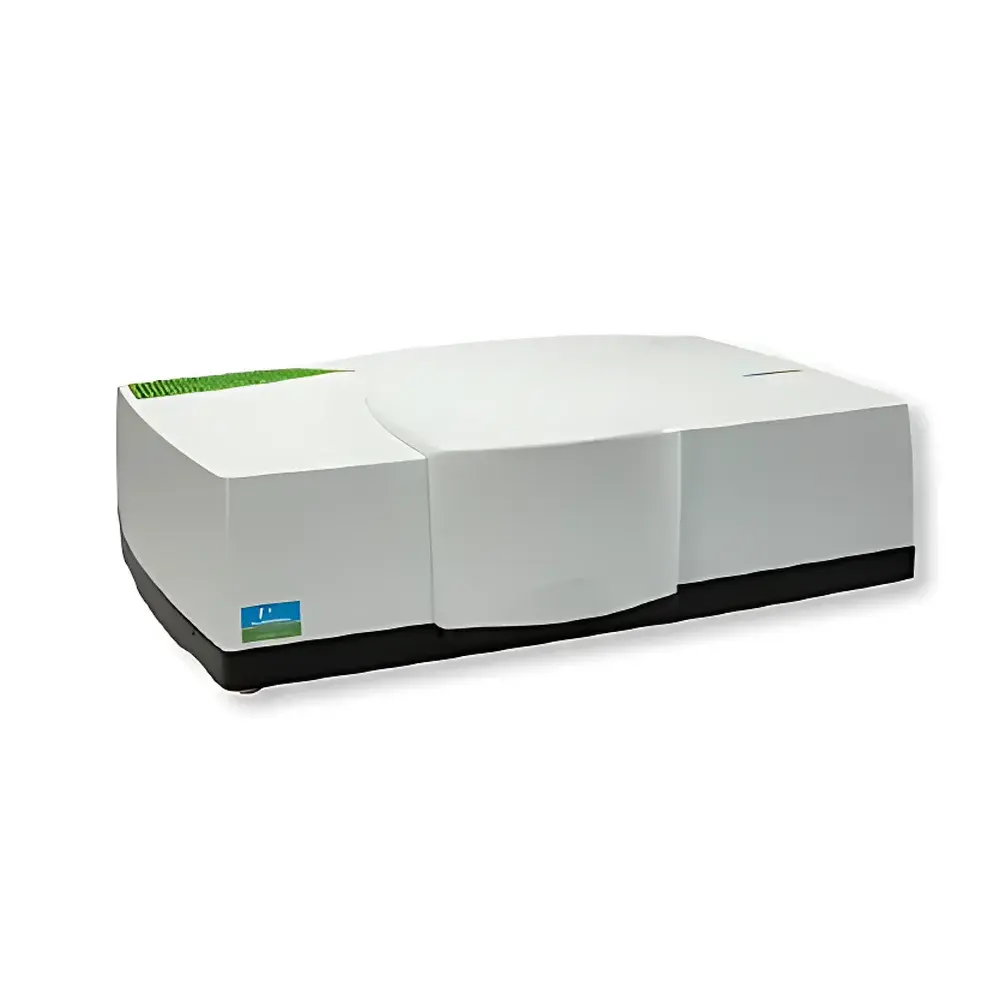
PerkinElmer LAMBDA 850+ UV/Vis Spectrophotometer
| Brand | PerkinElmer |
|---|---|
| Origin | United Kingdom |
| Manufacturer Type | Original Equipment Manufacturer (OEM) |
| Product Origin | Imported |
| Model | LAMBDA 850+ |
| Instrument Architecture | Double-Beam |
| Detector Type | R6872 Photomultiplier Tube (PMT) |
| Automation Level | Motorized Wavelength Scanning |
| Wavelength Range | 175–900 nm |
| Wavelength Accuracy | ±0.025 nm |
Overview
The PerkinElmer LAMBDA 850+ UV/Vis Spectrophotometer is a high-performance double-beam optical instrument engineered for precision absorbance, transmittance, and reflectance measurements across the deep ultraviolet to near-infrared spectrum (175–900 nm). It operates on classical photometric principles—comparing sample and reference beam intensities via a chopper-based optical path—to deliver exceptional photometric accuracy (<±0.0003 A), long-term baseline stability (<0.0002 A/h), and high spectral resolution (≤0.05 nm nominal bandwidth). Designed as the flagship platform of the LAMBDA series, the 850+ integrates an advanced R6872 ungridded photomultiplier tube detector optimized for quantum efficiency in the far-UV region, enabling reliable detection down to 175 nm without purge gas dependency under standard lab conditions. Its modular optical architecture supports rapid reconfiguration between transmission, diffuse reflectance, specular reflectance, and polarization-sensitive measurements—making it suitable for R&D laboratories, quality control environments, and regulatory-compliant testing workflows aligned with ISO 9001, ASTM E275, ASTM E308, CIE 15, and USP .
Key Features
- Double-beam optical design with real-time background correction and drift compensation
- R6872 high-sensitivity, low-noise photomultiplier tube detector with extended UV response and superior signal-to-noise ratio
- Wavelength accuracy of ±0.025 nm and repeatability of ±0.005 nm—validated per NIST-traceable standards
- Motorized, software-controlled wavelength scanning with scan speeds up to 24,000 nm/min and spectral resolution configurable from 0.05 nm to 8 nm
- Integrated optical accessories management: automated selection and positioning of beam attenuators, polarizers, depolarizers, and beam blockers within method sequences
- Modular dual-sample compartment architecture—the largest in its class—with independent thermal and mechanical isolation for simultaneous or sequential accessory deployment
- Optimized for GLP/GMP compliance: full audit trail, electronic signatures, and 21 CFR Part 11–ready software controls via UV WinLab™
Sample Compatibility & Compliance
The LAMBDA 850+ accommodates diverse sample formats—including liquids in cuvettes (1 mm to 100 mm pathlength), solids (films, lenses, coatings), powders, and optically heterogeneous materials—through a comprehensive suite of ISO- and ASTM-certified accessories. The standard 150 mm integrating sphere features PTFE-coated interior walls (>99% reflectance from 250–900 nm), certified per CIE Publication 177 and ASTM E1331 for colorimetric and total hemispherical reflectance measurements. Optional accessories include the URA (Universal Reflection Accessory) for angle-resolved reflectance (5°–85°, automated), the 6° specular reflectance attachment for anti-reflective coating validation per MIL-C-48497A, and the OphthalmoMeter module—designed specifically for contact lens transmittance testing per ISO 18369-3 and GB/T 11417.8. All accessories are mechanically registered and optically calibrated, ensuring traceable measurement uncertainty across configurations.
Software & Data Management
Controlled exclusively through PerkinElmer’s UV WinLab™ software, the LAMBDA 850+ supports method-driven operation, multi-step sequence programming, and automated report generation compliant with FDA 21 CFR Part 11 requirements. The software includes built-in calculation modules for SPF determination (ISO 24443), color coordinates (CIE XYZ, L*a*b*, ΔE*00), film thickness (via interference fringe analysis), and Kubelka-Munk transformation for scattering media. Raw spectral data are stored in vendor-neutral .spc format with embedded metadata (instrument ID, calibration date, operator, environmental conditions), and export options include CSV, XML, and PDF with digital signature support. Audit trails log all user actions—including parameter changes, calibration events, and data exports—with time-stamped, immutable records accessible for internal audits or regulatory inspections.
Applications
- Cosmetics & Sunscreen Development: Quantitative SPF prediction, UV-filter concentration profiling, and photostability assessment under controlled irradiation protocols
- Display & Optoelectronics: Color gamut mapping, luminance uniformity analysis, and angular-dependent transmittance of OLED/LCD components
- Inks, Pigments & Coatings: Batch-to-batch spectral consistency verification, metamerism evaluation, and fade resistance monitoring per ISO 105-B02
- Ophthalmic Devices: Absolute transmittance, haze, and blue-light filtration metrics for eyeglasses, intraocular lenses, and contact lenses—fully compliant with ISO 18369-3 and ANSI Z80.3
- Advanced Materials: Thin-film optical constants extraction (n, k) via variable-angle spectroscopic ellipsometry integration, and nanoparticle plasmonic characterization
FAQ
What is the minimum detectable absorbance for the LAMBDA 850+?
The instrument achieves a noise level of ≤0.00008 A (RMS, 1 nm bandwidth, 500 nm, 1 s response), corresponding to an absorbance detection limit of ~3 × 10⁻⁵ A.
Can the LAMBDA 850+ perform kinetic measurements?
Yes—UV WinLab supports time-based acquisition modes with sampling intervals from 10 ms to 1 hour, including triggered start, multi-wavelength monitoring, and reaction progress curve fitting.
Is the 150 mm integrating sphere compatible with fluorescence measurements?
No—the sphere is optimized for absorbance and reflectance; fluorescence quantification requires the dedicated LAMBDA FL spectrometer platform with xenon flash lamp and PMT detector configured for emission scanning.
How is wavelength calibration verified and maintained?
Calibration uses holmium oxide and didymium filters traceable to NIST SRM 2034 and SRM 2035; automated validation routines run at user-defined intervals and generate calibration certificates with uncertainty budgets.
Does the system support remote operation and networked data sharing?
Yes—UV WinLab includes secure TCP/IP connectivity, role-based access control, and optional integration with laboratory information management systems (LIMS) via ASTM E1394 or HL7 interfaces.
Related Products





