
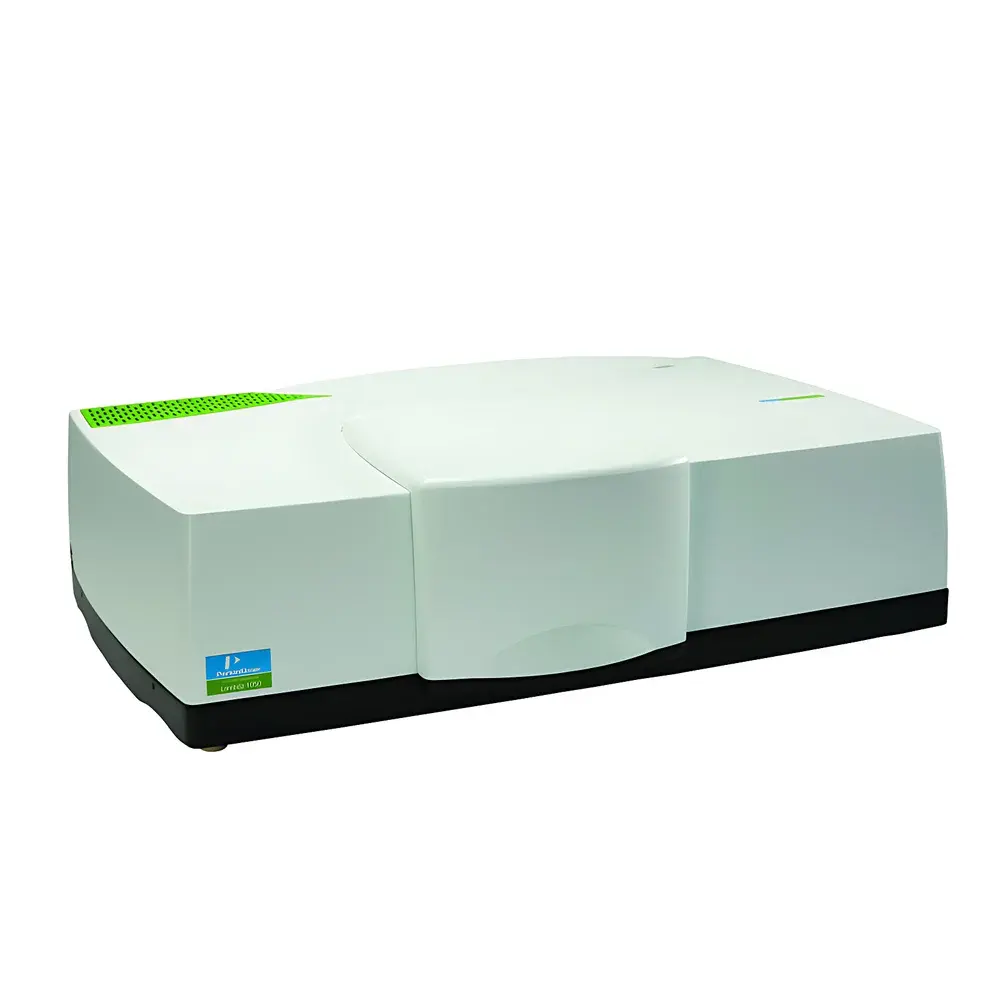
PerkinElmer Lambda 950 UV/Vis/NIR Spectrophotometer
| Brand | PerkinElmer |
|---|---|
| Origin | USA |
| Manufacturer Type | Original Equipment Manufacturer (OEM) |
| Instrument Type | Imported |
| Model | Lambda 950 |
| Optical Design | Double-Beam, Dual-Monochromator |
| Detector | R6872 Photomultiplier Tube (PMT) |
| Wavelength Range | 175–3300 nm (185 nm minimum under nitrogen purge) |
| Spectral Bandwidth | Variable (0.01–8 nm), software-selectable |
| Wavelength Accuracy | ±0.08 nm (UV/Vis), ±0.2 nm (NIR) |
| Stray Light | <0.00008% T at 220 nm (NaI), <0.0001% T at 340 nm (NaNO₂) |
| Photometric Linearity | Up to 8.0 A (absorbance) |
| Baseline Flatness | ±0.0004 A (190–3300 nm, 1 nm SBW) |
| Automation | Fully motorized optics, auto-lamp switching (D₂ & W/Tungsten), auto-correcting chopper, PC-controlled |
Overview
The PerkinElmer Lambda 950 UV/Vis/NIR Spectrophotometer is a high-performance, double-beam, dual-monochromator ratio-recording spectrophotometer engineered for precision optical characterization across the ultraviolet, visible, and near-infrared spectral regions (175–3300 nm). Designed and manufactured in the United States, it represents the culmination of decades of spectroscopic innovation by PerkinElmer, incorporating aerospace-grade optical fabrication techniques and rigorous metrological validation. Its core measurement principle relies on simultaneous, time-resolved sampling of sample and reference beams using a four-segment sector chopper — a proprietary Constant Sector Signal Correction (CSSC) architecture — which enables real-time black-level correction for both channels during each rotation cycle. This design eliminates drift-induced photometric error and ensures exceptional wavelength fidelity (±0.08 nm in UV/Vis) and photometric stability (<0.0004 A baseline flatness over full range). The instrument employs holographic, SiO₂-coated gratings (1440 lines/mm for UV/Vis; 360 lines/mm for NIR), thermally stabilized optics, and a high-sensitivity R6872 PMT detector offering fourfold gain improvement over legacy R928 tubes. All optical components are mounted on a rigid, low-expansion Invar platform to minimize thermal and mechanical hysteresis.
Key Features
- Double-beam, dual-monochromator architecture with real-time ratio recording and automatic beam balancing
- Four-segment sector chopper with Constant Sector Signal Correction (CSSC): data acquisition sequence is Sample → Black → Reference → Black, enabling continuous dark-current compensation without interrupting measurement flow
- Ultra-low stray light performance: <0.00008% T at 220 nm (NaI) and <0.0001% T at 340 nm (NaNO₂), directly supporting photometric linearity up to 8.0 absorbance units
- Automated, software-controlled lamp switching between deuterium (D₂) and tungsten/halogen sources, with pre-aligned, factory-calibrated positioning
- Motorized, variable spectral bandwidth (0.01–8.0 nm), selectable via software without manual slit adjustment
- Thermally isolated optical bench with active temperature stabilization to suppress thermal lensing and grating drift
- Integrated beam shutter and programmable neutral density filters for precise attenuation of reference and sample beams — enabling quantitative measurement of highly absorbing or scattering samples without signal saturation or detector nonlinearity
Sample Compatibility & Compliance
The Lambda 950 accommodates diverse sample formats through its large, modular sample compartment (120 × 120 mm clear aperture) and extensive accessory ecosystem. It supports transmission, reflectance (specular and diffuse), and fluorescence excitation measurements across solid, liquid, and thin-film geometries. Optional accessories include 60 mm and 150 mm integrating spheres (for absolute reflectance/transmittance of opaque, scattering, or turbid materials), Universal Reflectance Accessory (URA) for automated angle-resolved measurements from 8° to 70° over 185–3200 nm, General Purpose Optical Bench (GPOB) for oversized optics (e.g., telescope lenses, automotive glazing), and Q-COM rapid accessory interchange system. The system complies with ISO 9001 manufacturing standards and supports GLP/GMP workflows via audit-trail-enabled UV WinLab software. When configured with ASSP modules, it meets ASTM E308 (colorimetry), ASTM E971 (solar heat gain), ISO 9050 (glass optical properties), and USP (pharmaceutical UV/Vis validation) requirements. Data integrity conforms to FDA 21 CFR Part 11 when electronic signatures and role-based access controls are enabled.
Software & Data Management
The Lambda 950 operates exclusively via PerkinElmer’s UV WinLab software suite — shipped as standard — which provides three operational modes: QuickStart (guided workflow), Standard (full parameter control), and Expert Mode (advanced optimization of slit width, scan speed, PMT voltage, and signal averaging). UV WinLab includes KinLab (enzyme kinetics), BioLab (biomolecular quantification), and spectral database management tools. Optional Advanced Spectroscopy Software Package (ASSP) extends functionality with modules for color science (CIE 1931/1976, D65 illuminant), optical filter analysis, architectural glass certification (SHGC, VT, LSG), mathematical operations (derivative, smoothing, baseline correction), and custom method development. All raw spectral data are stored in vendor-neutral .spc format with embedded metadata (wavelength calibration, detector gain, slit settings, timestamp, operator ID). Audit trails log every instrument parameter change, file export, and user login event. Data export supports CSV, ASCII, JCAMP-DX, and XML for LIMS integration.
Applications
The Lambda 950 serves as a primary analytical platform in research and quality control laboratories requiring traceable, high-fidelity spectral data. It is routinely deployed for: optical coating characterization (anti-reflective, dichroic, and interference filters); solar control and safety glass certification (visible transmittance, UV rejection, infrared reflectance); pharmaceutical assay validation per USP ; semiconductor wafer and photovoltaic film thickness determination via interference fringe analysis; color measurement and formulation in paints, plastics, and textiles; enzymatic reaction kinetics and protein quantification (Bradford, BCA, Lowry); nanomaterial extinction profiling (Au/Ag nanoparticles); and advanced materials R&D including metamaterials, MOFs, and perovskite thin films. Its extended NIR capability (up to 3300 nm) supports moisture analysis in polymers and agricultural products, while its ultra-low stray light enables accurate measurement of high-optical-density standards used in national metrology institutes.
FAQ
What is the minimum measurable wavelength under ambient conditions?
The Lambda 950 achieves 175 nm under nitrogen purge; without purge, the practical lower limit is 185 nm due to atmospheric oxygen absorption.
Does the instrument support automated compliance reporting for pharmaceutical applications?
Yes — when paired with UV WinLab’s GxP-compliant configuration and ASSP’s USP module, it generates IQ/OQ documentation templates and full validation reports meeting FDA and EMA expectations.
Can the Lambda 950 measure absolute reflectance of curved or large-area surfaces?
Yes — using the General Purpose Optical Bench (GPOB) with motorized XYZ stage and optional URA or directional mirror accessories, curvature and size constraints are eliminated.
Is spectral bandwidth adjustable during a scan?
No — bandwidth is set prior to scan initiation but can be optimized per region (e.g., 0.1 nm in UV peaks, 2.0 nm in NIR baselines) using multi-segment scan programming.
How is detector linearity verified across the 8.0 A range?
Linearity is validated using NIST-traceable neutral density filters and certified optical density standards; deviation is reported in the instrument’s Certificate of Calibration and logged in UV WinLab’s Performance Verification Report.




