
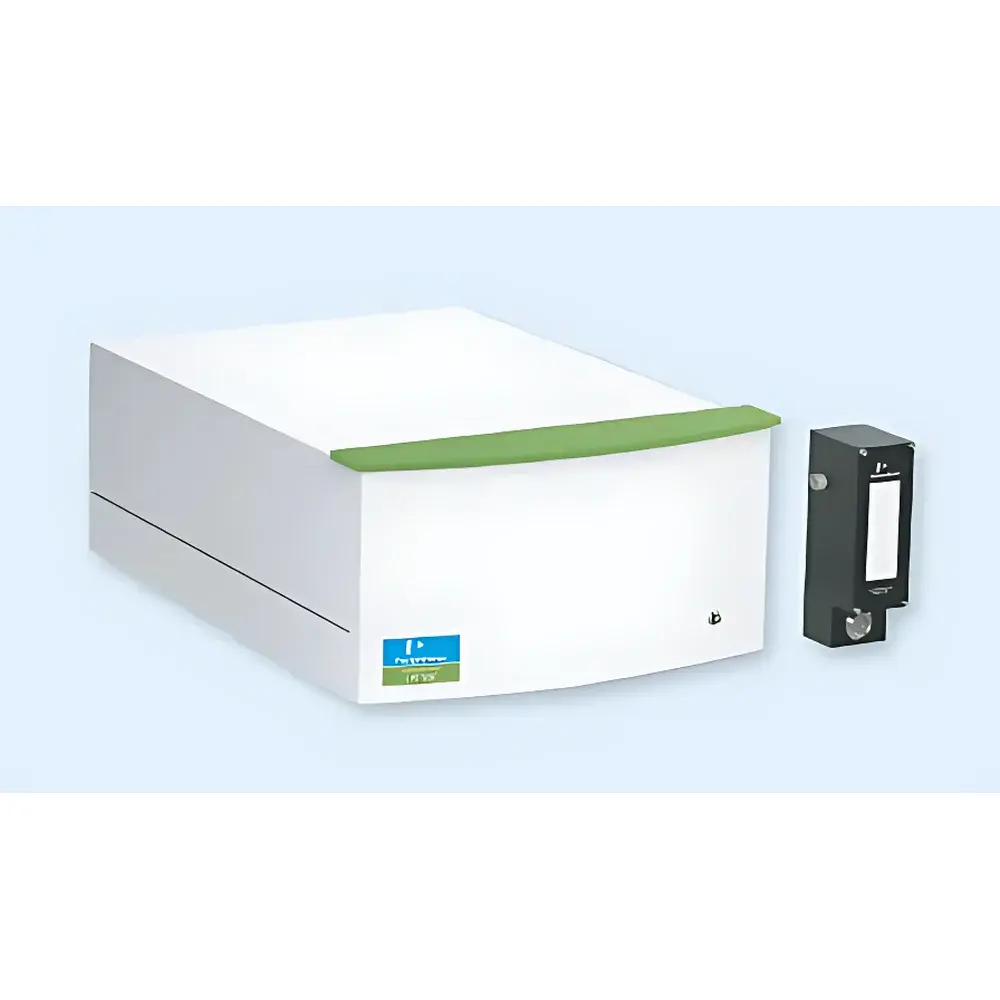
PerkinElmer LPC 500 Liquid Particle Counter
| Brand | PerkinElmer |
|---|---|
| Origin | USA |
| Manufacturer | PerkinElmer |
| Import Status | Imported |
| Model | LPC 500 |
| Pricing | Upon Request |
Overview
The PerkinElmer LPC 500 Liquid Particle Counter is a high-precision, single-particle optical sensing (SPOS) instrument engineered for quantitative particle counting and high-resolution size distribution analysis in liquid samples—particularly lubricating oils, hydraulic fluids, transformer oils, and other industrial process liquids. Unlike ensemble techniques such as light scattering or laser diffraction, SPOS detects and sizes individual particles as they transit a precisely defined optical sensing zone, delivering true number-based particle size distributions (PSD) with exceptional resolution across a broad dynamic range (0.5–400 µm). The system operates on the principle of dual-mode optical detection: simultaneous extinction (LE) and light scattering (LS), integrated into a patented hybrid signal summation architecture (U.S. Patent No. US5835211A). This design combines the wide sizing range and compositional robustness of extinction measurement with the enhanced sensitivity and lower detection limit of light scattering—enabling reliable quantification of sub-micron contaminants while maintaining accuracy for coarse particulates up to 400 µm.
Key Features
- Dual-mode optical detection (extinction + light scattering) for improved sensitivity and extended dynamic range
- Real-time, high-speed pulse processing: >10,000 particles per second throughput
- Configurable channel resolution: 8–512 logarithmically spaced size bins across 0.5–400 µm
- Minimal sample consumption: ≤1 mL undiluted oil (≤4 mL after 10× dilution) per analysis
- Compact footprint: smallest dedicated automated particle counter for in-service oil analysis
- Two operational configurations: standalone particle counter or integrated module with Avio® 500 ICP-OES Oil Analysis System
- Full compliance with ISO 4406:2017, ISO 11171:2010 (calibration standard), and ASTM D6786 (for oil cleanliness classification)
Sample Compatibility & Compliance
The LPC 500 is optimized for low- to high-viscosity hydrocarbon-based fluids, including turbine oils, engine oils, gear oils, hydraulic fluids, and insulating oils. Its flow path and sensor geometry accommodate both filtered and unfiltered samples without clogging, and its solvent-compatible wetted materials (e.g., fused silica, stainless steel, PEEK) ensure chemical stability during repeated cleaning cycles. All calibration and verification procedures follow ISO 11171:2010 traceable reference standards. For regulated environments—including aerospace, power generation, and defense maintenance labs—the system supports audit-ready data integrity through electronic signatures, user access controls, and full 21 CFR Part 11–compliant audit trails when operated within Syngistix™ software (in integrated mode) or the dedicated LPC Control Suite (standalone mode). It meets GLP/GMP documentation requirements for routine wear debris monitoring and fluid cleanliness certification.
Software & Data Management
In standalone configuration, the LPC 500 is controlled via the LPC Control Software—a Windows-based application enabling full parameter customization: threshold adjustment, channel binning, background subtraction, and real-time PSD visualization. In integrated configuration with the Avio 500 ICP-OES Oil Analysis System, particle counting functionality is embedded within Syngistix™ ICP Software v5.5+, allowing synchronized acquisition of elemental metal concentrations (ppm) and particle counts (per mL) from the same diluted sample injection. Data outputs include absolute count-per-size-bin histograms, differential and cumulative distributions (number-, area-, and volume-weighted), ISO 4406 codes, and customizable reports compliant with OEM specifications (e.g., SAE AS4059F, NAS 1638). All raw pulse data, calibration logs, and method files are stored with time-stamped metadata and support export to CSV, PDF, or LIMS-compatible formats.
Applications
- Condition-based maintenance: early detection of abnormal wear modes (e.g., fatigue spalling, cutting wear, corrosion) via particle morphology-informed size distribution trends
- Fluid cleanliness validation per ISO 4406, NAS 1638, or SAE AS4059F standards for hydraulic systems and turbine lube oils
- Filter efficiency testing and qualification under ISO 16889
- Contamination control in aviation fuel handling and power transformer maintenance
- Research-grade particulate characterization in tribology, additive degradation studies, and synthetic lubricant development
- Regulatory compliance reporting for military and nuclear facility lubricant surveillance programs
FAQ
What particle size range does the LPC 500 cover?
The LPC 500 measures particles from 0.5 µm to 400 µm in diameter using its hybrid extinction + light scattering detection architecture.
Can the LPC 500 analyze unfiltered oil samples directly?
Yes—it is designed for direct analysis of in-service oils; however, grossly contaminated samples (>10⁶ particles/mL) may require pre-filtration or dilution to avoid sensor saturation.
Is the LPC 500 compliant with international calibration standards?
Yes—its optical sensor is calibrated using NIST-traceable ISO 11171:2010 reference particles, and all factory calibrations include documented uncertainty budgets.
How does the LPC 500 integrate with existing ICP-OES workflows?
When coupled with the Avio 500, it shares the same OilPrep™ dilution station and autosampler, enabling simultaneous metal analysis and particle counting from a single 1-mL aliquot—with total cycle time under 45 seconds.
Does the standalone LPC 500 support 21 CFR Part 11 compliance?
Yes—the LPC Control Software includes role-based user authentication, electronic signatures, and immutable audit logs for GxP-regulated environments.



