
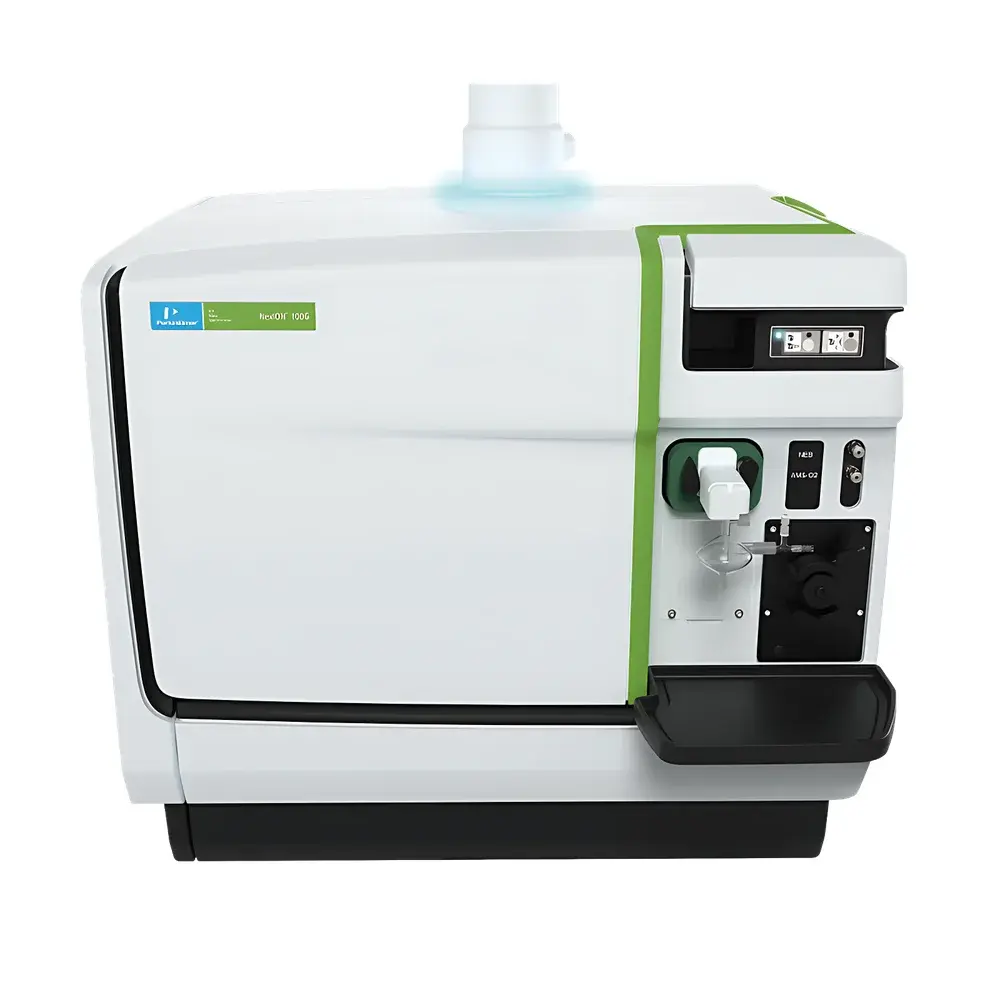
PerkinElmer NexION 100G Inductively Coupled Plasma Mass Spectrometer
| Brand | PerkinElmer |
|---|---|
| Origin | Shanghai, China |
| Manufacturer Type | Original Equipment Manufacturer (OEM) |
| Country of Origin | China |
| Model | NexION 100G |
| Pricing | Available upon Request |
Overview
The PerkinElmer NexION 100G Inductively Coupled Plasma Mass Spectrometer (ICP-MS) is a compact, high-performance elemental analysis platform engineered for laboratories requiring robust trace metal quantification with minimal operational overhead. It operates on the fundamental principle of inductively coupled plasma ionization followed by mass separation via quadrupole mass filtering and detection using a discrete-dynode electron multiplier. The instrument utilizes a 27 MHz solid-state RF generator to sustain a stable argon plasma at ~6,000–8,000 K, enabling efficient atomization, ionization (>70% typical for most elements), and transport of analyte ions into the mass spectrometer. Its core innovation lies in the Universal Cell Technology (UCT)—a pressurized, dynamically controlled quadrupole collision/reaction cell that employs helium, hydrogen, or oxygen gas modes to suppress polyatomic interferences (e.g., 40Ar16O+ on 56Fe+, 40Ar35Cl+ on 75As+) through kinetic energy discrimination and/or chemical reaction pathways—without compromising sensitivity or requiring hardware reconfiguration.
Key Features
- Universal Cell Technology (UCT): A dual-mode quadrupole cell capable of operating in both collision mode (He) and reaction mode (H2, O2, NH3) to resolve isobaric and polyatomic interferences across the full mass range (5–255 amu).
- High-Efficiency Sample Introduction System: Integrated with a PFA microflow nebulizer and cyclonic spray chamber for stable signal response, low oxide formation (<1.5% CeO+/Ce+), and reduced memory effects.
- Robust RF Generator & Plasma Stability: 27 MHz solid-state RF source with automatic impedance matching ensures consistent plasma ignition and long-term stability—even under variable matrix conditions.
- Low-Maintenance Design: Sealed detector with extended lifetime (>109 counts total ion current), simplified vacuum architecture with dual-stage turbomolecular pumping, and field-replaceable ion optics reduce scheduled downtime and service frequency.
- Compact Footprint & Energy Efficiency: Engineered for benchtop deployment in regulated environments; consumes <1.2 kW during operation and supports unattended overnight runs.
Sample Compatibility & Compliance
The NexION 100G accommodates aqueous solutions (0.1–5% HNO3, up to 0.2% HF), digested environmental solids (EPA Methods 200.8, 6020B), biological matrices (serum, urine, tissue homogenates post-microwave digestion), and nanoparticle suspensions (for single-particle ICP-MS mode when paired with optional fast-transient acquisition software). It meets critical regulatory requirements for method validation and data integrity, including support for audit trails, electronic signatures, and user-access controls compliant with FDA 21 CFR Part 11, ISO/IEC 17025:2017, and GLP/GMP documentation workflows. Instrument qualification documentation (IQ/OQ/PQ protocols) is available for laboratory compliance validation.
Software & Data Management
SYNCHRONOUS™ Software provides an integrated environment for instrument control, real-time spectral visualization, quantitative calibration (standard addition, isotope dilution, internal standardization), and reporting. FastQuant™ Data Viewer enables rapid review of batch results—including interference correction logs, detection limit calculations (IDL/MQL per EPA guidance), and isotopic ratio assessments—with customizable report templates exportable to PDF, CSV, or LIMS-compatible XML formats. All raw data files are stored in vendor-neutral .raw format with embedded metadata (date/time, operator ID, method version, cell gas parameters), ensuring long-term archival integrity and third-party software interoperability.
Applications
- Environmental Monitoring: Quantification of ultra-trace metals (e.g., As, Cd, Pb, U) in drinking water, wastewater, soil extracts, and airborne particulate matter per EPA 200.8 and ISO 17294-2.
- Pharmaceutical Quality Control: Elemental impurity testing of drug substances and products in accordance with ICH Q3D guidelines, including Category 1 (As, Cd, Hg, Pb) and Category 2A (Co, Ni, V) elements.
- Food Safety & Nutrition: Multi-element screening of toxicants (e.g., Sn, Al, Tl) and essential nutrients (e.g., Se, Zn, Cu) in infant formula, cereals, and dietary supplements per AOAC 2013.06 and EU Commission Regulation (EU) No 2023/2007.
- Advanced Materials Characterization: Trace contaminant profiling in high-purity silicon wafers, battery cathode precursors (Ni, Co, Mn), and catalyst formulations.
- Nanomaterial Analysis: Single-particle ICP-MS (spICP-MS) capability for size distribution, particle number concentration, and dissolved fraction determination of Ag, Au, TiO2, and CeO2 nanoparticles.
FAQ
Does the NexION 100G support isotope dilution mass spectrometry (IDMS)?
Yes—it includes fully configurable isotope ratio acquisition, mass bias correction algorithms, and certified isotopic spike integration for high-accuracy IDMS applications.
Can it analyze samples with high total dissolved solids (TDS)?
It supports up to 0.2% TDS with appropriate dilution and matrix-matched calibration; optional desolvation systems (e.g., Apex-Q) extend tolerance for saline or organic-rich matrices.
Is remote monitoring and diagnostics supported?
SYNCHRONOUS™ Software enables secure remote access via TLS-encrypted connections, real-time performance dashboarding, and predictive maintenance alerts based on vacuum gauge trends and detector aging metrics.
What regulatory documentation is provided for GxP environments?
PerkinElmer supplies comprehensive IQ/OQ/PQ protocols, 21 CFR Part 11 compliance packages, and raw data integrity validation reports aligned with Annex 11 and ALCOA+ principles.
How frequently does the detector require replacement?
Under typical usage (≤10 hr/day, ≤5 ppt detection limits), the discrete-dynode electron multiplier maintains linear response beyond 1×10⁹ total ion counts, typically exceeding 18–24 months of continuous operation.



