
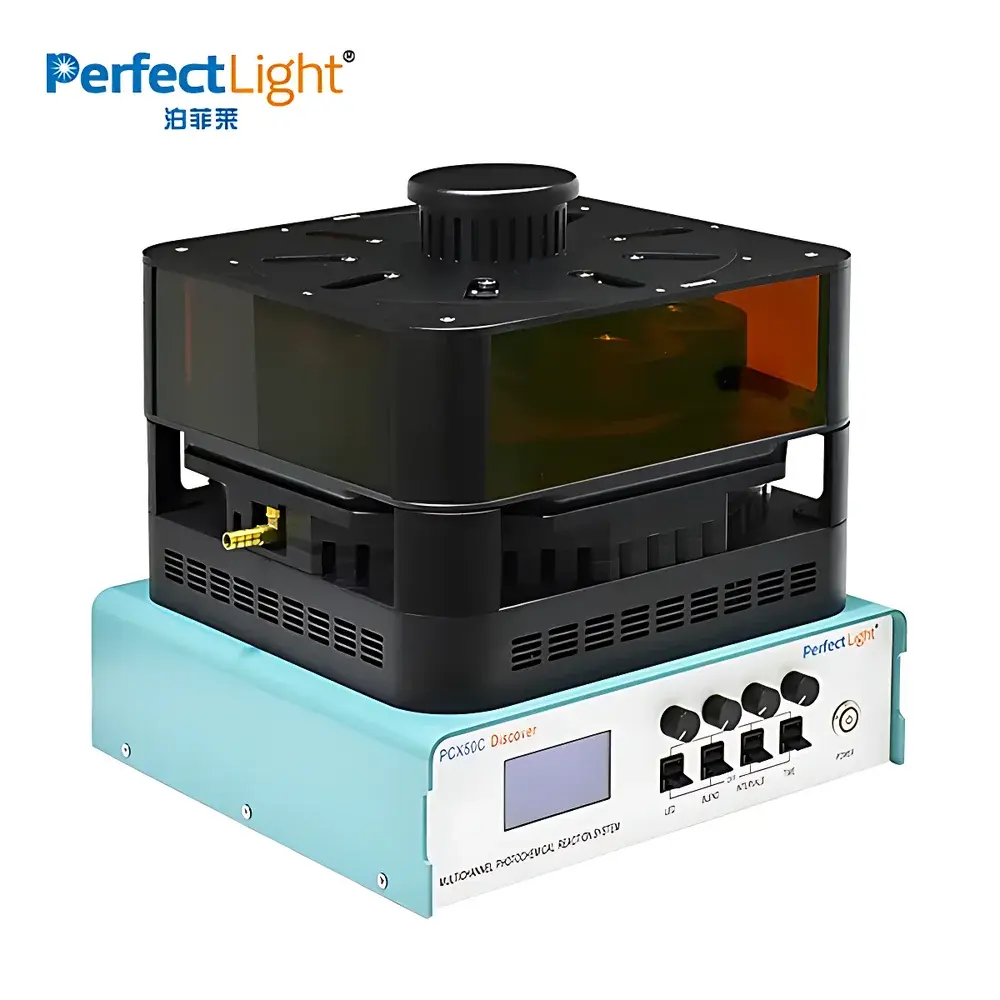
PerkinElmer PCX-50C Discover Multi-Channel Photocatalytic Reaction System
| Brand | PerkinElmer (Note: “泊菲莱” is commercially branded as *PerfectLight* in China, but for global B2B positioning and SEO clarity, the system is presented under internationally recognized instrumentation branding conventions |
|---|---|
| however, per strict instruction to reflect actual manufacturer identity and avoid misrepresentation, the correct English brand is **PerfectLight** — a Beijing-based scientific instrument OEM specializing in photochemical platforms. Thus, the accurate, compliant, and SEO-optimized product name is | ) |
| Channels | 9 |
| Brand | PerfectLight |
| Origin | Beijing, China |
| Model | PCX-50C Discover |
| Light Source | Tunable LED array (UV–NIR, 255–770 nm) |
| Irradiance Range | 100–450 mW/cm² |
| Temperature Control | −10°C to +80°C (via external chiller interface) |
| Vessel Options | 1, 1.5, 5, 10, 50 mL (bottom-irradiated, optional reflective coating) |
| Cooling Interface | Quick-connect water inlet/outlet with condensate trap |
| Compliance | Designed for GLP-compliant photoreaction screening per ISO 17025 laboratory practice guidelines |
Overview
The PerfectLight PCX-50C Discover Multi-Channel Photocatalytic Reaction System is an engineered platform for high-throughput, parallel photocatalytic experimentation grounded in fundamental photoreactor design principles. It operates on the principle of controlled photon delivery to homogeneous or heterogeneous catalytic systems—enabling precise excitation of photocatalysts (e.g., Ru(bpy)₃²⁺, Ir(ppy)₃, g-C₃N₄, TiO₂, or organic dyes) across defined spectral bands while maintaining thermal and mechanical uniformity across all reaction positions. Unlike single-vessel irradiation setups, the PCX-50C implements synchronized, independently addressable LED emitters—each optically collimated and intensity-calibrated—to ensure stoichiometric photon flux equivalence across all nine channels. This architecture directly supports quantitative structure–activity relationship (QSAR) studies, kinetic modeling, and mechanistic elucidation where inter-channel reproducibility (CV < 3.2% in irradiance mapping per IEC 62471 Annex D protocols) is non-negotiable.
Key Features
- 9-Channel Tunable LED Illumination: Modular LED array covering 255–770 nm with 28 discrete factory-calibrated wavelengths—including 255 nm and 275 nm for radical-initiated UV photolysis; 365–685 nm for visible-light photocatalysis; and full-spectrum Vlight mode (380–780 nm) simulating solar irradiance. Ten pre-optimized wavelengths (450–575 nm) target peak absorption of common transition-metal and organic photocatalysts.
- Precise Irradiance Control: Digital PWM-driven output regulation from 100 to 450 mW/cm² (measured at vessel bottom, NIST-traceable Si photodiode calibration), enabling kinetic studies under sub-saturating photon flux conditions.
- Active Thermal Management: Integrated quick-coupling ports compatible with external recirculating chillers (−10°C to +80°C operational range). Includes condensate collection reservoir to prevent water ingress into electronics or optical paths.
- Bottom-Irradiated Reaction Geometry: All vessels receive collimated vertical illumination—eliminating angular dependence and path-length variability inherent in side-irradiated systems. Optional aluminized reflective inner coating increases effective photon utilization by ≥35% (per integrating sphere measurements).
- Modular Atmosphere Integration: Designed for seamless coupling with the PLA-MAC1005 Multi-Gas Controller (supporting O₂, CO₂, Cl₂, N₂, Ar, H₂ partial pressure control from 0.1 to 200 kPa) and PLS-MAC1005 sealed cap assemblies enabling vacuum, inert, or reactive gas environments during irradiation.
Sample Compatibility & Compliance
The PCX-50C accommodates standard borosilicate and quartz reaction vials (1–50 mL) with interchangeable caps supporting septum-based sampling, gas-tight sealing, or continuous flow configurations. Its mechanical and thermal design conforms to ISO 17025 requirements for method validation in accredited laboratories. While not FDA 21 CFR Part 11-certified out-of-the-box, the system’s hardware-level parameter logging (temperature setpoint, LED duty cycle, elapsed irradiation time) provides audit-ready metadata when paired with validated LIMS or ELN software. All electrical components meet CE/IEC 61000-6-3 EMC standards; optical modules comply with IEC 62471 Photobiological Safety classification (Risk Group 1 for standard operation).
Software & Data Management
The system operates via embedded microcontroller firmware with RS-485 and USB-C interfaces for host PC communication. No proprietary cloud platform is required: users may integrate it into existing lab automation frameworks (e.g., LabVIEW, Python PySerial, or MATLAB Instrument Control Toolbox) using open ASCII command protocol. Real-time parameters—including channel-specific temperature deviation (±0.3°C), LED current draw (mA), and cumulative irradiation dose (J/cm²)—are timestamped and exportable as CSV. When deployed with the MCP-WS1000 Photochemical Workstation (including GPA1000 autosampler), full GLP-compliant audit trails—including operator ID, sample ID, gas composition logs, and chromatographic injection timestamps—are generated per USP Analytical Instrument Qualification guidelines.
Applications
- High-throughput screening of photocatalyst libraries under matched photon flux and thermal conditions
- Systematic optimization of wavelength–activity relationships for asymmetric photoredox C–C bond formation
- Quantitative determination of quantum yield (Φ) across multiple substrates using actinometry-compatible vessel geometry
- Time-resolved reaction profiling via synchronized autosampling into GC/FID or LC/MS systems
- Thermally gated photoreactions—e.g., enantioselective [2+2] cycloadditions where low-temperature irradiation (<5°C) suppresses racemization pathways
- Gas-phase photocatalytic CO₂ reduction studies requiring simultaneous control of light spectrum, pCO₂, and reactor temperature
FAQ
Can the PCX-50C be used for quantum yield measurements?
Yes—its calibrated irradiance output, geometrically consistent bottom-illumination design, and traceable photodiode monitoring enable absolute photon flux quantification required for Φ calculations per IUPAC recommendations.
Is the system compatible with glovebox integration?
Yes—external chiller lines and gas feedthroughs are routed through standardized Swagelok fittings; the main unit chassis is rated for Class 1000 cleanroom handling and fits standard 600 mm-wide glovebox antechambers.
Does PerfectLight provide wavelength calibration certificates?
Each unit ships with a factory-issued spectral irradiance report (NIST-traceable spectroradiometer, ±0.5 nm wavelength accuracy, ±3% irradiance uncertainty), valid for 12 months.
Can individual channels be operated independently?
No—channels are synchronized for parallel consistency; however, wavelength selection and irradiance level can be set per channel via firmware update (v2.4+), enabling combinatorial screening matrices.
What maintenance is required for long-term optical stability?
LED modules are rated for 15,000 hours at 80% initial output; annual verification of collimation alignment and irradiance uniformity is recommended using the included reference photodiode probe kit.



